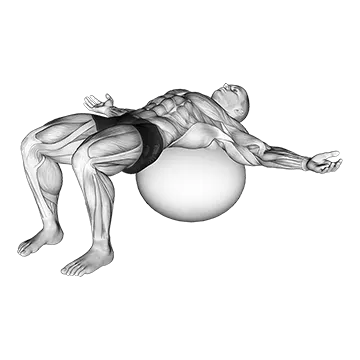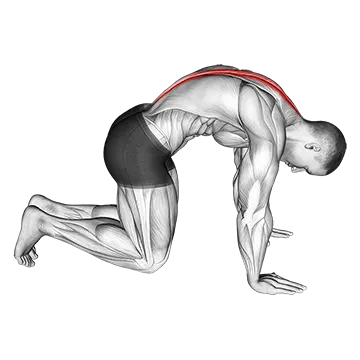
Suspension Hyperextension
- Zielmuskel
- Erector Spinae
- Synergistenmuskeln
- Gluteus Maximus, Hamstrings
- Equipment
- Suspension
- Körperregion
- Back
- Typ
- Strength
The suspension hyperextension is a bodyweight back-extension exercise performed face-down with your feet anchored in suspension straps, lifting your torso against gravity to build erector spinae strength and spinal endurance. The glutes and hamstrings work as key synergists to stabilize the hips and extend the movement. It is an effective accessory lift for improving lower-back resilience and posterior-chain coordination.
Suspension Hyperextension: So führst du sie aus
- 1Set the suspension straps to a low position — ankle height when you lie prone underneath the anchor point.
- 2Lie face-down on the floor and slide your feet into the foot cradles, laces down, so the strap sits across the top of each foot.
- 3Place your hands behind your head or cross them over your chest, and allow your upper body to relax toward the floor.
- 4Brace your core, squeeze your glutes, and drive your chest upward by contracting the erector spinae along your spine.
- 5Continue rising until your body forms a straight line from heels to shoulders — do not aggressively crank your neck back.
- 6Hold the top position for one to two seconds, focusing on the contraction in your lower back and glutes.
- 7Lower your torso slowly and under control back toward the floor, resisting the pull of gravity on the way down.
- 8Reset your brace before initiating the next repetition.
Technik-Tipps
- Keep your neck neutral throughout — your gaze should follow your chest, not lead it, to avoid compressing the cervical spine.
- Think of driving your sternum forward and up rather than yanking your head back; this cues proper spinal extension rather than neck hyperextension.
- Squeeze the glutes hard at the top — this protects the lumbar spine and ensures the hamstrings and gluteus maximus contribute fully.
- Control the eccentric (lowering) phase with a 2–3 second descent; the slow negative builds more erector strength than a fast drop.
- If the straps twist or your feet slide, reset so each strap sits flat across the top of the foot and press your feet lightly outward into the cradles to keep them steady.
Häufige Fehler
- Jerking up with momentum: swinging the torso up quickly removes tension from the erector spinae and transfers stress to the lumbar discs, increasing injury risk.
- Hyperextending the neck: craning the head back to look up at the ceiling compresses the cervical vertebrae and shifts focus away from the target muscle.
- Losing core bracing at the bottom: relaxing the abs completely at the lowest point places uncontrolled passive stress on the lumbar spine — maintain a light brace even at rest.
- Allowing the hips to sag: if the hips drop during the lift, the glutes and hamstrings disengage and the lower back compensates with excessive shear force.
- Rushing the top position: bouncing briefly at the peak and immediately descending shortens time under tension and reduces erector spinae development.
Häufig gestellte Fragen
What muscles does the suspension hyperextension work?
The primary muscle targeted is the erector spinae — the group of muscles that run along either side of your spine and are responsible for extending and stabilizing the back. The gluteus maximus and hamstrings act as synergists, stabilizing the hips and assisting with the upward drive.
How is the suspension hyperextension different from a Roman chair back extension?
On a Roman chair, your hips are supported on a pad so only your upper body moves freely. In the suspension version, your feet are anchored in straps while you lie prone on the floor, meaning your entire torso hangs unsupported. This increases the demand on the erector spinae and requires greater core stability to control the range of motion.
How many sets and reps should I do for suspension hyperextensions?
For building lower-back strength and endurance, 3–4 sets of 10–15 reps works well for most people. Because this is a bodyweight exercise with fixed load, prioritize slow, controlled reps and a deliberate hold at the top before adding more volume. Add a light weight vest only after you can perform 15 clean reps with a 2-second hold.
Is the suspension hyperextension safe for people with lower-back pain?
It depends on the cause and severity. Controlled back-extension exercises can rehabilitate certain lower-back conditions, but if you have a current disc herniation, fracture, or acute pain, consult a physiotherapist before attempting this movement. Start with a limited range of motion and ensure you can maintain a neutral spine without discomfort before progressing.
Can I make suspension hyperextensions harder without adding weight?
Yes. Extend your arms overhead (the 'Superman' position) to shift your center of mass further from your hips, significantly increasing the lever arm and the demand on the erector spinae. You can also slow the tempo — use a 3-second ascent, a 2-second hold at the top, and a 3-second descent — to maximize time under tension.