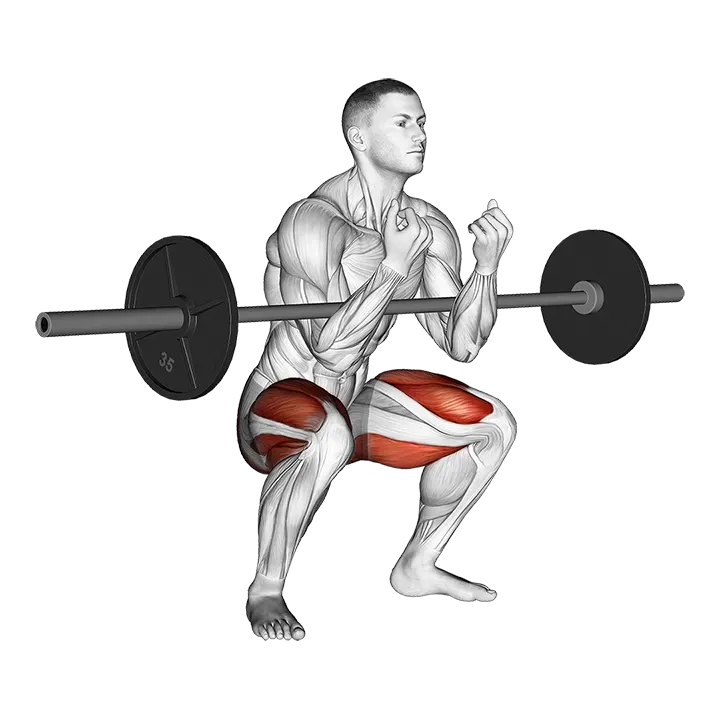
Barbell Zercher Squat Hold Isometric
- Equipment
- Barbell
- Körperregion
- Thighs
- Typ
- Stretching




The barbell Zercher squat hold isometric is a static lower-body exercise that loads the adductor magnus, gluteus maximus, and quadriceps by holding the bottom of a squat with the bar cradled in the crooks of your elbows. Because you hold the position rather than rep it, it builds bracing strength, midline stability, and time under tension in the deep squat, making it a useful accessory for squat strength and upright torso control.
Barbell Zercher Squat Hold Isometric: So führst du sie aus

- 1Set a barbell in a rack at about lower-chest height and step under it so the bar rests in the crooks of your elbows.
- 2Bend your elbows fully to cradle the bar against the front of your body, then either clasp your hands together or hold the bar firmly with both arms.
- 3Brace your core hard, lift the bar out of the rack, and take one or two steps back into a stance slightly wider than shoulder-width.

- 4Push your hips back and bend your knees to descend into a deep squat, keeping your torso as upright as possible and your elbows pointing down.
- 5Stop near the bottom with your thighs at or below parallel, knees tracking over your toes, and your weight balanced through your midfoot.
- 6Hold this bottom position statically for the prescribed time, keeping your core braced, chest up, and breathing shallow and controlled.
- 7When the hold is complete, stand back up under control, step forward to the rack, and re-rack the bar before releasing your arms.
Technik-Tipps
- Keep your torso tall and your elbows pointing toward the floor so the bar stays close to your body and the load tracks through your midfoot.
- Brace as if bracing for a punch and maintain that pressure for the entire hold rather than relaxing once you reach the bottom.
- Pad the crooks of your elbows with a towel or sleeve so bar discomfort doesn't force you to break the hold early.
- Start with shorter holds (10–20 seconds) and lighter load, and use a spotter or set safety arms at squat depth when holding heavy.
Häufige Fehler
- Letting the chest collapse and the upper back round forward, which shifts load off the legs and strains the lower back under a heavy hold.
- Holding your breath for the entire duration, which spikes blood pressure and can cause dizziness on a long isometric.
- Letting the knees cave inward, which reduces adductor and glute tension and stresses the knee joint.
- Rising onto the toes or shifting weight to the heels instead of staying balanced through the midfoot, which destabilizes the position.
Häufig gestellte Fragen
What muscles does the barbell Zercher squat hold isometric work?
It targets the adductor magnus, gluteus maximus, and quadriceps as you hold the deep squat position, while your core works hard to keep your torso upright under the front-loaded bar.
How long should I hold the Zercher squat isometric?
Holds of 10–30 seconds per set work well. Start at the shorter end with lighter weight, and add time or load only once you can keep an upright torso and a hard brace for the full duration.
Why hold the bar in the Zercher position instead of on my back?
Cradling the bar in the crooks of your elbows keeps the load in front of you, which forces a more upright torso and increases the demand on your core, glutes, and quads to resist folding forward.
Is the Zercher squat hold good for beginners?
Yes, with light load and short holds. The static bottom position teaches bracing and depth without the demands of repping, but pad your elbows and use safety arms or a spotter once the weight gets heavy.