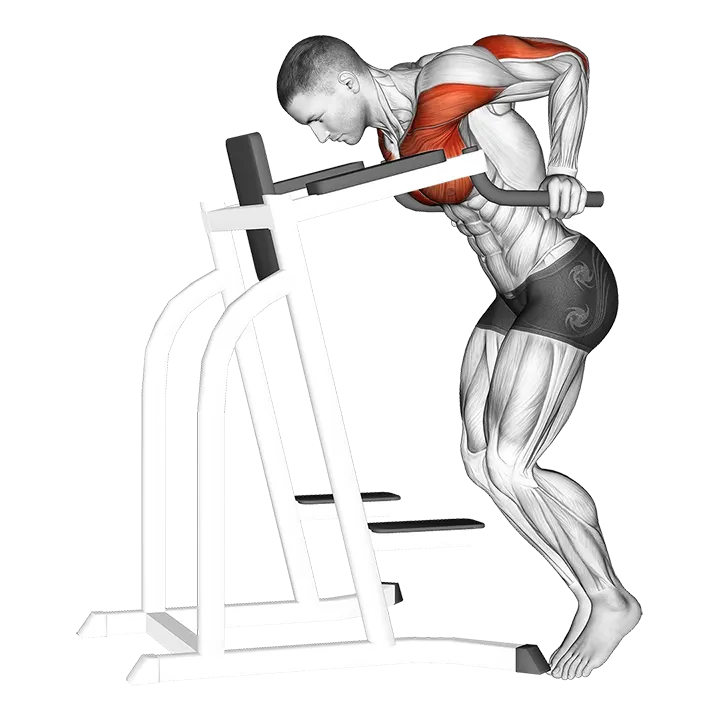
Dip Hold Isometric
- Zielmuskel
- Deltoid Anterior, Pectoralis Major Clavicular Head, Pectoralis Major Sternal Head, Triceps Brachii
- Equipment
- Body weight
- Körperregion
- Chest
- Typ
- Stretching
The dip hold isometric is a bodyweight static hold performed on parallel bars or a dip station, where you support yourself and hold a fixed position at the bottom of a dip rather than moving through reps. It builds static strength and stability in the front shoulders (anterior deltoid), the upper and lower chest (pectoralis major clavicular and sternal heads), and the triceps, making it a useful accessory for harder dip variations.
Dip Hold Isometric: So führst du sie aus
- 1Set up at parallel bars or a dip station with a grip roughly shoulder-width apart and your palms facing in toward each other.
- 2Mount the bars by pressing up to a fully locked-out support position, arms straight, shoulders down and away from your ears.
- 3Brace your core and squeeze your glutes, keeping your torso upright or with a slight forward lean over the bars.
- 4Bend your elbows and lower under control to your chosen hold position, stopping when your upper arms are roughly parallel to the floor.
- 5Hold the position statically, keeping your shoulders packed down, elbows tracking back, and your whole body tight.
- 6Breathe in a steady, shallow rhythm and maintain tension through the chest, shoulders, and triceps for the planned time.
- 7When the set is done, press back up to lockout or step down to the floor under control to dismount.
Technik-Tipps
- Keep your shoulders pulled down and back the whole time — actively depress the shoulder blades instead of letting them ride up toward your ears.
- Pick a hold depth you can own with good form; a higher hold near lockout is easier, a deeper hold near parallel is harder.
- Keep breathing in a controlled rhythm during the hold rather than holding your breath, so you can maintain tension for the full duration.
- Use a dip station with a spotter or an assisted-dip machine if you can't yet support your full bodyweight safely.
Häufige Fehler
- Shrugging the shoulders up toward the ears, which loads the neck and upper traps and removes the stable, packed-shoulder position the front delts and chest need.
- Sinking too deep into shoulder hyperextension below a comfortable range, which over-stretches the front of the shoulder and raises the risk of joint and tendon strain.
- Holding your breath and bearing down for the whole hold, which spikes blood pressure and makes you fatigue and lose tension faster than steady breathing would.
- Letting the chest collapse and the body sag, which drops the tension you are trying to build and turns the hold into dead hanging on the joints.
Häufig gestellte Fragen
What muscles does the dip hold isometric work?
It works the front shoulders (anterior deltoid), the upper and lower chest (pectoralis major clavicular and sternal heads), and the triceps, all under static tension while you hold a fixed dip position.
How long should I hold a dip isometric?
A common range is 10 to 30 seconds per hold for 2 to 4 sets. Start at the shorter end with clean form and build up the duration as your static strength improves.
Is the dip hold isometric good for beginners?
It can be, with a regression. If you can't hold your full bodyweight, use an assisted-dip machine, a resistance band, or hold higher near lockout, and only progress to deeper holds as you get stronger.
Isometric dip hold vs regular dips — what's the difference?
Regular dips move you up and down through a range of motion, while the isometric hold keeps you in one fixed position. The hold builds static strength and shoulder stability and is often used to strengthen sticking points before doing full dips.







