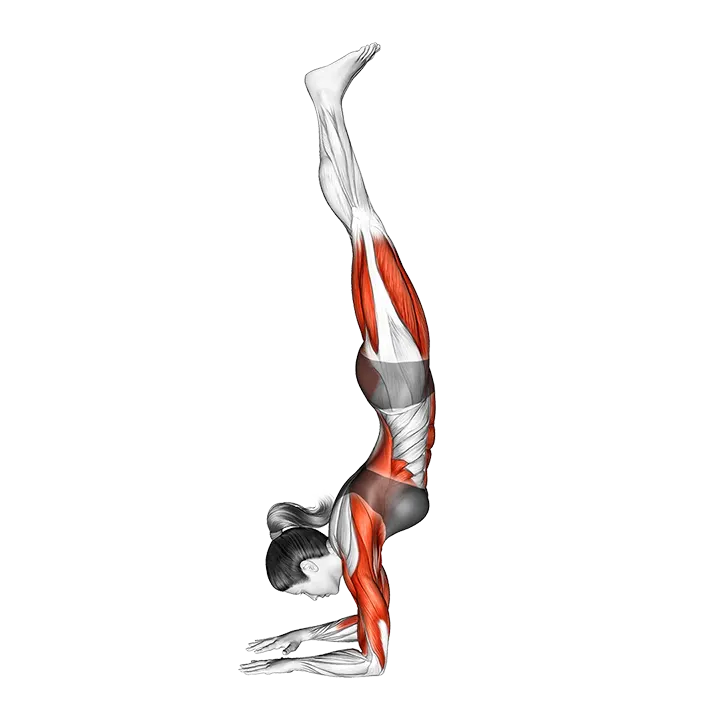
Forearms Stand Yoga Pose Pincha Mayurasana
- Zielmuskel
- —
- Equipment
- Body weight
- Körperregion
- Stretching
- Typ
- Stretching
Forearms Stand (Pincha Mayurasana) is an advanced body-weight inversion that balances your whole body on your forearms with your legs extended overhead. It builds shoulder and deltoid strength, engages the upper back and core for stability, and uses the forearms and hands to hold the balance. Practice it near a wall to develop the strength and control the pose demands.
Forearms Stand Yoga Pose Pincha Mayurasana: So führst du sie aus
- 1Kneel on the floor and place your forearms down parallel, shoulder-width apart, with your elbows directly under your shoulders. Work close to a wall for support.
- 2Press your palms and forearms firmly into the floor and spread your fingers wide to build a stable base.
- 3Tuck your toes, lift your hips, and walk your feet in toward your face until your shoulders stack over your elbows.
- 4Brace your core and lift one leg straight up toward the ceiling, keeping your gaze between your hands.
- 5Push the floor away through your forearms and kick gently off the lower foot to float both legs up overhead.
- 6Stack your hips over your shoulders and reach both legs straight up, drawing your ribs in and squeezing your inner thighs together.
- 7Hold the balance with steady breathing, pressing down through the forearms to keep your shoulders strong and lifted.
- 8To finish, lower one leg at a time back to the floor with control and rest in Child's Pose.
Technik-Tipps
- Keep your forearms parallel and elbows shoulder-width — letting the elbows splay wider collapses your base and strains the shoulders.
- Press the floor away actively so your shoulders stay lifted away from your ears, which protects the neck and holds the inversion.
- Engage your core and glutes throughout to keep the body in one straight line rather than arching through the lower back.
- Practice with your heels at a wall until you can balance freely; the wall is a support, not a crutch to lean dead weight into.
- Build up with Dolphin Pose and forearm planks first to develop the shoulder strength this balance requires.
Häufige Fehler
- Letting the elbows slide wider than the shoulders, which weakens the base and overloads the shoulder joints.
- Collapsing the shoulders toward the ears instead of pressing the floor away, which jams the neck and makes balancing far harder.
- Over-arching the lower back to throw the legs up, which strains the spine and tips you past your balance point.
- Kicking up explosively with no core engagement, which sends you crashing over rather than floating into a controlled stack.
- Holding the breath while balancing, which raises tension and shortens how long you can stay in the pose.
Häufig gestellte Fragen
What muscles does Forearms Stand (Pincha Mayurasana) work?
As a body-weight inversion it mainly works the shoulders and deltoids, with the upper back, core, and forearms engaging to hold and stabilize the balance. It also opens the shoulders and chest while building full-body control.
Is Pincha Mayurasana good for beginners?
No — it is an advanced balance pose. Beginners should first build shoulder strength and stability with Dolphin Pose, forearm planks, and wall-supported practice before attempting a free balance.
How do I use a wall for Forearm Stand?
Set your forearms a few inches from the wall and kick up so your heels rest lightly against it. The wall catches your balance so you can build strength and hold time safely until you can float away from it.
Why do my elbows keep sliding apart in Forearm Stand?
Splaying elbows usually means weak shoulders or a soft press into the floor. Keep your forearms parallel, press down firmly, and strengthen with Dolphin Pose so your base stays shoulder-width and stable.
How long should I hold Pincha Mayurasana?
Start with a few steady breaths and build toward 5 to 10 breaths as your strength and balance improve. Quality of alignment matters more than duration, so come down with control before form breaks down.







