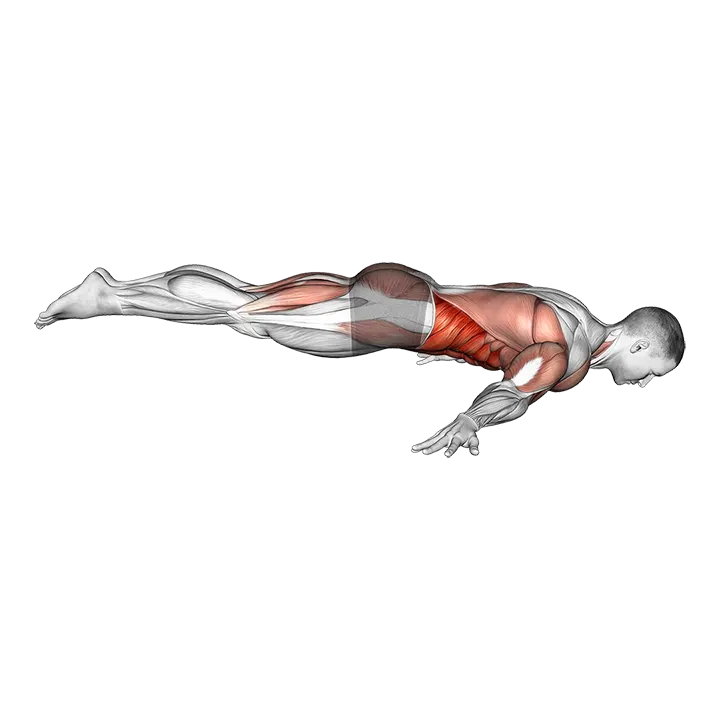
Full Maltese
- Zielmuskel
- —
- Equipment
- Body weight
- Körperregion
- Waist
- Typ
- Stretching
The full maltese is an elite-level bodyweight static hold from the planche family, performed on rings or the floor with your body held horizontal and your straight arms extended out to the sides. It is a whole-body skill that demands extreme core bracing, shoulder and wrist strength, and mobility to keep a rigid straight line. Treat it as a long-term goal that sits at the very top of a multi-year calisthenics progression.
Full Maltese: So führst du sie aus
- 1Build the prerequisites first: a solid full planche, strong straight-arm pushing strength, and the wrist and shoulder mobility to support an open, extended-arm position.
- 2Set up on rings or the floor with your hands turned out and your arms straight, fixing the elbows so they never bend during the hold.
- 3Brace your core hard, squeeze your glutes, and point your toes to lock your body into one rigid line from head to heels.
- 4Lean your shoulders forward of your hands and begin opening your arms out toward your sides, keeping them fully locked.
- 5Lift your hips and legs until your torso and legs are level, holding the whole body horizontal and parallel to the floor.
- 6Hold the straight-line position for as long as your form stays clean, breathing in short, controlled breaths without letting the hips sag.
- 7Exit under control by bringing your arms back under you and lowering to a tuck or a safe dismount before your form breaks.
Technik-Tipps
- Keep your arms dead straight and your elbows locked the entire time; any bend turns it into a different, easier hold and risks elbow strain.
- Drive your shoulders forward and protract your shoulder blades to balance the lever, rather than trying to muscle the legs up.
- Spend months conditioning your wrists, elbows, and biceps tendons with progressive straight-arm work before holding the full position.
- Train on rings or with a spotter and a soft surface so you can bail safely when your strength gives out.
- Chase short, clean holds with a rigid straight line instead of long, sagging ones that ingrain poor positions.
Häufige Fehler
- Letting the elbows bend to make the hold easier, which both cheats the skill and concentrates dangerous stress on the elbow joint.
- Allowing the hips to pike up or sag, which breaks the straight line and shifts the lever so the hold no longer counts.
- Attempting the full maltese before owning a full planche, which overloads the shoulders, wrists, and biceps tendons and invites injury.
- Holding the breath and bracing too loosely, which lets the midsection collapse and the body fold out of position.
- Rushing the progression with too much volume too soon, leading to wrist and tendon overuse rather than steady strength gains.
Häufig gestellte Fragen
What does the full maltese work?
It is a whole-body straight-arm static hold: keeping your body horizontal demands intense core bracing along with strong, mobile shoulders, arms, and wrists. No single target muscle is isolated — the skill is about holding the whole body in one rigid line.
Is the full maltese good for beginners?
No. It is one of the most advanced bodyweight holds and is unsafe to attempt without years of straight-arm strength work. Beginners should build basics like the plank, tuck planche, and eventually a full planche first.
How long does it take to learn the full maltese?
For most people it takes several years of consistent calisthenics, since it requires a full planche plus extra shoulder, wrist, and connective-tissue conditioning before the straight-arm-out position is safe.
What is a good progression toward the full maltese?
Work up through the planche family — plank, tuck planche, advanced tuck, straddle planche, and full planche — then gradually open the arms outward, training on rings or with support so you can bail safely.
Should I train the full maltese on rings or the floor?
Both are used. Rings let the wrists and shoulders move more freely and make bailing easier, while the floor is more fixed and unforgiving. Most people condition on rings before attempting it on the floor.







