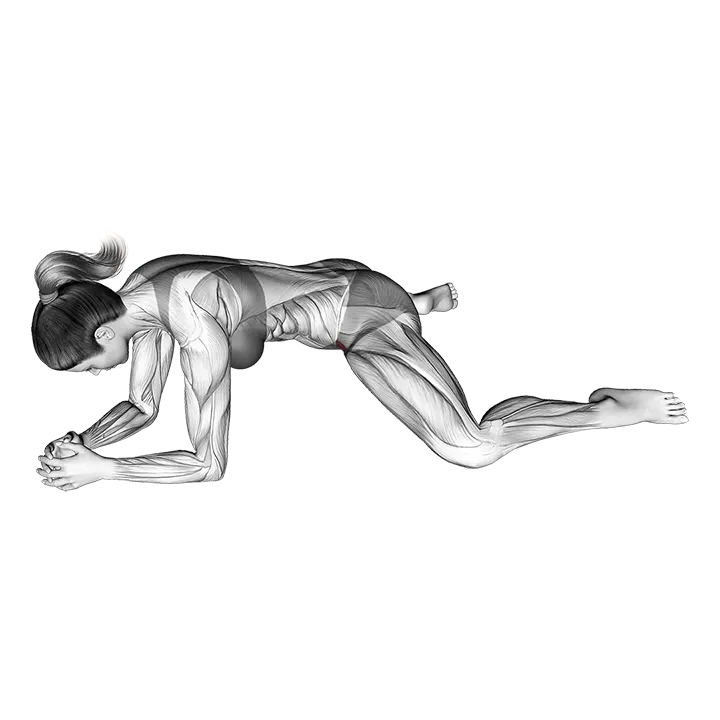
Kneeling Face Down Adductor Stretch
- Zielmuskel
- —
- Equipment
- Body weight
- Körperregion
- Hips
- Typ
- Stretching
The kneeling face down adductor stretch is a bodyweight floor stretch that opens the inner thighs and groin by widening the knees while supported on all fours or lowered toward prone. It targets the adductor muscle group along the inner thigh and is useful for improving hip mobility, relieving groin tightness, and preparing the hips for squatting or lateral movements.
Kneeling Face Down Adductor Stretch: So führst du sie aus
- 1Start on all fours on a mat with your hands directly under your shoulders and your knees directly under your hips.
- 2Slowly slide both knees apart, moving them as wide as is comfortable while keeping the inside edges of your feet and lower legs flat on the mat.
- 3Keep your hips level and parallel to the floor as you widen your knees — do not allow one hip to hike or rotate.
- 4Maintain a neutral spine with a flat back; avoid letting your lower back sag or round.
- 5Lower your hips toward the floor by sinking your pelvis down and slightly back until you feel a stretch along the inner thighs and groin.
- 6Rest your forearms on the mat in front of you for support if needed, keeping your torso relaxed.
- 7Breathe deeply and steadily — inhale to prepare, exhale to relax further into the stretch without forcing the range.
- 8Hold the position for 20 to 60 seconds, breathing continuously and letting the inner thighs release gradually.
- 9To exit, walk your knees back in toward each other slowly before returning to the starting position.
Technik-Tipps
- Keep your back flat and avoid letting the lumbar spine collapse — a neutral spine protects your lower back and allows the stretch to stay in the adductors.
- Let gravity and your breath do the work rather than pushing your hips down forcefully; passive relaxation yields a deeper, safer stretch.
- Ensure both hips remain level and square to the floor throughout — uneven hips shift the stretch away from the adductors and into the hip joint unevenly.
- Keep the inner edges of your lower legs and feet in contact with the mat to maintain proper alignment and maximize the inner-thigh stretch.
- Breathe continuously and never hold your breath; exhaling slowly helps the adductors release tension progressively.
Häufige Fehler
- Allowing the hips to rotate or one hip to hike upward, which unloads one side and can place uneven stress on the hip joint and lower back.
- Forcing the knees wider than the body can tolerate, which creates sharp groin pain rather than a productive stretch and risks straining the adductors.
- Letting the lower back sag into extension, which compresses the lumbar spine and redirects the stretch away from the inner thighs.
- Holding the breath while sinking into the position, which increases muscular tension and prevents the adductors from releasing effectively.
- Exiting the stretch by snapping the knees back together quickly, which can strain the inner-thigh tendons — always bring the knees in slowly and with control.
Häufig gestellte Fragen
What does the kneeling face down adductor stretch target?
It targets the adductor muscle group along the inner thigh and groin, including the adductor magnus, adductor longus, and adductor brevis, as well as the gracilis. The hip flexors and hip joint capsule receive a mild secondary stretch.
When should I do this stretch?
It works best as part of a warm-up before exercises that require hip mobility — such as squats, lunges, or lateral drills — or as a cool-down stretch after lower-body training to reduce post-exercise tightness in the groin.
How long should I hold the kneeling face down adductor stretch?
Hold for 20 to 60 seconds per set. For general mobility maintenance, two to three sets is sufficient. If you are working on improving flexibility, longer holds of 45 to 90 seconds repeated several times throughout the day can be more effective.
Who benefits most from adductor stretching?
People who sit for long periods, athletes who perform lateral or rotational movements (such as soccer or hockey players), and anyone experiencing groin tightness or reduced hip mobility. It is also commonly used in rehabilitation programs after groin strains once acute inflammation has subsided.
Is this stretch safe for people with groin injuries?
It should be avoided or modified during the acute phase of a groin strain while pain and inflammation are present. Once the injury is in the recovery phase, a gentle version with minimal knee separation may be appropriate, but you should follow guidance from a physical therapist or sports medicine professional before loading the area.







