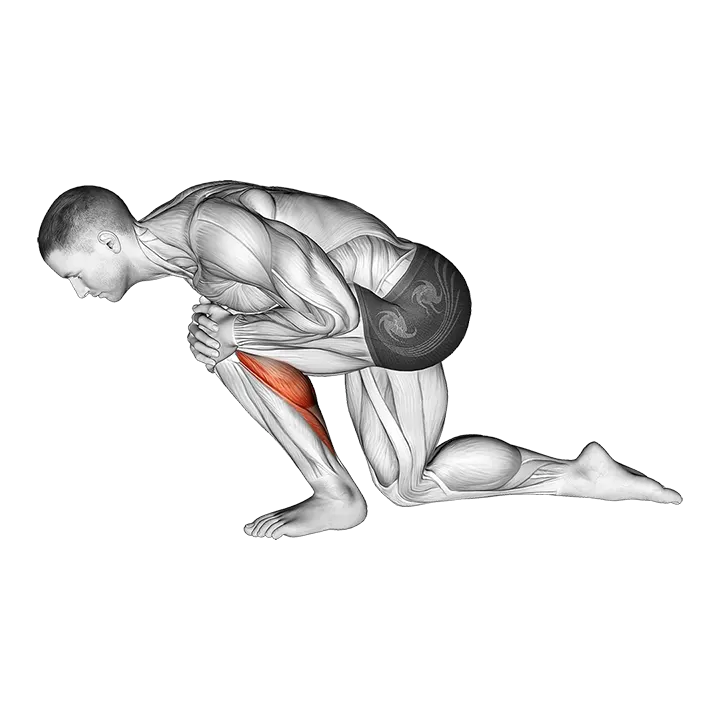
Kneeling Heel Down Achilles Stretch
- Zielmuskel
- —
- Equipment
- Body weight
- Körperregion
- Calves
- Typ
- Stretching
The Kneeling Heel Down Achilles Stretch is a bodyweight stretching exercise that targets the Achilles tendon and the soleus, the deep calf muscle beneath the gastrocnemius. By keeping the knee bent and the heel flat on the floor, the stretch bypasses the gastrocnemius and isolates the lower calf and Achilles tendon. It is particularly useful for improving ankle mobility, relieving Achilles tightness, and aiding recovery in runners and athletes.
Kneeling Heel Down Achilles Stretch: So führst du sie aus
- 1Begin in a half-kneeling position on a comfortable surface, with one knee on the floor and the opposite foot stepped forward.
- 2Place the forward foot flat on the floor so that the entire heel remains in contact with the ground throughout the movement.
- 3Position the forward foot close enough to your body that the knee can travel forward over the toes without the heel lifting.
- 4Rest both hands on your forward thigh or the floor beside your foot for balance and support.
- 5Slowly shift your weight forward, allowing the front knee to travel toward and slightly past the toes while keeping the heel firmly planted.
- 6Continue leaning forward until you feel a deep stretch low in the calf, in the Achilles tendon and soleus area, just above the heel.
- 7Hold the stretched position for 20 to 45 seconds, breathing slowly and allowing the tissue to relax with each exhale.
- 8Ease back gently to release the stretch, then switch legs and repeat on the other side.
- 9Perform 2 to 3 holds per side as part of a warm-up, cool-down, or mobility routine.
Technik-Tipps
- Keep the heel pressed firmly into the floor for the entire hold — the moment the heel lifts, the soleus and Achilles tendon are no longer under tension.
- Drive the knee forward in line with the second toe rather than letting it collapse inward, which can place unwanted stress on the ankle and knee.
- Progress the stretch gradually by inching the knee further forward rather than lurching forward all at once, to avoid overstretching the tendon.
- Breathe steadily throughout the hold and consciously relax the calf on each exhale to allow the stretch to deepen naturally.
- If balance is difficult, place one hand on a wall or hold a doorframe lightly — this lets you focus entirely on the stretch rather than stability.
Häufige Fehler
- Letting the heel rise off the floor: this is the most common error and directly defeats the purpose of the stretch, as the soleus and Achilles tendon lose tension the moment the heel lifts.
- Bouncing or pulsing through the stretch: ballistic movement in the Achilles tendon can trigger a protective reflex that increases tightness and raises the risk of micro-tears in an already stressed tendon.
- Leaning too aggressively at the start: forcing the knee far forward too quickly puts excessive load on the Achilles before the tissue has had time to relax, increasing the risk of discomfort or strain.
- Allowing the knee to cave inward: valgus collapse at the knee changes the angle of pull on the Achilles and shifts stress to the inner ankle, reducing the effectiveness of the stretch and stressing the medial structures.
- Placing the foot too far forward: positioning the foot well ahead of the body limits how far the knee can travel over the toes while the heel stays down, reducing the depth of the soleus and Achilles stretch.
Häufig gestellte Fragen
What does the kneeling heel-down Achilles stretch target?
The stretch primarily targets the Achilles tendon and the soleus, which is the flat, deep calf muscle that runs beneath the larger gastrocnemius. Keeping the knee bent reduces tension in the gastrocnemius, allowing the soleus and Achilles tendon to receive the bulk of the stretch.
How is it different from a standing calf stretch?
A straight-leg standing calf stretch with the heel on the ground primarily targets the gastrocnemius, the large two-headed calf muscle that crosses the knee. Because the kneeling heel-down version keeps the knee bent, the gastrocnemius is slack and the stretch is redirected almost entirely to the soleus and Achilles tendon — the structures closest to the heel.
How long should I hold the stretch?
Hold each repetition for 20 to 45 seconds. Research on static stretching generally supports holds in the 30-second range as effective for increasing flexibility. Performing 2 to 3 holds per side is sufficient for most purposes, whether warming up or cooling down.
Is this stretch good for runners?
Yes. Runners place repetitive load on the Achilles tendon and soleus with every stride, making these structures prone to tightness and overuse injury. The kneeling heel-down stretch directly addresses the tissues most commonly implicated in Achilles tendinopathy and plantar issues, and fits easily into post-run cool-down routines.
When should I do this stretch?
It works well as part of a post-workout cool-down or a dedicated mobility session when the tissues are warm. It can also be performed in the morning to address morning Achilles stiffness, which is common in people with Achilles tendinopathy. Avoid aggressive static stretching of a cold, unwarmed Achilles immediately before high-intensity activity.







