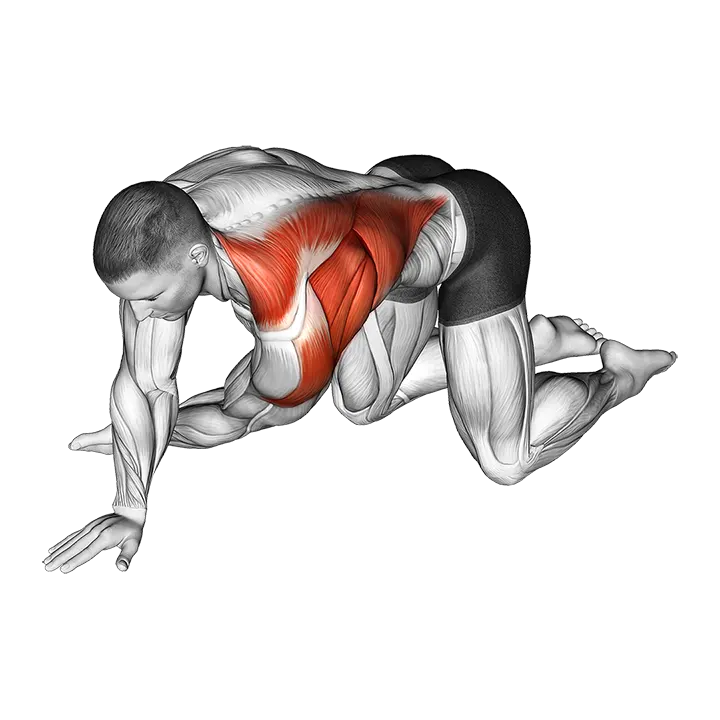
Kneeling T-Spine Mobility Stretching
- Zielmuskel
- —
- Equipment
- Body weight
- Körperregion
- Back, Shoulders
- Typ
- Stretching
The Kneeling T-Spine Mobility Stretching exercise targets the thoracic spine (mid-back) and shoulders, improving rotational range of motion and relieving stiffness in the upper back. Performed from a kneeling position with one hand behind the head, it is especially effective for desk workers and anyone who carries tension through the upper back and shoulders.
Kneeling T-Spine Mobility Stretching: So führst du sie aus
- 1Kneel on the floor with both knees hip-width apart and sit your hips back toward your heels so your torso is nearly parallel to the ground.
- 2Place your left hand flat on the floor directly beneath your left shoulder for support.
- 3Place your right hand behind your head, touching your fingertips to your temple with your elbow pointing out to the side.
- 4Take a breath in, then as you exhale, rotate your right elbow down toward the floor, letting your upper back round slightly.
- 5Reverse the movement by rotating your right elbow up and open toward the ceiling, following it with your eyes to increase thoracic rotation.
- 6Pause for one to two seconds at the top of the rotation, feeling the stretch through your mid-back and right shoulder.
- 7Return to the starting position in a controlled manner. Complete all reps on this side, then switch arms and repeat.
Technik-Tipps
- Keep your hips still throughout the movement — rotation should come from your thoracic spine, not your lower back or hips.
- Focus your gaze on your elbow as it rotates; letting your eyes lead the movement helps drive greater thoracic range of motion.
- Breathe out as you rotate open and breathe in as you return — using the exhale to relax into the stretch deepens the range.
- Keep your supporting arm slightly soft at the elbow rather than locked out to avoid loading the joint under the twist.
- Move slowly and with control; jerking through the rotation reduces the stretch stimulus and can irritate stiff thoracic joints.
Häufige Fehler
- Rotating from the lower back instead of the thoracic spine, which places unnecessary stress on the lumbar region and misses the intended stretch.
- Letting the hips shift or rise during the rotation, which reduces thoracic range of motion and can strain the lower back.
- Rushing through the movement without pausing at the top, which shortens time under stretch and limits mobility gains.
- Collapsing the supporting shoulder so it wings outward, which destabilizes the base and reduces control over the rotation.
- Pulling the neck with the hand rather than resting it lightly, which creates cervical tension and diverts the stretch away from the thoracic spine.
Häufig gestellte Fragen
What is T-spine mobility and why does it matter?
T-spine (thoracic spine) mobility refers to the ability of your mid-back vertebrae to rotate, extend, and flex freely. Good thoracic mobility supports overhead movements, reduces shoulder impingement risk, and takes compensatory load off the lower back and neck.
Is the Kneeling T-Spine Mobility Stretch good for desk workers?
Yes. Prolonged sitting causes the thoracic spine to stiffen into flexion and limits rotation. This stretch directly counteracts that pattern by encouraging extension and rotation through the mid-back and shoulders, making it a practical daily reset for people who sit for long periods.
How many reps and sets should I do?
Aim for 8–12 controlled reps per side for 2–3 sets. As a mobility drill it responds best to quality of movement and time under stretch rather than high volume — performing it daily or as part of a warm-up is more effective than doing it infrequently with high sets.
Where should I feel this stretch?
You should feel the stretch primarily through your mid-back (thoracic spine) and into the back of the shoulder on the rotating side. If you feel it mainly in your lower back, your hips are likely rotating — reset and focus the movement higher up the spine.
What are good alternatives to the Kneeling T-Spine Mobility Stretch?
Alternatives that target thoracic rotation and extension include the thread-the-needle stretch (from a quadruped position), the seated thoracic rotation with a foam roller, and the open-book stretch performed lying on your side. All use bodyweight and complement similar mobility goals.







