L-sit
- Equipment
- Body weight
- Körperregion
- Waist
- Typ
- Strength

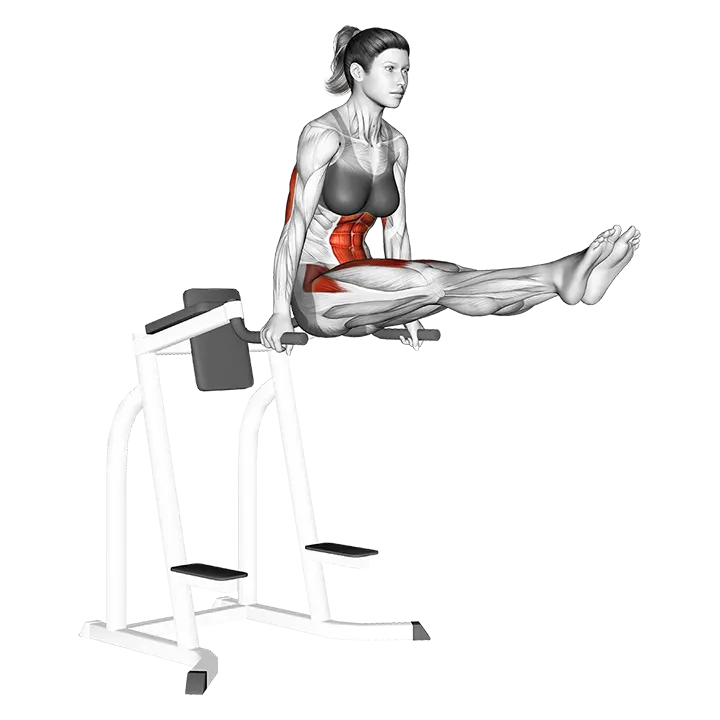
The L-sit is a bodyweight strength hold that simultaneously trains the iliopsoas, quadriceps, and tensor fasciae latae to keep the legs parallel to the floor, while the rectus abdominis braces the core and the triceps brachii press the body upward. It builds exceptional hip flexor endurance, core stability, and pressing strength in a single isometric position.
L-sit: So führst du sie aus
- 1Sit on the floor and place your hands flat on the ground beside your hips, fingers pointing forward or slightly outward.
- 2Straighten your legs fully and point your toes away from you.
- 3Press firmly through both palms to lock out your elbows, engaging your triceps brachii.
- 4Brace your core hard, drawing the rectus abdominis tight, and actively contract your iliopsoas and quadriceps to lift your legs.
- 5Push your shoulders down away from your ears to create clearance and depress your scapulae.
- 6Raise your hips and legs until your thighs are parallel to the floor, forming a 90-degree angle at the hips — the 'L' shape.
- 7Hold the position with legs fully extended, arms locked, and feet together for the target duration.
- 8Lower your hips and legs back to the floor with control to complete the rep.
Technik-Tipps
- Point your toes and squeeze your legs together throughout the hold — one tight leg line is easier to keep level and stops the knees from drifting apart.
- Think about pushing the floor away rather than simply lifting your legs; the downward press through your triceps is what elevates your hips.
- Protract and then depress your shoulder girdle before you lift — this gives your hips the vertical clearance they need to rise off the ground.
- If your hips cannot clear the floor yet, tuck one or both knees toward your chest to reduce the lever arm while you build hip-flexor strength.
Häufige Fehler
- Bent knees: Allowing the knees to bend shortens the lever and removes most of the demand on the iliopsoas and quadriceps, turning the move into a tuck hold rather than a true L-sit.
- Shrugging the shoulders: Elevating the shoulders toward the ears reduces the range your hips can travel upward and places unnecessary stress on the neck and upper traps.
- Soft elbows: Failing to fully lock out the elbows means the triceps brachii are not doing their job, and the structure collapses — making a sustained hold impossible.
- Leaning too far forward: Shifting body weight excessively over the wrists unloads the core and hip flexors, turning a full-body isometric into a wrist-balance exercise.
- Holding the breath: Bracing without breathing causes a rapid spike in intra-abdominal pressure, leading to early fatigue and dizziness during longer holds.
Häufig gestellte Fragen
What muscles does the L-sit work?
The L-sit primarily targets the iliopsoas and tensor fasciae latae (hip flexors that hold the legs up), the quadriceps (which keep the legs straight), the rectus abdominis (which stabilizes the pelvis and lower back), and the triceps brachii (which lock the elbows and press the body off the ground).
How long should I hold an L-sit?
Beginners can aim for 3–5 seconds per attempt. As you build strength, progress toward a single 10-second hold, then work up to 30–60 seconds. Accumulating 20–30 total seconds across multiple holds per set is a practical target for intermediate athletes.
Can I do an L-sit if I can't lift my hips off the floor yet?
Yes. Start with a tucked L-sit (knees bent toward the chest) or a single-leg L-sit (one leg extended, one tucked) to reduce the lever arm. As your hip flexors and core strengthen, gradually extend the legs until both are fully straight.
Is the L-sit better on the floor, parallettes, or dip bars?
Elevated surfaces such as parallettes or dip bars give your hips more clearance and make it easier to achieve the full position, especially if hip flexibility is a limiting factor. The floor version is the most demanding because hand height is fixed low. Start elevated if needed, then progress to the floor.
How often should I train the L-sit?
Because it is an isometric hold rather than a dynamic movement, the L-sit recovers relatively quickly. Training it 3–4 times per week with 3–5 sets of maximal-duration holds is effective for most people. Pair it with exercises that strengthen the hip flexors and triceps to accelerate progress.