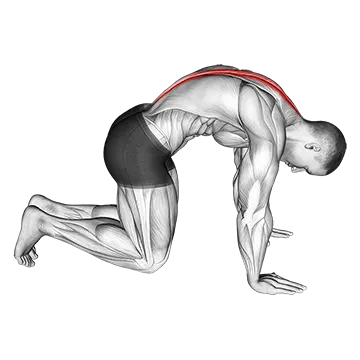
Lower Back Curl
- Zielmuskel
- Erector Spinae
- Equipment
- Body weight
- Körperregion
- Back
- Typ
- Strength




The Lower Back Curl is a bodyweight exercise performed face down on the floor that primarily targets the erector spinae muscles running along the spine. By curling your chest and shoulders off the ground under control, you strengthen and condition the lower back extensors. It is especially useful for building spinal stability, improving posture, and shoring up a weak lower back.
Lower Back Curl: So führst du sie aus
- 1Lie face down on a mat with your legs straight and your arms extended overhead or placed alongside your body.
- 2Engage your core gently and press your hips and pelvis into the mat to stabilize your lower body.
- 3Exhale and slowly curl your chest and shoulders off the mat by contracting your erector spinae, keeping your neck in a neutral position.
- 4Lift only as high as you can without straining — your feet should remain on the floor and your gaze directed slightly downward.
- 5Hold the top position for one to two seconds, squeezing the muscles along your spine.
- 6Inhale and slowly lower your torso back down to the mat in a controlled manner.
- 7Complete all reps, then rest before the next set.
Technik-Tipps
- Use your arm position as the difficulty dial: hands alongside your hips is easiest, hands crossed on your chest is harder, and arms extended overhead is hardest because it lengthens the lever.
- Take two to three seconds on the way down and set your chest back on the mat gradually, so the erector spinae stay under tension instead of collapsing at the bottom.
- If the top of the rep feels pinchy in your lower back, slide a folded towel under your hips — the slight forward tilt shortens the range where compression builds.
- Train this at the end of a session rather than before heavy squats or deadlifts, so a pre-fatigued lower back does not limit your bigger lifts.
Häufige Fehler
- Hyperextending the lower back: Lifting too high creates excessive lumbar compression and can cause injury — stop when you feel peak tension in the erector spinae, not when you can go no higher.
- Using momentum: Swinging or bouncing up removes tension from the target muscles and increases injury risk — always move slowly and under control.
- Craning the neck: Looking straight up instead of maintaining a neutral spine places undue stress on the cervical vertebrae — keep your gaze slightly downward.
- Holding your breath: Breath-holding raises intra-thoracic pressure and can cause dizziness — exhale during the exertion phase and inhale on the return.
- Raising the hips off the floor: Letting the pelvis lift shifts the workload away from the erector spinae — keep your hips pressed down throughout each repetition.
Häufig gestellte Fragen
What muscles does the Lower Back Curl work?
The Lower Back Curl primarily targets the erector spinae — the group of muscles that run vertically along both sides of the spine. These muscles are responsible for spinal extension and maintaining an upright posture. It is a bodyweight isolation-style movement for the spinal extensors and needs no equipment.
Is the Lower Back Curl safe for people with lower back pain?
For many people, gentle lower back extension exercises can relieve muscle-related back pain by strengthening the erector spinae. However, if you have a diagnosed disc herniation, spinal stenosis, or acute back injury, consult a healthcare professional before performing this exercise, as spinal extension movements are contraindicated for some conditions.
How many reps and sets should I do for the Lower Back Curl?
Beginners typically start with 2–3 sets of 10–15 slow, controlled repetitions. As strength improves, you can increase reps to 20 or add a longer hold at the top position. Because this is a bodyweight exercise with no load adjustment, increasing time under tension is the primary progressive overload strategy.
What is the difference between the Lower Back Curl and the Superman exercise?
Both are prone floor exercises that target the erector spinae, but they differ in execution. The Superman exercise involves lifting both the arms and legs simultaneously off the floor, creating a more intense extension. The Lower Back Curl focuses on curling only the upper torso, making it a more accessible and controlled option for those new to lower back training or in early-stage rehabilitation.
Can I do the Lower Back Curl every day?
Light, low-intensity lower back curls can be performed daily as part of a mobility or postural routine. However, if you are using them as a strength exercise with maximum effort, allow 48 hours of recovery between sessions so the erector spinae muscles can repair and grow stronger.