
Lying Floor Hyperextension with Towel
- Zielmuskel
- Erector Spinae
- Synergistenmuskeln
- Gluteus Maximus, Hamstrings
- Equipment
- Body weight
- Körperregion
- Hips
- Typ
- Strength

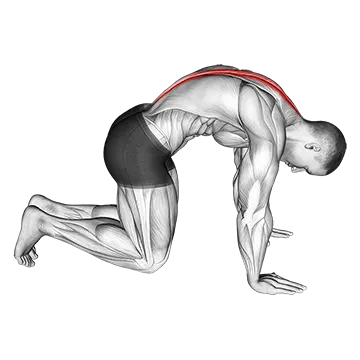






The lying floor hyperextension with towel is a bodyweight lower-back exercise performed face down on the floor while holding a towel behind the head for neck support. It primarily targets the erector spinae and recruits the gluteus maximus and hamstrings as synergists. This exercise is ideal for building posterior-chain strength and improving spinal extension without any equipment beyond a towel.
Lying Floor Hyperextension with Towel: So führst du sie aus
- 1Lie face down on the floor with your legs straight and your body fully extended.
- 2Hold a towel with both hands and drape it behind your head, creating a sling that supports the back of your skull.
- 3Keep your feet hip-width apart and press the tops of your feet gently into the floor throughout the movement.
- 4Brace your core and squeeze your glutes before initiating the lift.
- 5Exhale and lift your chest and upper torso off the floor by extending your spine, using the towel as a light support — do not pull on it aggressively.
- 6Raise until your torso forms a straight line with your hips and thighs; avoid hyperextending beyond a neutral spine.
- 7Hold the top position for one to two seconds, keeping tension in the erector spinae, gluteus maximus, and hamstrings.
- 8Inhale and slowly lower your chest back to the floor under control.
- 9Repeat for the desired number of repetitions.
Technik-Tipps
- Use the towel for gentle neck support only — your erector spinae should do the work of lifting, not your arms pulling the towel.
- Keep your gaze toward the floor throughout the movement to maintain a neutral cervical spine.
- Squeeze your glutes at the top of each rep to maximize posterior-chain engagement and protect the lumbar spine.
- Move slowly and deliberately; a two-second ascent and two-second descent improves muscle activation and reduces momentum.
- Keep your legs straight and in contact with the floor to ensure the load stays on the target muscles rather than shifting to the hip flexors.
Häufige Fehler
- Pulling hard on the towel with both hands: this strains the neck and shifts effort away from the erector spinae, defeating the purpose of the exercise.
- Hyperextending past a neutral spine at the top: going too high compresses the lumbar vertebrae and increases injury risk without adding meaningful muscle stimulus.
- Using momentum to swing the torso up: bouncing off the floor reduces time under tension and can cause lower-back strain — always lift under control.
- Letting the feet rise off the floor: lifting the legs removes the stable base and shifts stress away from the target muscles, reducing effectiveness.
- Holding the breath throughout the set: failing to breathe properly raises intra-abdominal pressure unnecessarily; exhale on the way up and inhale on the way down.
Häufig gestellte Fragen
What muscles does the lying floor hyperextension with towel work?
The primary muscle targeted is the erector spinae (lower back). The gluteus maximus and hamstrings act as synergists, making it an effective posterior-chain exercise.
Do I need any equipment other than a towel?
No. The exercise uses only your body weight and a standard towel held behind the head for neck support, making it fully equipment-free.
How is the towel used during this exercise?
The towel is draped behind the head as a cradle or sling for the skull. It provides light support to keep the neck in a comfortable, neutral position — you should not actively pull on it to raise your torso.
How many reps and sets should I do?
For lower-back strength and endurance, 3 sets of 10–15 controlled reps works well. Focus on quality of movement over high rep counts, especially when first learning the exercise.
Is this exercise safe for people with lower-back pain?
Light spinal extension work can be beneficial for some individuals with lower-back discomfort, but you should consult a healthcare professional before attempting this exercise if you have a diagnosed back condition. Stop immediately if you feel sharp or radiating pain.