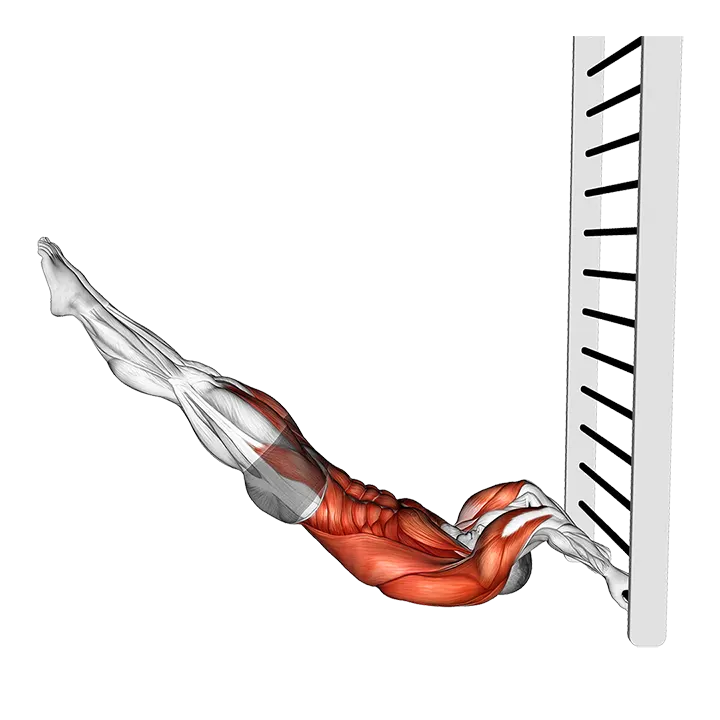
Lying Floor Negative Half Dragon Flag
- Zielmuskel
- —
- Equipment
- Body weight
- Körperregion
- Waist
- Typ
- Strength
The lying floor negative half dragon flag is a core strength exercise that develops the abs, obliques, and waist by training only the lowering (eccentric) phase of the movement with knees bent. Performed flat on the floor with your upper back anchored and body held rigid from shoulders to knees, it is the safest entry point for building the control and core strength needed to progress to the full dragon flag.
Lying Floor Negative Half Dragon Flag: So führst du sie aus
- 1Lie on your back on the floor with your head near a fixed anchor — a heavy bench leg, a wall post, or a partner's feet. Grip the anchor firmly with both hands, elbows bent and tucked close to your ears.
- 2Bend your knees to roughly 90° and pull your heels toward your glutes. This is the half-flag position that reduces the lever arm and makes the movement accessible.
- 3Brace your entire body: squeeze your abs hard, tighten your glutes, and press your lower back slightly into the floor. Your body from shoulders to knees should feel like a single rigid unit.
- 4Drive through your hands to lift your hips and legs off the floor, raising them until your torso and thighs form a straight line from shoulders to knees — this is the top starting position.
- 5Keeping your core and glutes fully braced, slowly lower your hips and legs toward the floor in a controlled arc. Take 3–5 seconds for the descent.
- 6Stop the descent just before your hips touch the floor — do not let your lower back crash down or your body collapse.
- 7From the bottom, use your hands and a small hip drive to reset back to the top position without performing an active concentric rep. Only the lowering phase counts.
- 8Repeat for the prescribed number of reps, maintaining rigidity throughout each descent.
Technik-Tipps
- Think of your body from shoulders to knees as a steel plank — the moment your hips sag or your lower back loses tension, the stimulus drops and the risk of strain rises.
- Grip the anchor as hard as you can. A tight grip activates the lats and upper back, which are critical for keeping your shoulders pinned and your body stable during the descent.
- Control the speed of the lowering phase deliberately — aim for at least 3 seconds down. A faster drop means momentum is doing the work instead of your core.
- Breathe in at the top before you lower, hold your breath during the descent (Valsalva), and exhale only after you stop at the bottom. This keeps intra-abdominal pressure high.
- If your lower back aches rather than your abs burning, your hips are likely sagging — reset, brace harder, or reduce range of motion until your core strength catches up.
Häufige Fehler
- Letting the hips sag as you lower: this collapses the rigid body position and shifts load onto the lumbar spine rather than the abs, increasing injury risk.
- Dropping too fast: a fast, uncontrolled descent removes most of the eccentric training stimulus — the slow lowering is the entire point of the negative variation.
- Pulling excessively with the arms instead of the core: the hands provide stability at the anchor, not a pulling force; over-relying on them reduces core engagement and can strain the shoulders.
- Letting the lower back crash into the floor at the bottom: impact at the end range places sharp compressive force on the lumbar spine and should be avoided by stopping just above the floor.
- Skipping the full-body brace and only tensing the abs: the glutes and legs must also remain contracted to keep the kinetic chain rigid from shoulders to knees throughout every rep.
Häufig gestellte Fragen
What muscles does the lying floor negative half dragon flag work?
It primarily targets the core — the rectus abdominis, obliques, and deep stabilizers of the waist — while the glutes, hip flexors, and lats assist in maintaining the rigid body position throughout the lowering phase.
Why do only the negative (lowering) phase instead of full reps?
Muscles are significantly stronger in the eccentric (lowering) phase than the concentric (lifting) phase. Isolating the negative allows beginners to train the dragon flag pattern under real load before they have the concentric strength to press back up, making it the safest and most effective progression step.
What can I use as an anchor if I don't have a bench?
Any fixed, stable object at floor level works — a squat rack upright, the base of a heavy sofa, a doorframe, or a training partner sitting on your hands. The anchor just needs to stay completely still when you pull against it.
How is the half version different from the full dragon flag?
In the half version, your knees are bent to roughly 90°, which shortens the lever arm from your hips and makes the movement significantly easier. The full dragon flag requires a straight body from shoulders to feet, which is far more demanding on core strength and shoulder stability.
How do I progress from the negative half dragon flag to the full dragon flag?
Work toward very slow, controlled negatives (5+ seconds) with perfect form in the half version. Then extend your legs progressively — straighter knees mean a longer lever and more difficulty. Once you can lower fully extended legs with control, begin practicing pressing back up from the bottom to add the concentric phase.







