Lying Lat Pulldown
- Synergistenmuskeln
- Brachialis, Brachioradialis, Deltoid Posterior
- Equipment
- Body weight
- Körperregion
- Back
- Typ
- Strength
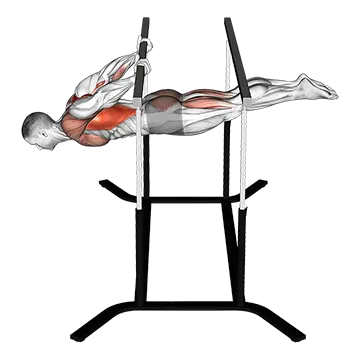

The lying lat pulldown is a bodyweight back exercise performed prone on the floor that targets the latissimus dorsi, erector spinae, infraspinatus, teres major, teres minor, and trapezius lower and middle fibers, with the brachialis, brachioradialis, and posterior deltoid assisting the pull. By anchoring the feet and reaching overhead to grip a fixed object, you replicate the pulling arc of a lat pulldown using your own bodyweight. It is an effective equipment-free option for building back width, thickness, and scapular control.
Lying Lat Pulldown: So führst du sie aus
- 1Lie face down on the floor with your body fully extended. Position yourself so that a fixed anchor point — such as the legs of a heavy piece of furniture, a door frame, or a partner's hands — is directly overhead at arm's length.
- 2Reach both arms overhead and grip the anchor with an overhand grip slightly wider than shoulder-width. Your arms should be fully extended and your forehead near the floor.
- 3Engage your core and squeeze your glutes lightly to keep your hips pressed into the floor throughout the movement.
- 4Retract your shoulder blades and begin pulling your chest forward and up toward your hands by driving your elbows down and back toward your hips.
- 5Continue pulling until your chest reaches your hands or your elbows can travel no further, feeling a strong contraction through your lats and upper back.
- 6Hold the contracted position for a brief pause, squeezing the latissimus dorsi and mid-trapezius.
- 7Slowly extend your arms back to the starting position under control, allowing your shoulder blades to protract and your lats to stretch fully.
- 8Complete your reps, maintaining tension throughout the eccentric phase on every repetition.
Technik-Tipps
- Think about driving your elbows toward your hips rather than simply bending your arms — this keeps the focus on the lats rather than the biceps.
- Keep your hips pressed firmly into the floor the entire set; letting them rise shifts the load off the target muscles and strains the lower back.
- Initiate every rep with a scapular retraction before you pull with your arms to maximize trapezius and infraspinatus engagement.
- Control the return: a slow, deliberate eccentric stretch of 2–3 seconds will increase lat recruitment and time under tension.
- Choose an anchor that is completely stable — any shift or give in the anchor point disrupts your pulling path and can cause injury.
Häufige Fehler
- Shrugging the shoulders toward the ears during the pull, which overloads the upper trapezius and takes tension away from the lats and mid-back.
- Using momentum or a jerking motion to initiate the pull rather than a smooth, controlled contraction, reducing muscle activation and risking shoulder strain.
- Lifting the hips off the floor during the movement, which introduces lumbar extension and reduces the stability needed for effective lat recruitment.
- Allowing the elbows to flare wide rather than tucking them toward the body, which shifts stress to the shoulder joint instead of the latissimus dorsi.
- Rushing through the eccentric phase by dropping back to the start position, losing the opportunity for full lat stretch and undermining total muscle development.
Häufig gestellte Fragen
What muscles does the lying lat pulldown work?
It primarily works the latissimus dorsi, erector spinae, infraspinatus, teres major, teres minor, and trapezius lower and middle fibers. The brachialis, brachioradialis, and posterior deltoid assist the pulling motion.
What can I use as an anchor for the lying lat pulldown?
Any stable, fixed object at arm's length overhead works — heavy furniture legs, a door frame, wall-mounted rings, or a partner holding your hands. Make sure the anchor cannot shift under load.
Is the lying lat pulldown effective without weights?
Yes. Because you are moving your torso toward a fixed point rather than pulling a cable down, the load is a significant portion of your bodyweight, making it challenging for most people. Slowing the eccentric increases difficulty further.
How is this different from a regular lat pulldown?
A traditional lat pulldown uses a cable machine to pull weight downward while seated. The lying lat pulldown replaces the machine with a fixed anchor and uses bodyweight as the resistance, making it accessible without any equipment.
How many sets and reps should I do?
For back development, 3–4 sets of 8–15 controlled reps works well. Focus on a full range of motion and a slow eccentric rather than chasing high rep counts with poor form.