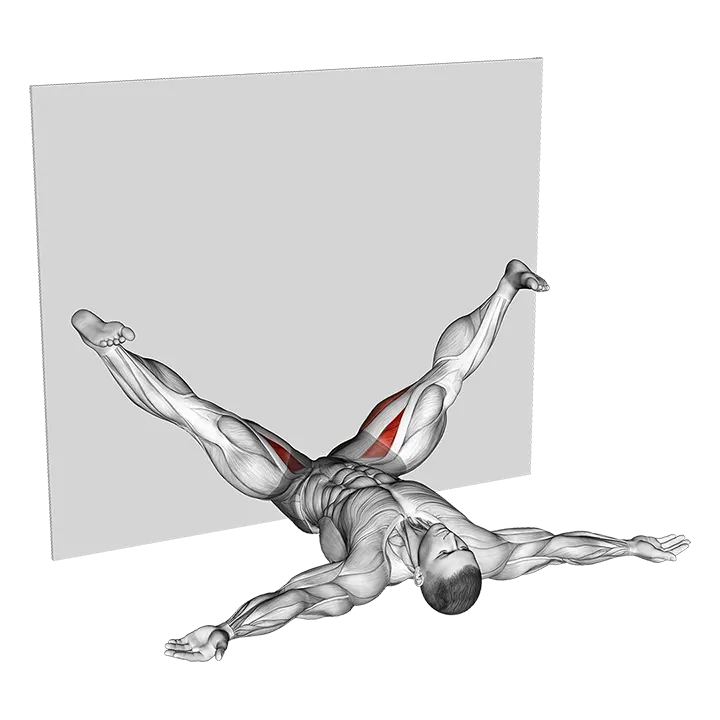
Lying Leaning Against The Wall Stretch
- Zielmuskel
- —
- Equipment
- Body weight
- Körperregion
- Hips
- Typ
- Stretching
The Lying Leaning Against The Wall Stretch is a passive bodyweight hip opener performed on the floor with the legs resting against a wall. Lying on your back with hips close to the baseboard, you use gravity and the wall's support to release tension through the hip flexors, outer hips, and glutes. It fits well as a cool-down or mobility drill on rest days.
Lying Leaning Against The Wall Stretch: So führst du sie aus
- 1Sit sideways next to a wall, lower your back to the floor, and swing your legs up so the backs of your legs rest flat against the wall.
- 2Shuffle your hips as close to the wall as is comfortable so your lower back stays in contact with the floor.
- 3Let your arms rest out to your sides, palms facing up, to keep your shoulders relaxed.
- 4Allow gravity to settle your hips down and your legs to lean into the wall naturally — avoid actively pressing the legs into the wall.
- 5To deepen the hip stretch, slowly let your legs separate into a V shape, sliding your feet apart along the wall as far as comfortable.
- 6Hold the position, breathing slowly and deeply, for 60–120 seconds or as long as directed.
- 7To finish, bend your knees, place the soles of your feet flat on the wall, and roll gently onto one side before pushing yourself up.
Technik-Tipps
- Keep your lower back flat on the floor throughout — if it lifts off, move your hips a few inches away from the wall.
- Breathe into your belly on every inhale and let the hips soften on every exhale to encourage a deeper release.
- The closer your hips sit to the wall, the more intense the stretch on the hips and inner thighs — start a few inches back and edge in gradually.
- Use a folded towel or thin pillow under your hips if your lower back feels uncomfortable on a hard floor.
- Relax your leg muscles completely and let gravity do the work rather than pushing your legs toward the wall.
Häufige Fehler
- Sitting too far from the wall with little hip flexion, which reduces the stretch stimulus on the hips and turns the pose into passive leg elevation rather than a hip opener.
- Allowing the lower back to arch away from the floor, which shifts stress onto the lumbar spine instead of opening the hips.
- Actively pressing the legs into the wall or tensing the thighs, which prevents the hip muscles from releasing and shortens the effective stretch.
- Rushing through a short hold of only 10–15 seconds — hip soft tissue needs at least 60 seconds of sustained load to begin releasing.
- Turning the head to the side repeatedly to check a phone or clock, which creates neck tension that transfers into the shoulders and prevents a full body release.
Häufig gestellte Fragen
What does the Lying Leaning Against The Wall Stretch target?
The stretch targets the hip area — specifically the hip flexors, outer hips, and glutes — using gravity and your body weight to create a passive, sustained release without any equipment.
How long should I hold the Lying Leaning Against The Wall Stretch?
Aim for at least 60 seconds per session, and up to 2–3 minutes for a deeper release. Shorter holds of 10–15 seconds are too brief for passive hip tissue to relax and lengthen.
Is this stretch safe for people with tight hips or limited flexibility?
Yes. Because you control how close your hips sit to the wall, beginners can start a foot or more away and gradually move closer as flexibility improves. The position is low-load and easy to modify.
When is the best time to do the Lying Leaning Against The Wall Stretch?
It works best as a cool-down after a lower-body workout, before bed to decompress the hips after prolonged sitting, or on active recovery days. Avoid doing it as a dynamic warm-up — passive stretching is most effective when muscles are already warm.
Can I do this stretch every day?
Yes. Because it is a passive, low-intensity bodyweight stretch with no resistance, performing it daily is safe and beneficial for maintaining hip mobility and reducing tightness from long periods of sitting.







