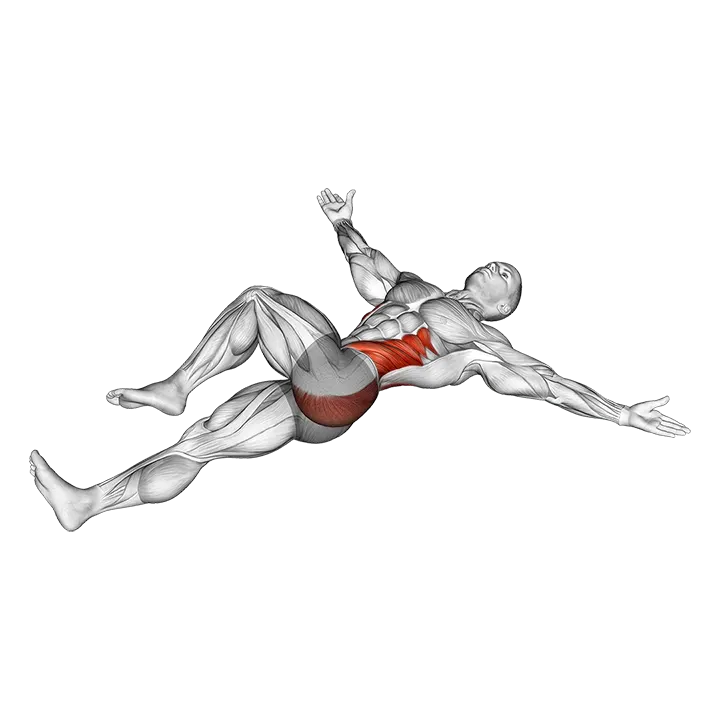
Lying T-Spine Mobility Stretching
- Zielmuskel
- —
- Equipment
- Body weight
- Körperregion
- Hips
- Typ
- Stretching
The lying T-spine mobility stretch is a bodyweight floor exercise designed to improve thoracic spine rotation and hip flexibility simultaneously. By anchoring the lower body while rotating the upper torso, it relieves stiffness in the mid-back and opens the chest, making it an effective warm-up or recovery drill for athletes and desk workers alike.
Lying T-Spine Mobility Stretching: So führst du sie aus
- 1Lie on your right side on a comfortable surface with your hips and knees bent to roughly 90°, stacking your knees on top of each other.
- 2Extend both arms straight out in front of you at chest height, palms together, so your body forms an L-shape.
- 3Take a deep breath in to prepare, then on the exhale, slowly rotate your left arm upward and over toward the floor on your left side, following it with your eyes and head.
- 4Allow your left shoulder to drop toward the floor and your chest to open toward the ceiling, keeping your knees stacked and hips as still as possible.
- 5Breathe into the stretch and hold the end position for 2–3 seconds, feeling the rotation through your mid and upper back.
- 6Inhale, then return your left arm back to the starting position, stacking both palms together again.
- 7Perform all reps on one side, then roll onto your left side and repeat the sequence with your right arm rotating open.
- 8Complete 8–12 controlled repetitions per side, focusing on increasing range of motion with each rep.
Technik-Tipps
- Keep your knees firmly stacked and your hips squared throughout the movement — the rotation should come from the thoracic spine, not the lower back or hips.
- Follow your rotating hand with your gaze; letting your eyes lead the movement helps your neck and upper spine rotate more fully.
- Breathe out as you rotate open and breathe in on the return — using your breath actively helps release thoracic tension and increases range of motion.
- Move slowly and with control rather than swinging the arm, to keep the stretch targeted at the T-spine rather than using momentum.
- If your shoulder does not reach the floor, that is fine — work within a pain-free range and allow the stretch to deepen gradually over multiple reps.
Häufige Fehler
- Letting the top knee lift or the hips rotate open as the arm sweeps back — this transfers the movement to the lower back instead of the thoracic spine, reducing effectiveness and risking lumbar strain.
- Rushing through the rotation with momentum instead of moving slowly, which shortens the time under stretch and prevents the thoracic joints from opening fully.
- Holding the breath during the rotation, which increases tension and limits how far the thoracic spine can rotate — exhaling during the opening phase is essential.
- Placing the knees at too shallow an angle (nearly straight), which reduces the pelvic lock and makes it harder to isolate T-spine rotation from hip movement.
- Forcing the shoulder to the floor before the spine is ready, which can strain the shoulder joint or lumbar spine — allow the range to develop naturally over successive reps.
Häufig gestellte Fragen
What does the lying T-spine mobility stretch do?
It improves rotation in the thoracic spine (the mid and upper back) while simultaneously stretching the hips and chest. Better T-spine mobility reduces compensatory stress on the lower back and shoulders and is especially valuable for people who sit for long periods or who play rotational sports.
How often should I do lying T-spine mobility stretches?
Daily practice is ideal, especially if you have a sedentary lifestyle or experience mid-back stiffness. It works well as part of a morning mobility routine, a pre-workout warm-up, or a post-workout cool-down. Aim for 8–12 reps per side each session.
Why are my hips listed as the body part for a T-spine stretch?
In the lying position, the bent-knee setup actively engages and anchors the hips to isolate thoracic rotation. The hips act as a stable base, so they are involved in the movement even though the primary mobility benefit is in the thoracic spine.
Can I do this stretch if I have lower back pain?
In many cases, yes — the stacked-knee position is specifically designed to take the lumbar spine out of the equation and encourage thoracic rotation instead. However, if you feel any pain in the lower back during the movement, stop and consult a healthcare professional before continuing.
What is the difference between T-spine mobility and flexibility?
Flexibility refers to passive range of motion (how far a joint can move with external help), while mobility refers to active, controlled range of motion you can use in movement. This stretch trains both: it lengthens the soft tissues around the thoracic spine and also trains your nervous system to move through that range with control.







