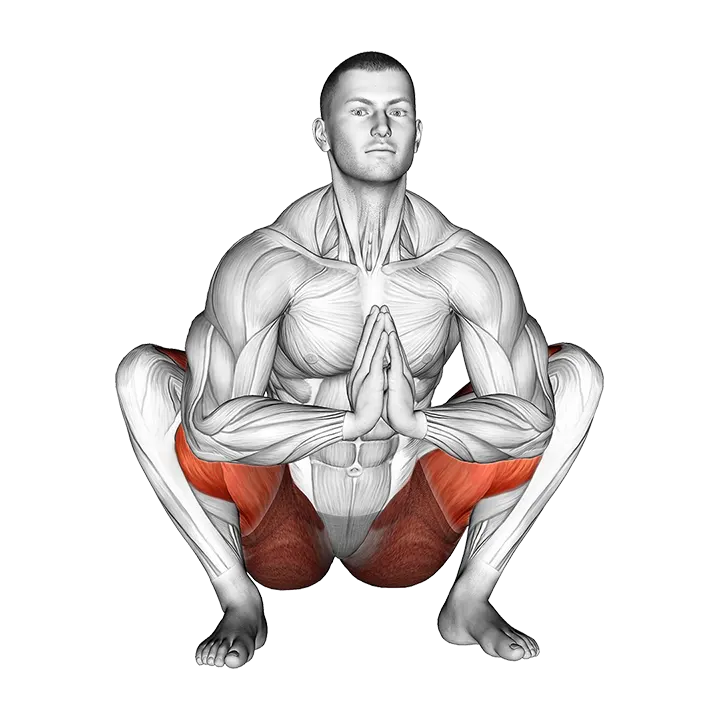
Prayer Squat Yoga Pose
- Zielmuskel
- —
- Equipment
- Body weight
- Körperregion
- Stretching
- Typ
- Stretching
Prayer Squat Yoga Pose (Malasana) is a deep bodyweight squat that stretches the hips, inner groin, adductors, and ankles while gently decompressing the lower back. It is an excellent daily mobility drill for desk workers and athletes alike, improving hip flexibility and ankle range of motion.
Prayer Squat Yoga Pose: So führst du sie aus
- 1Stand with your feet slightly wider than shoulder-width apart and toes turned out at roughly 45 degrees.
- 2Bring your palms together at chest height in a prayer position (thumbs lightly touching your sternum).
- 3Take a breath in, then on the exhale begin to lower your hips straight down toward the floor, keeping your chest tall and spine neutral.
- 4Continue descending until your hips drop below knee level and your elbows are inside your knees.
- 5Press your elbows gently outward against the inner thighs to encourage the knees to track over the toes and open the hips wider.
- 6Keep your heels flat on the floor; if they rise, widen your stance slightly or place a folded mat under your heels for support.
- 7Lift your chest, lengthen through the crown of your head, and breathe deeply, relaxing deeper into the stretch on each exhale.
- 8Hold the position for 30–60 seconds, continuing to breathe slowly and evenly.
- 9To exit, press through your heels, engage your glutes, and slowly rise back to standing.
Technik-Tipps
- Keep your weight distributed evenly across the entire foot — avoid letting it roll to the outer edges or lift the heels.
- Use the elbows-to-knees pressure as a two-way lever: your elbows push the knees out while the knees resist back, deepening the groin stretch without strain.
- If balance is difficult, hold onto a doorframe, squat rack upright, or wall with one hand while you build flexibility.
- Relax your jaw, shoulders, and pelvic floor — conscious relaxation in these areas allows the hips and groin to open more freely.
- Progress the hold gradually: start with 20–30 seconds and extend to 60–90 seconds over several weeks as mobility improves.
Häufige Fehler
- Heels lifting off the floor — this shifts load onto the knees and reduces the ankle and Achilles stretch; widen the stance or use a heel wedge until flexibility improves.
- Rounding the lower back into a deep slouch — excessive lumbar flexion can stress the spine; maintain a neutral or lightly extended lower back by lifting the chest and engaging a slight core brace.
- Knees caving inward — allowing the knees to collapse medially reduces the hip-opening effect and places stress on the knee joint; actively press elbows against inner thighs to keep knees tracking over the toes.
- Holding the breath — breath-holding increases tension throughout the body and limits how deeply you can relax into the stretch; breathe slowly and deeply throughout the hold.
- Forcing the depth too quickly — bouncing or pushing aggressively into the squat can strain the groin or inner knee; ease in gradually and let each exhale carry you deeper.
Häufig gestellte Fragen
What muscles does Prayer Squat Yoga Pose stretch?
Prayer Squat primarily stretches the inner groin (adductors), hip flexors, glutes, and ankles (Achilles tendon and calves). It also gently decompresses the lumbar spine and opens the sacroiliac area when performed with proper alignment.
How long should I hold the Prayer Squat?
Aim for 30–60 seconds per set to allow the connective tissue to release. Beginners can start with 20–30 seconds and gradually work up. Two to three sets daily will produce noticeable hip and ankle mobility improvements within a few weeks.
My heels keep lifting — what should I do?
Limited ankle dorsiflexion is the most common cause. Try widening your stance and turning your toes out a little more. You can also place a folded yoga mat or weight plate under your heels as a temporary wedge while you build ankle flexibility over time.
Is Prayer Squat safe for people with knee problems?
For many people, a properly aligned prayer squat places minimal harmful load on the knees because body weight is distributed through the hips and ankles. However, if you have acute knee pain, meniscus issues, or recent knee surgery, consult a physiotherapist before attempting deep squats.
Can I do Prayer Squat every day?
Yes — because it is a passive bodyweight stretch with no loading, daily practice is generally safe and beneficial. Incorporating it into your morning routine or as a post-workout cool-down can steadily improve hip and ankle mobility over time.







