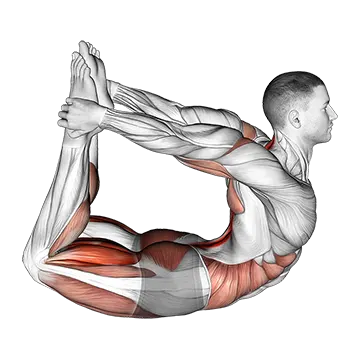
Prone Press-Swan
- Synergistenmuskeln
- Deltoid Anterior, Gastrocnemius, Pectoralis Major Clavicular Head, Pectoralis Major Sternal Head, Triceps Brachii
- Equipment
- Body weight
- Körperregion
- Hips, Waist
- Typ
- Stretching
The Prone Press-Swan is a prone backbend stretch drawn from yoga and Pilates that targets the erector spinae, gluteus maximus, and hamstrings by extending the spine against gravity. You lie face down, place your hands beside your lower ribs, and press your torso upward while keeping your hips grounded, progressively opening the front body and lengthening the posterior chain. It is an effective movement for reducing lower-back stiffness, improving spinal extension range of motion, and counteracting the effects of prolonged sitting.
Prone Press-Swan: So führst du sie aus
- 1Lie face down on a mat with your legs extended and the tops of your feet resting flat on the floor. Position your hands palm-down beside your lower ribs, elbows pointing upward and staying close to your sides.
- 2Press your pubic bone gently into the mat and lengthen through the crown of your head to establish a neutral spine in the starting position.
- 3On an inhale, begin pressing through your palms to lift your head, chest, and upper abdomen off the mat, leading with the crown of your head rather than jutting your chin forward.
- 4Continue pressing until your arms reach a comfortable degree of extension — either a low position with elbows bent or a full swan with arms nearly straight — depending on your current spinal mobility.
- 5Keep your hips and legs grounded on the mat throughout. Actively engage your gluteus maximus and press the tops of your feet down to stabilize the pelvis and protect the lumbar spine.
- 6Hold the top position for 2–5 slow breaths, maintaining length through the spine rather than compressing the lower back. Keep your gaze forward and slightly downward with the neck long.
- 7On an exhale, lower your chest back to the mat with control, working vertebra by vertebra rather than dropping down all at once.
- 8Rest briefly in the starting position, then repeat for the prescribed number of repetitions or hold duration.
Technik-Tipps
- Lead the lift with your sternum rather than your chin — initiating through the head compresses the cervical spine and shortens the thoracic extension that makes this movement effective.
- Keep your elbows close to your ribs on the way up; flaring them wide shifts the load onto the shoulder joints and reduces the spinal-extension stimulus.
- Actively press the tops of your feet into the mat and squeeze your glutes — this stabilizes the pelvis and allows the erector spinae to lengthen safely rather than over-compressing the lumbar facet joints.
- Breathe continuously throughout the hold; inhaling expands the chest and deepens thoracic extension, while exhaling softens tension in the hamstrings and hip flexors.
- Go only as high as you can without pain in the lower back — a smaller range with the hips grounded is more beneficial than a larger range with the pelvis lifting off the mat.
Häufige Fehler
- Pushing too high before mobility allows it — forcing the arms to full extension prematurely compresses the lumbar facet joints and can cause sharp lower-back pain; earn each degree of extension gradually over multiple sessions.
- Allowing the hips to rise off the mat — if the pelvis lifts as you press up, the backbend is coming from the hips rather than the spine, which reduces the erector spinae stretch and shifts stress onto the lumbar discs.
- Flaring the elbows wide — this recruits the deltoid anterior and pectoralis major as primary movers instead of using the arms to support spinal extension; keep the elbows tracking close to the torso.
- Dropping the head back and compressing the neck — tilting the chin upward shortens the cervical spine; maintain a long neck and a forward gaze to extend the whole spine evenly.
- Holding the breath — breath-holding increases intra-abdominal pressure and reduces the effectiveness of the stretch; breathe steadily throughout so the chest and ribcage can expand into the backbend.
Häufig gestellte Fragen
What is the Prone Press-Swan and how does it differ from a standard cobra pose?
The Prone Press-Swan is a Pilates-derived variation of the prone backbend. Like cobra, it begins face-down and extends the spine upward, but the swan places more emphasis on active posterior-chain engagement — squeezing the glutes and pressing the feet into the mat — rather than a purely passive chest opener. The lowering phase is also more deliberate, making the movement a controlled exercise rather than a static hold.
Which muscles does the Prone Press-Swan stretch?
The primary muscles stretched are the erector spinae, which lengthen as the spine extends, along with the gluteus maximus and hamstrings. The deltoid anterior, pectoralis major clavicular and sternal heads, triceps brachii, and gastrocnemius function as synergists, assisting the press and stabilizing the position.
Is the Prone Press-Swan safe for people with lower-back pain?
For many people whose lower-back discomfort stems from prolonged sitting or flexion-dominant activities, prone extension movements can provide relief. However, if you have a herniated lumbar disc, spinal stenosis, or experience sharp or radiating pain during the movement, consult a physiotherapist before practising it. Always work within a pain-free range of motion.
How many repetitions or how long should I hold the position?
A common approach is 3–5 repetitions per session, holding the top position for 2–5 slow breaths, roughly 5–10 seconds. As spinal mobility improves you can progress to holds of 10–20 seconds. Including this movement in a cool-down or mobility routine three to five times per week is appropriate.
Does the Prone Press-Swan require any equipment?
No equipment is needed beyond your own bodyweight. Performing it on a yoga mat or exercise mat is recommended for comfort, particularly on hard floors where bony contact points on the hips and ribs may cause discomfort.