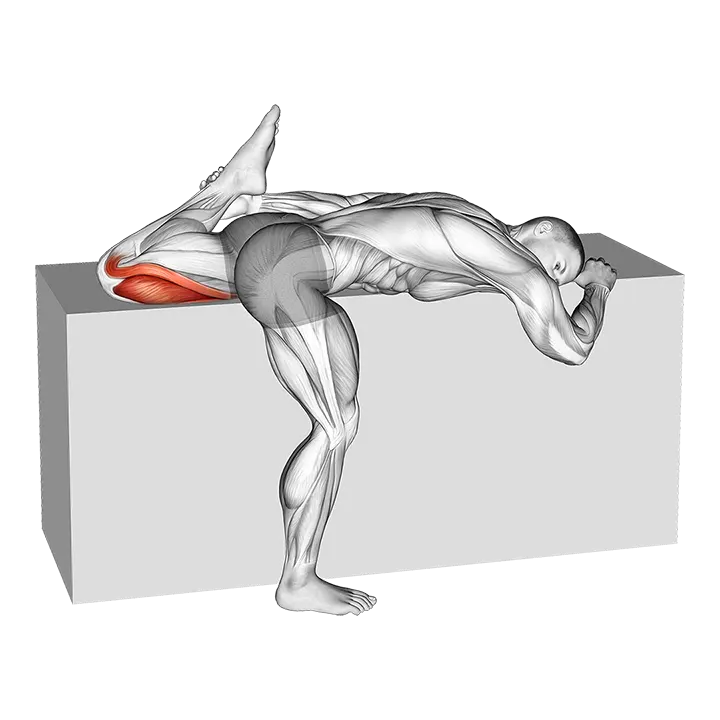
Quadriceps Stretch On Box
- Zielmuskel
- —
- Equipment
- Body weight
- Körperregion
- Thighs
- Typ
- Stretching
The quadriceps stretch on box is a bodyweight stretching exercise that targets the quadriceps and hip flexors of the thighs by resting one foot on an elevated surface behind you while kneeling. The box raises the rear foot higher than a standard standing quad stretch, allowing a deeper, more controlled range of motion. It is well-suited for athletes, runners, and anyone looking to relieve tightness in the front of the thigh after lower-body training.
Quadriceps Stretch On Box: So führst du sie aus
- 1Place a sturdy box or bench behind you at roughly knee height and stand about one step in front of it.
- 2Shift your weight onto your left foot, reach back, and place the top of your right foot on the box so the laces face down.
- 3Lower your right knee toward the floor, keeping your torso upright, until you feel a stretch along the front of your right thigh.
- 4Position your left knee directly over your left ankle so your front shin stays vertical.
- 5Place your hands on your left thigh or a stable surface for balance if needed.
- 6Breathe out and gently deepen the stretch by pressing your hips slightly forward and down without arching your lower back.
- 7Hold the stretch for 20 to 45 seconds, breathing steadily throughout.
- 8Carefully step your right foot off the box, return to standing, and repeat on the opposite side.
Technik-Tipps
- Keep your torso tall and your core lightly braced throughout the hold to protect your lower back from excessive arching.
- Press your hips forward gradually rather than forcing them down quickly — small adjustments produce a deeper stretch without strain.
- Rest the top of your foot flat on the box surface so the ankle stays neutral and pressure is distributed evenly.
- Use a wall, doorframe, or chair for balance support if the single-leg stance feels unstable.
- Breathe slowly and consistently; exhaling as you settle deeper into the stretch helps the muscle relax.
Häufige Fehler
- Letting the lower back arch aggressively to push the hips forward, which compresses the lumbar spine instead of stretching the quad effectively.
- Placing the knee of the front leg too far forward past the toes, which shifts stress onto the front knee rather than opening the hip and thigh.
- Rushing through the hold and releasing before 20 seconds, which does not give the quadriceps enough time to relax and lengthen.
- Using a box that is too high before building enough flexibility, creating excessive torque on the knee joint of the rear leg.
- Twisting or leaning the torso to one side during the hold, which reduces the stretch on the target muscles and can create imbalance.
Häufig gestellte Fragen
How long should I hold the quadriceps stretch on box?
Hold each side for 20 to 45 seconds per repetition. For general flexibility maintenance, one to two holds per side is sufficient. If you are working to improve range of motion, aim for two to three holds of 30 to 45 seconds with a short rest between rounds.
How is this different from a standing quad stretch?
Elevating the rear foot on a box increases the angle at the hip and knee, producing a deeper stretch along the front of the thigh and hip flexors compared to pulling the foot up by hand in a standing position. The box also removes the need to grip your foot, making it easier to relax into the stretch.
When is the best time to do this stretch?
It works well as part of a post-workout cool-down when the muscles are warm, or as a standalone mobility session. Avoid performing deep passive stretches like this immediately before heavy strength training, as they can temporarily reduce force output.
Who benefits most from the quadriceps stretch on box?
Runners, cyclists, and anyone who spends long hours sitting can develop tight quadriceps and hip flexors. This stretch is particularly useful for those groups, as well as athletes returning from lower-body training sessions or anyone addressing anterior hip tightness.
Is this stretch safe if I have knee pain?
If you have existing knee pain, consult a healthcare professional before attempting this movement. The stretch places the rear knee near the floor and the rear foot elevated, which can load sensitive structures. Starting with a lower surface and keeping the range of motion comfortable is advisable.







