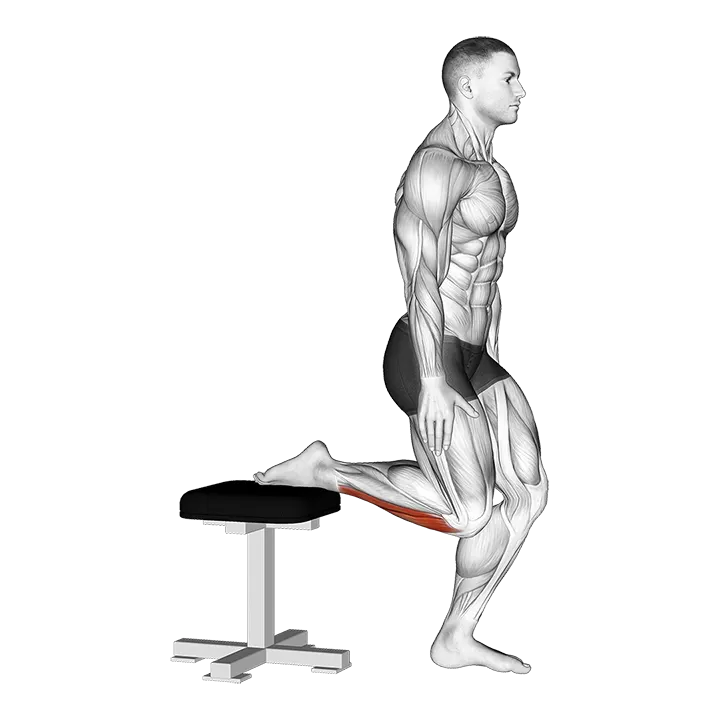
Raised Foot Shin Stretch
- Zielmuskel
- —
- Equipment
- Body weight
- Körperregion
- Calves
- Typ
- Stretching
The Raised Foot Shin Stretch targets the tibialis anterior and surrounding muscles along the front of the lower leg by placing the top of the foot on a raised surface and gently pressing the shin forward. Elevating the foot increases the range of motion compared to a flat-floor shin stretch, making it effective for relieving tightness after running or walking. It fits naturally into a warm-up or cool-down routine for athletes who experience anterior lower-leg fatigue.
Raised Foot Shin Stretch: So führst du sie aus
- 1Stand facing a low step, box, or raised surface roughly 15 to 30 centimetres high.
- 2Shift your weight onto your left foot and place the top of your right foot on the raised surface so the toes point away from you and the laces face down.
- 3Stand tall with your hips square and your hands on your hips or lightly resting on a wall for balance.
- 4Slowly bend your left knee and lower your body slightly to allow the right ankle to plantarflex, which brings the shin closer to the surface.
- 5Gently press your right shin forward and down until you feel a stretch along the front of the lower leg, just below the knee and along the shin bone.
- 6Keep your right heel in contact with the raised surface throughout the movement.
- 7Hold the stretched position for 20 to 45 seconds, breathing steadily.
- 8Slowly straighten your left leg and lift your right foot off the surface to release the stretch.
- 9Repeat on the opposite side.
Technik-Tipps
- Keep the top of the foot fully in contact with the raised surface — curling the toes under shifts load to the toe joints instead of the shin.
- Move into the stretch gradually by bending the standing knee rather than forcing the shin down with your hands.
- Use a wall or sturdy chair for balance support so you can relax the foot and lower leg fully during the hold.
- Keep your hips level and facing forward throughout — rotating the hip outward reduces the stretch on the tibialis anterior.
- Breathe slowly and avoid holding your breath, as relaxing on the exhale helps the shin muscles lengthen.
Häufige Fehler
- Placing the toes on the surface instead of the top of the foot, which diverts the stretch to the toe extensors rather than the tibialis anterior along the shin.
- Forcing the shin down aggressively with the hand or body weight, which can strain the ankle and does not give the muscle time to relax and lengthen.
- Using a surface that is too high before adequate flexibility exists, placing excessive stress on the ankle joint and the dorsal foot.
- Releasing the stretch before 20 seconds, which does not allow enough time for the shin muscles to respond to the sustained tension.
- Letting the standing knee lock out straight, which reduces the ability to control depth and limits how effectively the shin is brought into the stretch.
Häufig gestellte Fragen
What muscles does the raised foot shin stretch target?
The primary target is the tibialis anterior, the muscle that runs along the front of the shin and is responsible for pulling the foot upward. The stretch also reaches the extensor muscles along the top of the foot and lower leg. Placing the foot on a raised surface increases ankle plantarflexion, producing a deeper stretch than versions done on a flat floor.
How long should I hold the stretch?
Hold each side for 20 to 45 seconds. One to two holds per side is sufficient for general maintenance. If you are working on improving flexibility in the shin area or recovering from tightness, aim for two to three holds of 30 to 45 seconds with a brief rest between rounds.
Is this stretch useful for runners?
Yes. Runners frequently develop tightness in the tibialis anterior from repeated dorsiflexion during the swing phase of the stride. Stretching the shin regularly can reduce the risk of shin splints and anterior lower-leg fatigue, particularly for those increasing their training volume or running on hard surfaces.
How high should the raised surface be?
Start with a surface around 15 centimetres, such as the edge of a low step. A higher surface intensifies the stretch by increasing plantarflexion at the ankle, so only progress to a taller surface once you can hold the lower position comfortably without any discomfort in the ankle or foot.
When is the best time to do this stretch?
It works best as part of a post-workout cool-down when the lower leg muscles are already warm. You can also include it in a standalone mobility session. Avoid holding deep passive stretches like this immediately before explosive or heavy training, as sustained static stretching can temporarily reduce muscle output.







