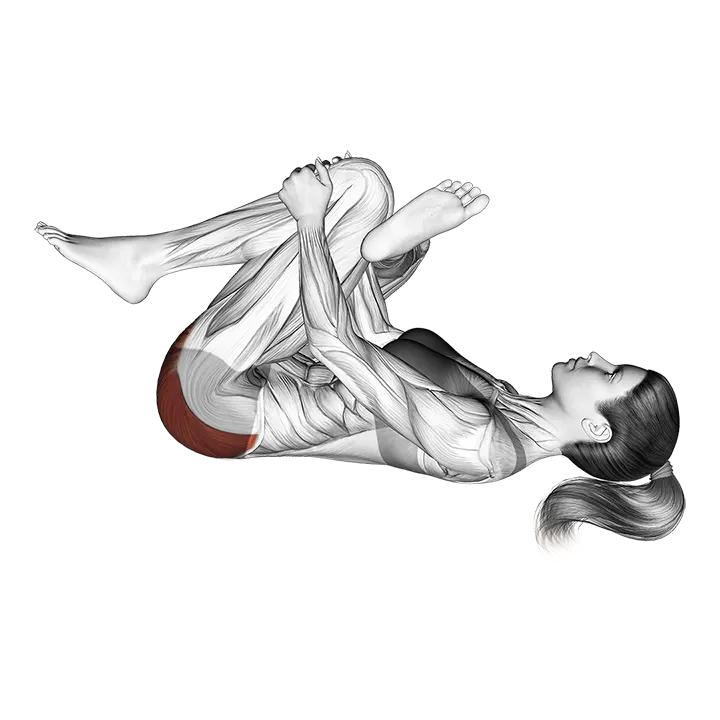
Recumbent Hip External Rotator And Hip Extensor Stretch (Crossed Leg)
- Zielmuskel
- —
- Equipment
- Body weight
- Körperregion
- Hips
- Typ
- Stretching
The recumbent hip external rotator and hip extensor stretch targets the hip external rotators — including the piriformis and deep short rotators — along with the gluteal muscles, using a crossed-leg position while lying on your back. It requires no equipment and is especially useful for relieving tightness from prolonged sitting, improving hip mobility, and reducing tension in the lower back and hips.
Recumbent Hip External Rotator And Hip Extensor Stretch (Crossed Leg): So führst du sie aus
- 1Lie flat on your back on a mat with your knees bent and both feet flat on the floor.
- 2Cross your right ankle over your left thigh, just above the knee, so your right knee points out to the side — this is the figure-four position.
- 3Flex your right foot by pulling your toes back toward your shin to protect your knee joint.
- 4Reach both hands around your left thigh — or clasp them behind your left knee if that is easier to hold.
- 5Gently draw your left leg toward your chest, keeping your head and shoulders relaxed on the floor.
- 6Pull until you feel a deep stretch in your right hip and glute. Avoid forcing the range; let gravity and a slow exhale deepen the stretch.
- 7Hold the position for 20–60 seconds, breathing steadily throughout.
- 8Slowly lower your left foot back to the floor, uncross your legs, and repeat on the other side.
Technik-Tipps
- Keep your lower back pressed gently into the mat rather than letting it arch as you pull your leg in.
- Flex the foot of the crossed leg throughout the hold to keep your knee in a safe, neutral alignment.
- Let your breath do the work — exhale slowly to encourage a deeper release without forcing the stretch.
- Keep your head and shoulders flat on the floor rather than craning your neck up toward your knee.
Häufige Fehler
- Placing the ankle too close to or on top of the knee instead of just above it, which puts shearing stress on the knee joint.
- Letting the foot of the crossed leg go limp, which removes the protective tension needed to stabilize the knee.
- Pulling the supporting leg too hard and too fast, which causes the lower back to lift off the floor and shifts tension away from the hip.
- Holding your breath during the stretch, which increases muscle tension and reduces how far the stretch can progress.
- Performing only one side and skipping the other, which can reinforce muscular imbalances between hips.
Häufig gestellte Fragen
What muscles does the recumbent crossed-leg hip stretch target?
It primarily stretches the hip external rotators — especially the piriformis and the short deep rotators — along with the gluteus maximus and gluteus medius. These muscles all attach around the hip joint and can become tight from sitting or repetitive lower-body training.
How long should I hold this stretch?
Hold each side for 20–60 seconds. Holding for at least 30 seconds allows the muscle and connective tissue to begin releasing tension more fully than a quick 10-second hold.
Can this stretch help with lower back pain?
Yes, indirectly. Tight hip external rotators and glutes can pull on the pelvis and contribute to lower back tension. Releasing them with this stretch can reduce that referred tightness, though it is not a substitute for professional evaluation of back pain.
Is this the same as the figure-four stretch?
Yes — the crossed-leg position used here is the same figure-four shape. This version is performed lying down, which allows your body weight and gravity to assist the stretch without requiring balance or hip flexor effort.
How often should I do this stretch?
For general maintenance, once or twice daily works well, especially after long periods of sitting or after lower-body workouts. If you are working on improving hip mobility, performing two to three sets per side each session accelerates progress.







