

Resistance Band Pull Apart (45 degrees)
- Zielmuskel
- Deltoid Posterior
- Synergistenmuskeln
- Infraspinatus, Teres Minor, Trapezius Lower Fibers, Trapezius Middle Fibers
- Equipment
- Resistance Band
- Körperregion
- Shoulders
- Typ
- Strength
The resistance band pull apart at 45 degrees is a shoulder accessory exercise that targets the posterior deltoid, with supporting work from the infraspinatus, teres minor, and lower and middle trapezius. By angling the arms downward at roughly 45 degrees rather than holding them parallel to the floor, you shift the line of pull to place slightly greater emphasis on the lower posterior shoulder. It is well suited as a warm-up, corrective drill, or high-rep accessory to improve rear-delt strength and scapular stability.
Resistance Band Pull Apart (45 degrees): So führst du sie aus
- 1Stand tall with your feet about hip-width apart and hold a resistance band with both hands, palms facing down.
- 2Raise your arms in front of you so they are angled downward at roughly 45 degrees from horizontal — hands at approximately upper-chest height, fingertips pointing toward the floor at a diagonal.
- 3Set your grip so there is light tension in the band at the start position, with hands roughly shoulder-width apart or slightly wider.
- 4Retract your shoulder blades slightly and brace your core before initiating the movement.
- 5Pull the band apart by driving both hands outward and back, keeping the 45-degree downward angle constant throughout the motion.
- 6Continue pulling until the band touches your chest, squeezing the rear delts and upper back at the end range.
- 7Pause briefly at the fully stretched position, feeling the contraction in the posterior deltoid and between the shoulder blades.
- 8Reverse the motion under control, allowing the band to return to the start position without letting your arms drift above or below the 45-degree angle.
- 9Repeat for the desired number of reps, maintaining a steady tempo and consistent arm angle on every repetition.
Technik-Tipps
- Keep the 45-degree downward angle fixed throughout the rep — letting your arms drift up to horizontal shifts the emphasis away from the intended target.
- Lead the movement with your elbows rather than your hands to ensure the rear delts and upper back are doing the work instead of the forearms.
- Use a band with enough resistance that you feel a clear squeeze in the rear deltoid at the end of each rep, but light enough that you can complete all reps without your arms drifting or your torso swaying.
- Avoid shrugging your shoulders toward your ears as you pull; keep the traps depressed so the posterior deltoid and mid-trapezius remain the primary movers.
- Control the return phase — resist the band rather than letting it snap back, as the eccentric portion of each rep adds training stimulus.
Häufige Fehler
- Raising the arms to horizontal mid-set, which converts the movement into a standard pull apart and removes the angle-specific loading on the posterior deltoid.
- Using too much band resistance and swinging the torso to complete reps, which reduces muscular tension and increases the risk of lower-back strain.
- Allowing the elbows to bend excessively, which turns the movement into a row pattern and takes emphasis off the rear deltoid.
- Shrugging the shoulders upward during the pull, which recruits the upper trapezius and reduces isolation of the posterior deltoid and middle trapezius.
- Rushing through reps without pausing at full extension, which sacrifices the peak contraction where the posterior deltoid and infraspinatus are most activated.
Häufig gestellte Fragen
What muscles does the resistance band pull apart at 45 degrees work?
The primary muscle is the posterior deltoid. The infraspinatus, teres minor, lower trapezius, and middle trapezius act as synergists, assisting with external rotation and scapular retraction throughout the movement.
How does the 45-degree angle differ from the standard horizontal pull apart?
Angling the arms downward at 45 degrees shifts the line of pull so the lower fibers of the posterior deltoid are emphasized more than in the horizontal version. It also increases involvement of the lower trapezius compared to a standard pull apart performed with the arms parallel to the floor.
How many reps and sets should I do?
Because the posterior deltoid and rotator-cuff muscles respond well to moderate-to-high rep ranges, 3 sets of 15–25 reps is a practical starting point. You can use it as a warm-up before pressing or pulling work, or as a corrective accessory at the end of a session.
How do I choose the right band resistance?
Start with a lighter band than you think you need. You should feel a clear squeeze at full extension and be able to complete all reps while keeping your arms at the 45-degree angle and your torso still. If you find yourself swaying or your arms drifting upward, the band is too heavy.
Can I do this exercise seated?
Yes. Sitting on a bench or chair removes any temptation to use body sway, which can make it a useful regression for beginners or a stricter variation for anyone who has trouble stabilizing their torso when standing.
Ähnliche Übungen
 Resistance Band Half Kneeling Face PullShoulders
 Resistance Band Pull ApartShoulders
 Resistance Band Rear FlyShoulders
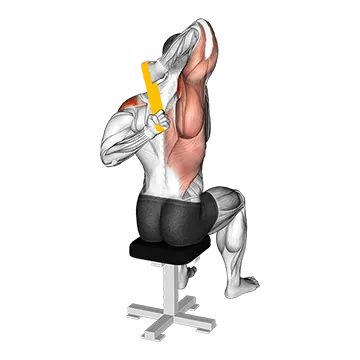 Resistance Band Shoulder Stretch Behind the BackShoulders
 Band Face PullShoulders
 Band horizontal Pallof Press with Resistance Band SquatHips, Thighs, Waist
 Band rear delt rowShoulders
 Band reverse flyShoulders