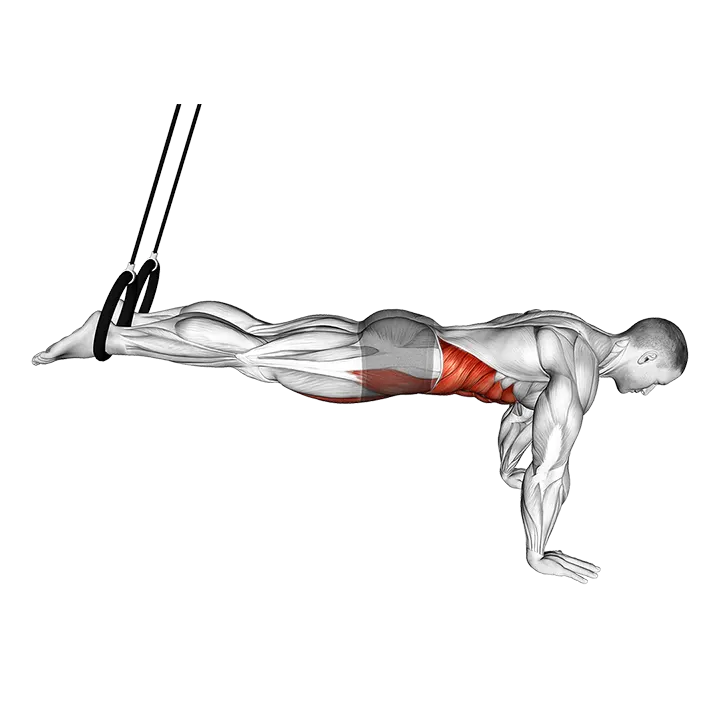
Ring Isometric Hold Reverse Ab Rollout
- Zielmuskel
- —
- Equipment
- Body weight
- Körperregion
- Waist
- Typ
- Strength
The Ring Isometric Hold Reverse Ab Rollout is an advanced bodyweight exercise performed on gymnastic rings that trains the core in a demanding anti-extension pattern. By holding the fully extended position — arms overhead, body in a hollow line — you isometrically challenge the rectus abdominis, obliques, and transverse abdominis, making it one of the most intense static core exercises available.
Ring Isometric Hold Reverse Ab Rollout: So führst du sie aus
- 1Adjust the rings so they hang just a few inches above the floor, enough clearance to kneel beneath them comfortably.
- 2Kneel on a mat and grip one ring in each hand with a neutral or pronated grip, hands roughly shoulder-width apart.
- 3Brace your core, posteriorly tilt your pelvis, and slowly walk your knees back while extending your arms forward and overhead until your body forms a straight, hollow-body line — hips in line with your torso, arms fully extended.
- 4Hold that extended position: arms straight and pressed down against the rings, ribcage depressed, glutes and abs fully contracted, and hips just above floor level.
- 5Keep your gaze toward the floor and your neck neutral so your spine stays in alignment throughout the hold.
- 6Breathe in controlled nasal inhales and exhale slowly without releasing the abdominal brace — do not hold your breath for the entire set.
- 7Maintain the hollow-body position for the target duration, typically 10–30 seconds, resisting any temptation to let the hips drop or the lower back arch.
- 8To finish, bend your elbows and pull the rings back toward your hips while walking your knees forward, returning to the kneeling start position under control.
Technik-Tipps
- Tilt your pelvis posteriorly — think of pulling your tailbone toward your knees — before you roll out; this locks the lumbar spine and transfers load onto the abs instead of the lower back.
- Press down and slightly apart into the rings throughout the hold to create tension through the shoulders and lats, which stabilizes the extended position.
- Build the hold duration before increasing the number of sets; a solid 20-second hold with perfect form is far more valuable than a longer hold with sagging hips.
- Place a folded mat beneath your hips as a safety stop when learning the movement so you have a reference point for depth and can bail safely.
- If the rings rotate during the hold, actively counter-rotate your hands to keep the straps vertical — this prevents wrist strain and keeps the shoulder in a stable position.
Häufige Fehler
- Letting the hips sag toward the floor, which removes anti-extension demand from the core and compresses the lumbar spine — keep hips in line with the torso throughout.
- Bending the elbows during the hold, which shortens the moment arm and dramatically reduces the load on the abs; keep arms fully extended to maintain the training stimulus.
- Holding the breath for the entire duration, which spikes intra-thoracic pressure and causes premature fatigue — use controlled breathing while maintaining the abdominal brace.
- Setting the rings too high off the floor, which reduces the challenge by limiting how far the arms can extend and allowing the knees to bear excess load.
- Rolling out too quickly without first establishing the hollow-body position, which means the torso arrives at the extended point without the core pre-braced and risks lower-back strain.
Häufig gestellte Fragen
What muscles does the Ring Isometric Hold Reverse Ab Rollout work?
The exercise primarily challenges the anterior core: the rectus abdominis, obliques, and transverse abdominis all work isometrically to resist spinal extension. The hip flexors, lats, and serratus anterior also engage to hold the body in the extended hollow-body position.
What is the difference between a regular ab rollout and a reverse ab rollout isometric hold?
In a standard ab rollout you start in a compressed position and roll out to the extended position, then return. In the reverse variation you start at or near the extended position and hold it statically, emphasizing the most mechanically demanding point of the movement — the moment of maximum anti-extension — without the momentum of a rolling motion.
How long should I hold the position?
Beginners can target 5–10 seconds with strict form; intermediate athletes work toward 20 seconds; advanced practitioners can aim for 30 or more. Quality of position matters far more than duration — cut the hold the moment the hips drop or the lower back arches.
Is this exercise suitable for beginners?
No. This is an advanced core exercise that requires a strong foundation of anti-extension strength. Master plank progressions, regular ab wheel rollouts from the knees, and hollow-body holds before attempting ring isometric holds, as the rings add instability that magnifies any form breakdown.
How do I program the Ring Isometric Hold Reverse Ab Rollout in my training?
Use it as a primary core exercise near the start of a session when the abs are fresh. Two to four sets of one hold per set, with 60–90 seconds of rest between sets, works well. It can also serve as an accessory finisher after compound lifts 1–2 times per week.







