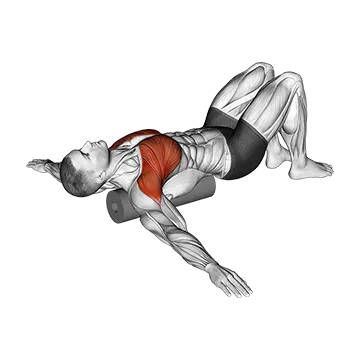
Roll Back Stretch
- Zielmuskel
- Erector Spinae, Latissimus Dorsi
- Synergistenmuskeln
- Gluteus Maximus, Serratus Anterior
- Equipment
- Roll
- Körperregion
- Back
- Typ
- Stretching

The Roll Back Stretch is a foam-roller mobility exercise that targets the erector spinae and latissimus dorsi by extending the spine over a cylindrical roll placed horizontally under the mid or upper back. The gluteus maximus engages to support the pelvis, and the serratus anterior assists with arm and shoulder position. It is well suited for reducing thoracic stiffness, improving spinal extension, and releasing tension through the back after training or prolonged sitting.
Roll Back Stretch: So führst du sie aus
- 1Place a foam roller or cylindrical roll on the floor perpendicular to your body.
- 2Sit on the floor in front of the roller, then lean back so the roller contacts the middle of your upper back, just below the shoulder blades.
- 3Cross your arms over your chest or support the back of your head with both hands to keep your neck neutral.
- 4Plant your feet flat on the floor, hip-width apart, and engage your glutes to lift your hips slightly so your body forms a gentle arc over the roller.
- 5Allow gravity to extend your thoracic spine over the roller, breathing out as you relax into the stretch.
- 6Hold the stretched position for one to two seconds, then use your feet and glutes to drive your hips up and roll the foam roller a few centimetres toward your upper back.
- 7Pause again at each new segment, letting the spine extend over the roller before rolling further.
- 8Continue rolling upward until you reach the base of the neck, then reverse direction and work back down toward the lower thoracic area.
- 9Complete the desired number of passes, then roll to one side and press up to a seated position.
Technik-Tipps
- Keep your hips elevated throughout — dropping them to the floor puts your lumbar spine over the roller rather than the thoracic, which is not the target and can be uncomfortable.
- Control the roll with your feet rather than letting the roller slide freely, so you can pause and breathe into each stiff segment.
- Use your arms to create a small amount of shoulder retraction or overhead reach, which opens the lats and increases the stretch on the latissimus dorsi.
- Exhale as you sink into each position to help the erector spinae relax into the extension.
- Stop the roller at the base of the neck — rolling directly on the cervical spine is unsafe.
Häufige Fehler
- Rolling over the lumbar spine, which compresses the lower back vertebrae in an unsupported arch and can cause discomfort or injury — keep the roller confined to the thoracic region.
- Letting the hips drop to the floor, which collapses the stretch and transfers load to the lumbar spine instead of mobilizing the mid and upper back.
- Moving too fast without pausing at each segment, which turns the exercise into a rolling motion rather than a true stretch and prevents the erector spinae from releasing.
- Pulling the head forward with the hands, which strains the neck and reduces the quality of thoracic extension — hands should cradle the head without yanking it.
- Holding the breath through the movement, which keeps the spinal muscles tense and limits how far the spine can extend over the roller.
Häufig gestellte Fragen
What muscles does the Roll Back Stretch target?
It primarily stretches the erector spinae, which run along either side of the spine, and the latissimus dorsi, the broad muscles of the mid and upper back. The gluteus maximus works to support the pelvis, and the serratus anterior assists with shoulder and arm positioning.
Where should the foam roller be placed on my back?
Start just below the shoulder blades, in the mid-thoracic area, and work up toward the upper thoracic region. Avoid placing the roller under the lumbar spine or directly on the cervical vertebrae at the base of the neck.
How long should I hold each position?
Pause for one to two breaths — roughly five to ten seconds — at each segment before rolling to the next. This gives the erector spinae and lats enough time to relax and lengthen into the extension.
How often should I do the Roll Back Stretch?
Daily use is appropriate for most people, either as part of a warm-up to improve thoracic mobility before training or as a cool-down to release tension after a session. Two to three passes per session is usually enough.
Is the Roll Back Stretch safe if I have back pain?
For general thoracic stiffness it is generally well tolerated, but if you have an acute spinal injury, disc issues, or osteoporosis you should consult a physiotherapist before using it, as spinal extension over a roller may not be appropriate for all conditions.