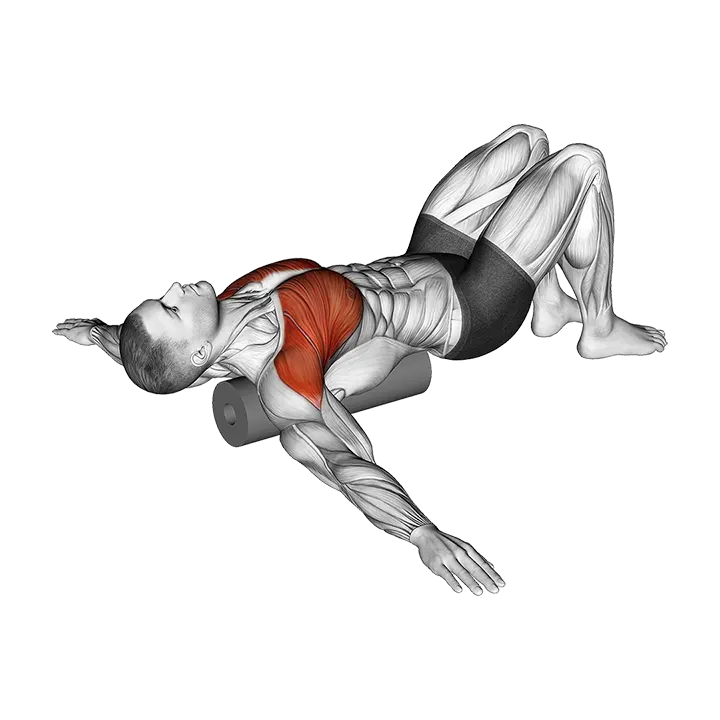
Roll Chest Opener Lying on Floor
- Zielmuskel
- —
- Equipment
- Roll
- Körperregion
- Chest
- Typ
- Stretching
The Roll Chest Opener Lying on Floor is a passive foam roller stretch that targets the pectoralis major and promotes thoracic extension. You lie on a roller placed lengthwise along your spine and let gravity draw your arms outward, gently opening the chest. It is particularly effective for countering rounded shoulders caused by prolonged sitting or pressing-heavy training.
Roll Chest Opener Lying on Floor: So führst du sie aus
- 1Place a foam roller on the floor and sit at one end of it with your knees bent and feet flat.
- 2Slowly lower yourself backward so the roller runs lengthwise along your entire spine, from tailbone to the base of your skull.
- 3Keep your knees bent and feet flat on the floor to stabilise your lower body throughout the stretch.
- 4Let your arms fall out to the sides with palms facing up, positioning them between 45° and 90° relative to your torso — find the angle where you feel the most tension across your chest.
- 5Allow gravity to draw your chest open and your shoulders toward the floor, breathing steadily and without forcing the stretch.
- 6Hold the position for 30–60 seconds, taking slow, deep breaths to encourage progressive relaxation of the chest and anterior shoulders.
- 7To finish, bring your arms back to your sides, roll to one side, and use your hands to press yourself back up to seated.
Technik-Tipps
- Let gravity do the work — resist the urge to actively pull your arms down. Passive relaxation produces a deeper, safer stretch.
- Experiment with arm angle: a lower angle (closer to your hips) targets the lower pectoralis major, while a higher angle (toward your head) engages the clavicular head and anterior deltoid more.
- Take slow, diaphragmatic breaths during the hold. Inhaling deeply expands the rib cage and amplifies the stretch with each breath cycle.
- Keep your lower back from arching excessively off the roller — a slight bend in the knees and feet flat on the floor helps maintain a neutral lumbar position.
Häufige Fehler
- Placing the roller horizontally across the upper back instead of lengthwise along the spine, which destabilises the position and reduces the chest-opening effect.
- Actively forcing the arms down toward the floor, which can strain the shoulder capsule — the stretch should be passive and gravity-driven.
- Holding your breath during the stretch, which increases muscle tension and limits how deeply the chest can open.
- Allowing the lower back to hyperextend away from the roller, which stresses the lumbar spine — keep the knees bent and feet grounded to protect it.
- Rushing the hold and spending fewer than 20 seconds in position, which is not long enough for the myofascial tissue to relax and lengthen.
Häufig gestellte Fragen
What muscles does the Roll Chest Opener Lying on Floor stretch?
The primary target is the pectoralis major. The anterior deltoids and the connective tissue across the front of the shoulder also receive a significant stretch, and the thoracic extensors benefit from the supported spinal extension.
How long should I hold the Roll Chest Opener stretch?
Aim for 30–60 seconds per set. Holding for at least 30 seconds gives the chest and shoulder tissue enough time to relax and lengthen. You can repeat the stretch two or three times for a cumulative effect.
Can this exercise help with rounded shoulders or poor posture?
Yes. Regularly stretching the pectoralis major reduces the forward pull on the shoulder girdle, which is one of the main contributors to rounded-shoulder posture. Combine it with thoracic mobility work and scapular-stabilising exercises for best results.
Is this stretch safe for people with lower back pain?
For most people, keeping the knees bent and feet flat on the floor minimises lumbar stress and makes the stretch comfortable. If you experience pain rather than a gentle stretch in the lower back, stop and consult a healthcare professional before continuing.
When is the best time to do this stretch — before or after a workout?
This is a passive, static stretch, so it is best performed after a workout or as part of a dedicated mobility session when your muscles are already warm. Avoid using it as a pre-workout stretch immediately before heavy pressing work.