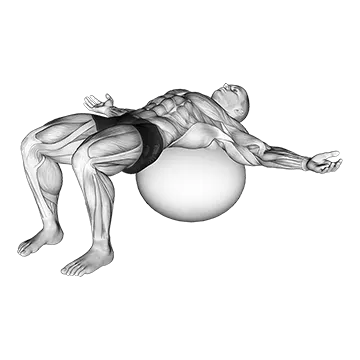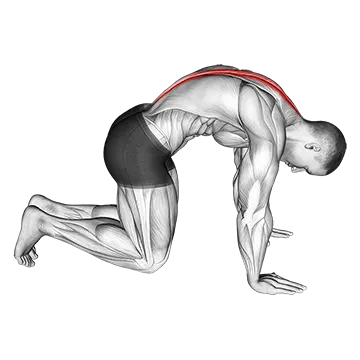
Roll Ball Lower Back
- Zielmuskel
- Erector Spinae
- Equipment
- Rollball
- Körperregion
- Hips
- Typ
- Stretching
Roll Ball Lower Back is a self-myofascial release exercise that targets the erector spinae muscles running along the lumbar region. By applying sustained pressure with a small firm ball against the muscle tissue on either side of the spine, you break up adhesions and relieve chronic tightness. It is especially effective for reducing lower back stiffness caused by prolonged sitting, poor posture, or heavy lifting sessions.
Roll Ball Lower Back: So führst du sie aus
- 1Choose your position: stand with your back against a wall, or lie on the floor with your knees bent and feet flat.
- 2Place a small firm rollball between your lower back and the wall or floor, positioning it on the muscle tissue just to one side of the lumbar spine — never directly on the vertebrae.
- 3Slowly shift your body weight into the ball until you feel moderate, tolerable pressure on the target muscle.
- 4Hold steady pressure on any tender spot for 20–30 seconds, breathing slowly and allowing the muscle to relax.
- 5Once the tension releases, nudge your body slightly up, down, or in a small circle to find the next tender area.
- 6Continue exploring the erector spinae tissue on that side for 60–90 seconds before switching to the opposite side of the spine.
- 7Keep your core lightly engaged and your glutes relaxed throughout to allow the lower back muscles to release fully.
- 8Finish by gently rolling off the ball, resting for a moment, and performing a slow knee-to-chest stretch to further lengthen the lower back.
Technik-Tipps
- Keep the ball lateral to the spine at all times — place it on the thick muscle column beside the vertebrae, never directly on the bony spine itself.
- Start with lighter pressure by using a softer ball or reducing body weight on the ball; you can progress to firmer pressure as the tissue adapts.
- Breathe slowly and deliberately into the area of pressure — exhaling fully helps the nervous system relax the muscle and deepens the release.
- Move in very small, slow increments (1–2 cm at a time) rather than rolling quickly; slow sustained pressure is far more effective than rapid rolling.
- Stop immediately if you feel sharp, shooting, or nerve-like pain radiating into the leg — this signals the ball may be pressing on a nerve root and you should reposition.
Häufige Fehler
- Rolling directly on the lumbar vertebrae: placing the ball on the bony spine rather than the adjacent muscle tissue can compress the vertebrae and irritate spinal structures — always keep the ball on the muscle to the side.
- Using too much pressure too soon: loading full body weight onto the ball before the muscle is warmed up can cause bruising or aggravate existing tension instead of relieving it.
- Moving too fast: rushing through the release misses the sustained pressure needed for myofascial change — stay on each spot for at least 20 seconds.
- Holding your breath: breath-holding increases muscular tension and prevents the muscle from releasing — maintain slow, relaxed breathing throughout.
- Rolling on acutely injured tissue: performing self-myofascial release directly on a recently strained or inflamed lower back can worsen the injury — wait until acute pain has subsided and consult a healthcare provider if unsure.
Häufig gestellte Fragen
How is Roll Ball Lower Back different from using a foam roller on the lower back?
A small firm ball applies concentrated point pressure to a specific spot in the erector spinae, making it easier to target tight knots and avoid the vertebrae entirely. A foam roller covers a broader area and can be harder to control precisely in the lumbar region. The ball technique is generally safer and more effective for the lower back.
How often should I do Roll Ball Lower Back?
Most people benefit from one to two sessions per day, especially after long periods of sitting or after strength training. Each session of 2–4 minutes per side is sufficient. Avoid performing it more than twice daily on the same area to give the tissue time to recover between sessions.
Can Roll Ball Lower Back replace stretching for lower back tightness?
It works best as a complement to stretching, not a replacement. Self-myofascial release with the ball first relaxes muscle tension and adhesions, which then allows stretches such as the knee-to-chest or cat-cow to be more effective and comfortable.
Is it safe to do Roll Ball Lower Back if I have a herniated disc?
You should consult your physician or physical therapist before using this technique if you have a diagnosed disc herniation or any nerve symptoms such as sciatica. While gentle pressure on the erector spinae muscle tissue away from the spine can be beneficial, improper placement near an already irritated nerve root could aggravate symptoms.
What type of ball is best for Roll Ball Lower Back?
A lacrosse ball or a dedicated massage/rollball with a firm but slightly yielding surface works well. A tennis ball is softer and good for beginners. Avoid hard baseballs or golf balls, which can apply excessive point pressure and cause tissue damage, especially on a sensitive lower back area.