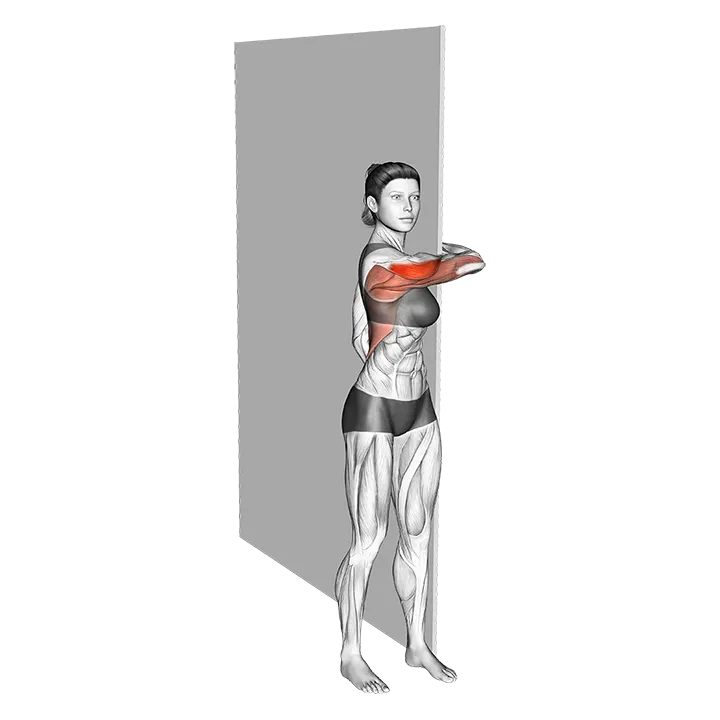
Rotation Shoulder Stretch
- Zielmuskel
- —
- Equipment
- Body weight
- Körperregion
- Shoulders
- Typ
- Stretching
Rotation Shoulder Stretch is a bodyweight mobility drill that guides the shoulder joint through controlled internal and external rotation to stretch the shoulder capsule, rotator cuff, and surrounding soft tissue. Moving slowly through the full rotational arc helps relieve chronic shoulder tightness, restore overhead range of motion, and reduce stiffness accumulated from pressing, pulling, or prolonged desk posture. It works equally well as a warm-up primer before upper-body training or as a cool-down recovery tool after a session.
Rotation Shoulder Stretch: So führst du sie aus
- 1Stand tall or sit upright with your feet shoulder-width apart and your spine neutral, keeping your core lightly engaged throughout.
- 2Raise your right arm out to the side to shoulder height and bend the elbow to ninety degrees so your forearm points straight up toward the ceiling.
- 3Keeping the elbow fixed at shoulder height, slowly rotate the shoulder internally so the forearm swings forward and downward toward the floor.
- 4Move only as far as you can without pain or compensation, and pause at the end of your available internal-rotation range for two to three seconds.
- 5Reverse the motion and rotate the shoulder externally, sweeping the forearm upward and backward until it points behind you or until you reach your end range.
- 6Hold the external-rotation end position for two to three seconds, feeling a gentle stretch across the front of the shoulder and chest.
- 7Return the forearm to the starting vertical position and repeat the full internal-to-external arc for the desired number of repetitions.
- 8Lower the arm, rest briefly, then perform the same sequence on the left side.
Technik-Tipps
- Move slowly and deliberately through each arc — a controlled tempo of two to three seconds in each direction gives the shoulder capsule time to respond and yield to the stretch.
- Keep the elbow firmly at shoulder height throughout the movement; allowing it to drop changes the joint angle and reduces the effectiveness of the rotational stretch.
- Breathe out as you move into each end-range position — a slow exhale reduces muscle tension and allows the shoulder to open a little further without force.
- Never push into pain; work only within a comfortable, pain-free range of motion and let the available range improve gradually over sessions.
- Keep the shoulder blade down and back against the ribcage rather than letting it shrug upward or wing outward, which keeps the stretch focused on the shoulder joint itself.
Häufige Fehler
- Forcing rotation past the pain-free range, which places excessive stress on the rotator cuff tendons and shoulder capsule and increases the risk of irritation or strain.
- Letting the shoulder shrug upward toward the ear during the movement, which elevates the scapula, alters the joint mechanics, and shifts the stretch away from the target tissue.
- Holding the breath while moving into end range, which increases whole-body muscle tension and actively prevents the shoulder from releasing into a deeper stretch position.
- Rushing through the rotation with momentum instead of controlled muscle effort, which bypasses the stretch stimulus entirely and provides no lasting mobility benefit.
- Allowing the elbow to drift away from shoulder height, which changes the line of pull on the shoulder capsule and reduces the precision of both internal and external rotation loading.
Häufig gestellte Fragen
What does the Rotation Shoulder Stretch target?
The exercise mobilizes the shoulder capsule and the rotator cuff — the group of muscles and tendons that surround and stabilize the shoulder joint. By guiding the joint through internal and external rotation, it stretches the soft tissue on both the front and back of the shoulder, reducing overall joint stiffness.
When is the best time to do the Rotation Shoulder Stretch?
It fits both ends of a session. Before training, two or three slow rotational sets help lubricate the shoulder joint and improve range of motion for pressing and pulling exercises. After training, it aids recovery by gently mobilizing tissue that has been loaded. Aim for five to ten repetitions per arm in each context.
How many reps and sets should I do?
Two to three sets of eight to twelve slow rotations per arm is a useful starting point. Focus on quality over volume — a single unhurried set that reaches true end range provides more benefit than multiple sets performed quickly.
Can I do this stretch if I have shoulder pain?
Work only within a pain-free range and consult a physiotherapist or sports medicine professional before using this or any shoulder mobility exercise if you have a diagnosed shoulder condition, recent injury, or sharp pain during movement. Discomfort from mild stiffness is normal; sharp, pinching, or radiating pain is a signal to stop.
Why does my shoulder click during the rotation stretch?
Occasional painless clicking or popping is common and is usually caused by tendons or soft tissue shifting over bony landmarks as the joint moves through rotation. If the clicking is accompanied by pain, catching, or instability, have the shoulder assessed by a healthcare professional before continuing.







