Seated Groin Stretch
- Equipment
- Body weight
- Körperregion
- Hips
- Typ
- Stretching

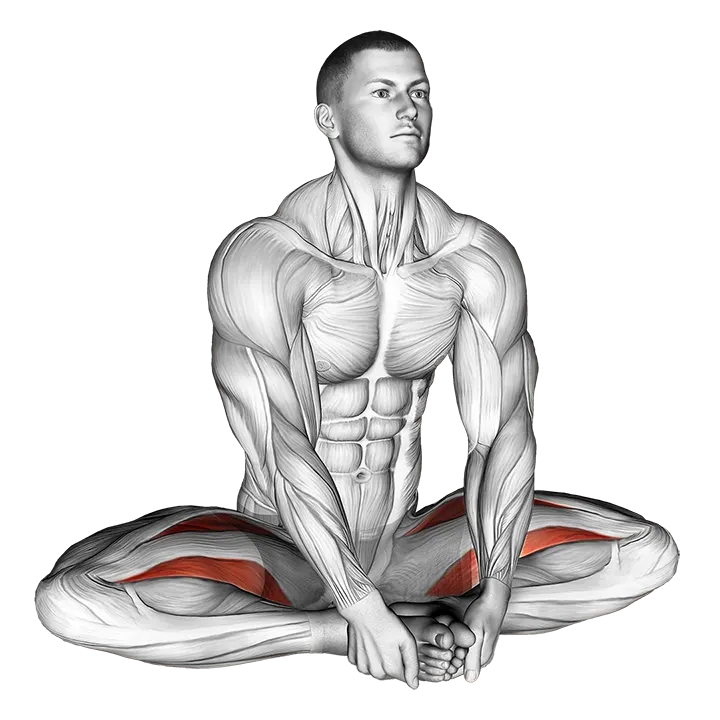
The seated groin stretch is a floor-based hip flexibility exercise that targets the inner thigh and groin muscles — adductor brevis, adductor longus, adductor magnus, and pectineus. Performed by sitting with the soles of your feet together and your knees dropped outward, it lengthens the adductors along their full range and is a reliable tool for improving hip mobility and reducing groin tightness.
Seated Groin Stretch: So führst du sie aus
- 1Sit on the floor with your spine tall. Bend both knees and bring the soles of your feet together so they touch, letting your knees fall out to the sides.
- 2Draw your heels in toward your groin until you feel a mild stretch along your inner thighs. The closer your heels are to your body, the more intense the stretch.
- 3Place your hands on your ankles or feet to keep them together, or rest them on your inner thighs.
- 4Sit up straight, lengthening your spine from the tailbone to the crown of your head. Avoid rounding your lower back.
- 5Take a slow, steady breath in. As you exhale, allow your knees to gently lower toward the floor — use gravity rather than forcing them down.
- 6If you want to deepen the stretch, hinge forward from your hips, not your waist, keeping your back flat as you lean over your feet.
- 7Hold the position for 20–60 seconds, breathing steadily throughout. You should feel the stretch in your inner thighs, not pain.
- 8To release, bring your knees back together with your hands and extend your legs slowly.
Technik-Tipps
- Sit on a folded blanket or yoga block if your hips are tight and your lower back rounds immediately — raising your hips allows your pelvis to tilt forward and your spine to stay long.
- Let gravity do the work of lowering your knees; pressing them down forcefully with your hands can strain the inner knee ligaments.
- Keep your chin level and your gaze forward while holding the stretch — craning your neck forward encourages the whole spine to round.
- Breathe slowly and steadily throughout; deliberately exhaling during the held position helps the adductors release further.
- Warm tissue stretches more effectively and with less discomfort — perform this stretch after a workout or a light warm-up rather than on a completely cold body.
Häufige Fehler
- Rounding the lower back instead of hinging at the hips — a rounded lumbar spine shifts the stretch away from the adductors and onto the lower back, reducing effectiveness and increasing spinal stress.
- Forcing the knees toward the floor with the hands or elbows — applying downward pressure puts strain on the medial knee structures rather than stretching the groin.
- Sitting with the heels too far away from the body — placing the feet far out in front reduces the adductor stretch significantly; draw the heels in close to feel the correct target.
- Bouncing or pulsing through the stretch — ballistic movement in a groin stretch can cause the adductors to contract protectively and risks a muscle strain.
- Holding the breath — breath-holding creates full-body tension that prevents the adductors from releasing; maintain slow, relaxed breathing throughout.
Häufig gestellte Fragen
How long should I hold the seated groin stretch?
Aim for 20–60 seconds per hold. Research on static stretching suggests holding for at least 30 seconds produces meaningful flexibility gains. You can repeat the hold 2–3 times per session if your schedule allows.
Is it normal for my knees to be far off the floor?
Yes, especially if your adductors are tight. The distance your knees are from the floor is simply a reflection of your current hip mobility — it has no bearing on form or safety. With consistent practice, your range will improve over weeks and months.
When is the best time to do this stretch?
After exercise, when your muscles are warm, is ideal. You can also do it after a brief warm-up such as a 5–10 minute walk. Avoid performing deep static stretches on completely cold muscles, as the tissue is less pliable and more prone to strain.
Can I do this stretch if I have a groin injury?
A mild groin strain may benefit from gentle stretching once acute pain subsides, but you should consult a physiotherapist before stretching a fresh or severe groin injury. Stretching a torn muscle too soon can delay healing.
What can I do to make the stretch easier if I feel pain in my knees?
Discomfort in the inner knee usually means your adductors are very tight and the joint is under too much stress. Move your feet farther away from your groin to reduce the angle, or sit on a folded blanket to tilt your pelvis forward. If sharp knee pain persists, stop and seek professional advice.