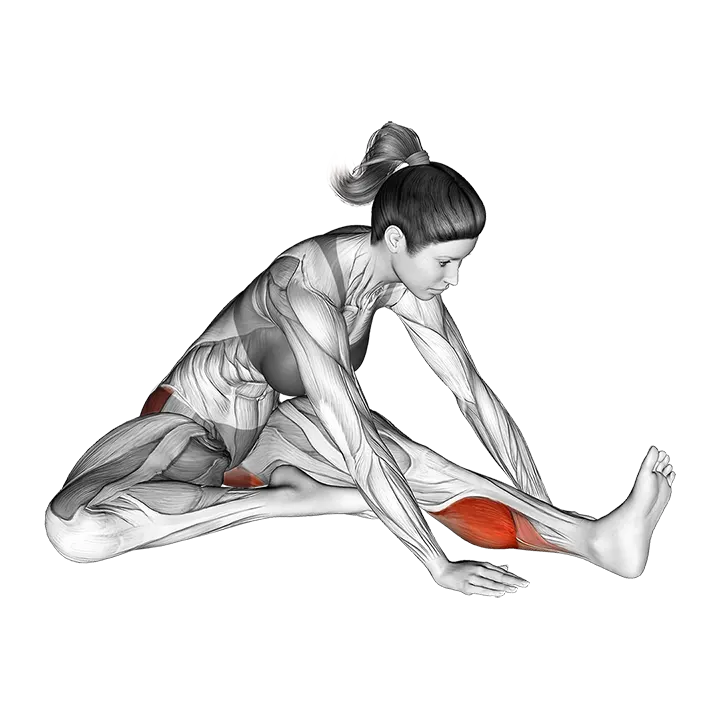
Seated Hip External Rotator And Hip Extensor Stretch
- Zielmuskel
- —
- Equipment
- Body weight
- Körperregion
- Hips
- Typ
- Stretching
The Seated Hip External Rotator And Hip Extensor Stretch is a bodyweight flexibility exercise that targets the hip external rotators — primarily the piriformis and the deep gluteal rotators — along with the hip extensors, the gluteus maximus and hamstrings. Performed in a figure-4 position on a chair or the floor, it is an effective tool for improving hip mobility and relieving tightness from prolonged sitting.
Seated Hip External Rotator And Hip Extensor Stretch: So führst du sie aus
- 1Sit toward the front edge of a sturdy chair with your feet flat on the floor and your spine tall.
- 2Lift your right ankle and place it across your left thigh, positioning it well above the knee so no lateral force is applied to the knee joint.
- 3Allow your right knee to drop toward the floor as far as your current flexibility allows — do not force it down.
- 4Rest your right hand lightly on your right knee and keep your left foot grounded. Sit tall with a long spine.
- 5Keeping your back straight and your chest lifted, hinge slowly forward from the hips until you feel a clear stretch deep in the right hip, outer glute, and the back of the thigh.
- 6Hold the position for 20–45 seconds, breathing steadily. On each exhale, allow your body to relax a little further into the stretch without forcing it.
- 7Return slowly to upright, lower your right leg, and repeat the sequence on the left side.
Technik-Tipps
- Keep your spine neutral throughout — rounding the lower back redirects tension away from the hip and into the lumbar spine, reducing the effectiveness of the stretch.
- Use your breath to deepen the position: inhale to lengthen the spine, exhale to ease a little further into the forward lean.
- Apply only gentle, downward pressure to the crossed knee with your hand; the hip external rotators are dense connective tissue and forcing the stretch risks irritating the joint.
- If your crossed knee sits very high above your thigh, place a folded towel beneath it for support and work within a comfortable range until your flexibility improves.
- Hold each side for at least 20 seconds — shorter holds provide little lasting benefit to the hip capsule and surrounding connective tissue.
Häufige Fehler
- Rounding the lower back when leaning forward — this shifts the stretch away from the hip and into the lumbar spine, reducing effectiveness and placing unnecessary stress on the lower back.
- Placing the ankle too close to or directly on the knee — this concentrates lateral shear force on the knee joint rather than creating the lever arm needed to open the hip. Always rest the ankle on the mid-thigh.
- Forcing the crossed knee down with hard pressure — aggressive overpressure on the hip external rotators can strain the piriformis or irritate the hip joint; use only gentle, sustained pressure.
- Holding the breath — breath-holding increases muscular tension throughout the body, actively working against the stretch. Breathe slowly and continuously to allow the muscles to relax.
- Cutting holds short — spending fewer than 20 seconds in the stretch is unlikely to produce meaningful change in tissue length or joint mobility; sustain each side for a full 20–45 seconds.
Häufig gestellte Fragen
What muscles does this stretch target?
It primarily stretches the hip external rotators of the crossed leg — mainly the piriformis and the other deep gluteal rotators — along with the hip extensors, the gluteus maximus and hamstrings. No synergist muscles are significantly loaded.
Can I do this stretch on the floor instead of a chair?
Yes. Sit on the floor with one leg extended or gently bent, cross the other ankle over the opposite knee into a seated figure-4 position, then lean forward from the hips. The mechanics are identical; some people find the floor version easier to hold because the pelvis sits lower and more stably.
How often should I do this stretch?
For general hip mobility, two to three sessions per day of 20–45 seconds per side is effective. Adding a session immediately after prolonged sitting is especially useful, as the hip external rotators tend to shorten and stiffen during long periods in a chair.
I feel the stretch in my knee rather than my hip — what am I doing wrong?
Your ankle is most likely resting too close to the knee joint, concentrating lateral force there instead of at the hip. Slide the ankle further up your thigh toward your hip so the lever arm is positioned correctly. If knee discomfort persists, stop and consult a healthcare provider.
Who benefits most from this stretch?
People who sit for extended periods, runners, cyclists, and anyone carrying tension in the outer hip or deep glute tend to benefit most. It is also commonly used to reduce tension in the piriformis that can contribute to sciatic nerve irritation, though it is not a substitute for professional medical advice if you have diagnosed sciatica.







