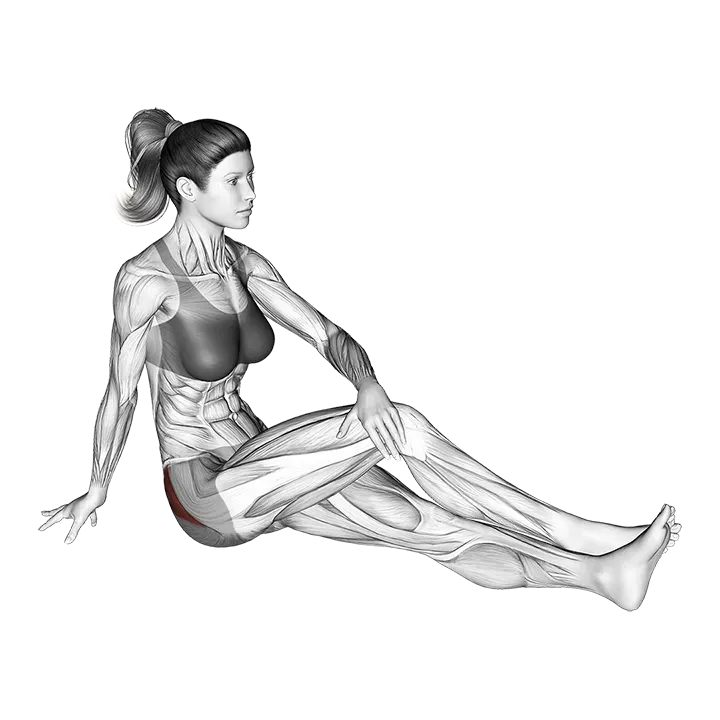
Seated Hip Stretch With Slightly Bent Leg
- Zielmuskel
- —
- Equipment
- Body weight
- Körperregion
- Hips
- Typ
- Stretching
The Seated Hip Stretch With Slightly Bent Leg is a bodyweight floor stretch that targets the muscles and connective tissue surrounding the hip joint, including the hip rotators and hip flexors. Keeping the stretching leg slightly bent rather than fully extended shifts the emphasis away from the hamstrings and into the hip itself, making it a useful mobility and recovery drill after extended sitting or lower-body training.
Seated Hip Stretch With Slightly Bent Leg: So führst du sie aus
- 1Sit on the floor with your back upright and both legs loosely extended in front of you.
- 2Bend your right knee slightly so the sole of your right foot rests flat on the floor a comfortable distance from your body, rather than locking the leg fully straight.
- 3Allow your right knee to drop gently outward so your right thigh rotates into a mild external rotation and you feel light tension in the outer hip area.
- 4Place your hands on the floor behind you or rest them on your right thigh for support, and sit tall to lengthen your spine.
- 5Take a slow breath in and, on the exhale, hinge forward from your hips — not your lower back — until you feel a distinct stretch deep in the right hip.
- 6Hold the position for 20–30 seconds, breathing slowly and allowing the hip to relax and open further with each exhale.
- 7Carefully return to the upright starting position.
- 8Repeat on the opposite side, bending your left knee slightly and following the same steps.
Technik-Tipps
- Let patient breathing do the work — allow the hip to soften and release on each exhale rather than pushing or bouncing into a deeper position.
- Keep your spine long as you hinge forward; if your lower back rounds sharply, reduce how far you lean until you build enough flexibility to go deeper with a neutral back.
- Press your supporting hand lightly into the floor to maintain balance and prevent your torso from collapsing to one side.
- Progress range gradually over multiple sessions rather than forcing maximum depth on any single attempt.
Häufige Fehler
- Rounding the lower back instead of hinging from the hip, which stretches the lumbar spine rather than the hip joint and reduces the effectiveness of the drill.
- Locking the leg fully straight, which engages the hamstrings heavily and shifts tension away from the hip rotators that the slight knee bend is specifically meant to target.
- Holding your breath, which keeps the surrounding musculature tense and prevents the hip from relaxing into the stretch.
- Bouncing or forcing a deeper position, which triggers a protective reflex in the muscle tissue and can cause a strain.
- Letting the knee of the stretching leg collapse inward instead of allowing it to rest in gentle external rotation, which reduces the stretch on the hip rotators.
Häufig gestellte Fragen
What muscles does the Seated Hip Stretch With Slightly Bent Leg work?
The stretch targets the muscles surrounding the hip joint, including the hip rotators and hip flexors. Keeping the knee slightly bent reduces hamstring tension so the stretch can focus on the hip itself rather than the back of the thigh.
Why keep the leg slightly bent instead of fully straight?
A fully extended leg places the hamstrings on significant stretch, which can mask or limit the sensation in the hip. A slight bend in the knee reduces hamstring involvement and allows you to direct the stretch more precisely into the hip rotators and hip flexors.
How long should I hold this stretch?
Hold each side for 20–30 seconds and repeat 2–3 times per side. For persistent hip tightness, holding up to 60 seconds can be beneficial as long as you stay within a comfortable range.
Is this stretch good for people who sit at a desk for long periods?
Yes. Prolonged sitting shortens the hip flexors and restricts hip rotation over time. This stretch helps restore range of motion in the hip, which can ease discomfort in the hips and lower back associated with extended sitting.
Should I do this stretch before or after a workout?
It is most effective as a post-workout cool-down or standalone mobility drill, since sustained static holds are generally better suited to relaxed tissue. A shorter hold of 10–15 seconds is acceptable as part of a gentle warm-up if needed.







