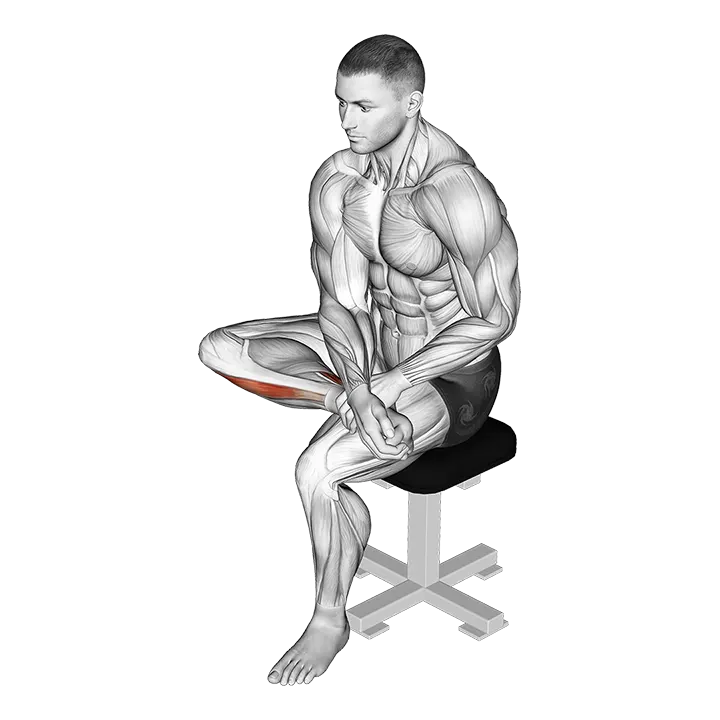
Seated Toe Flexor And Foot Everter Stretch
- Zielmuskel
- —
- Equipment
- Body weight
- Körperregion
- Calves
- Typ
- Stretching
The seated toe flexor and foot everter stretch is a bodyweight calf and lower-leg flexibility exercise performed in a seated position. It simultaneously lengthens the toe flexors (flexor digitorum longus/brevis) that curl the toes under, and the foot everters (peroneus longus/brevis) that roll the foot outward. It is well-suited for relieving tightness in the lower leg and improving ankle mobility.
Seated Toe Flexor And Foot Everter Stretch: So führst du sie aus
- 1Sit upright on a chair or flat surface with both feet flat on the floor and your spine tall.
- 2Cross one ankle over the opposite knee so that the outer edge of your foot faces upward.
- 3Rest the crossed foot in your hands, gripping lightly around the midfoot for control.
- 4Use your fingers to gently curl the toes downward and inward (plantarflex and invert) to lengthen the toe flexors along the sole of the foot.
- 5At the same time, tilt the sole of the foot upward and inward (inversion) to stretch the foot everters along the outer ankle and lower leg.
- 6Hold the combined stretch for 20–30 seconds, breathing steadily and allowing the muscles to relax.
- 7Release slowly and repeat on the opposite foot.
Technik-Tipps
- Sit tall with a neutral spine — rounding forward reduces your ability to stabilise the crossed leg and decreases the stretch quality.
- Apply the stretch gently and progressively; these small muscles of the foot and ankle are sensitive to overpressure.
- Focus on feeling the pull along the outer ankle (peroneal region) and the sole of the foot simultaneously — if you only feel one area, adjust the foot position slightly.
- Breathe out as you deepen the stretch; exhaling helps the muscles relax and allows a greater range of motion.
Häufige Fehler
- Forcing the toes aggressively rather than applying steady, controlled pressure, which can strain the small joints of the foot and toes.
- Neglecting the eversion component and only stretching the toe flexors, which misses the peroneal muscles and defeats the purpose of the combined stretch.
- Holding the breath or tensing the leg, which prevents the target muscles from releasing into the stretch.
- Rushing through the hold — spending fewer than 20 seconds limits the neurological relaxation response needed for effective flexibility gains.
Häufig gestellte Fragen
What muscles does the seated toe flexor and foot everter stretch target?
It targets the toe flexor muscles (primarily flexor digitorum longus and brevis along the sole and lower leg) and the foot everter muscles (peroneus longus and brevis along the outer lower leg and ankle). Together these muscles control toe curling and outward rolling of the foot.
Who benefits most from this stretch?
People who experience tightness along the outer ankle or sole of the foot, runners, and those recovering from ankle sprains often benefit most. It is also useful for improving general ankle mobility and reducing calf fatigue.
How long should I hold the stretch?
Hold each side for 20–30 seconds and repeat 2–3 times per foot. This duration is generally sufficient to trigger the muscle relaxation response and make meaningful progress in flexibility.
Can I do this stretch if I have had an ankle sprain?
Light, pain-free stretching of the peroneals is often incorporated in ankle sprain rehabilitation, but you should consult a healthcare professional before stretching a recently injured ankle to ensure the tissues are ready for the load.
Is any equipment needed?
No equipment is needed — just a chair or any stable surface to sit on. The stretch is performed entirely with your own hands guiding the foot, making it easy to do anywhere.







