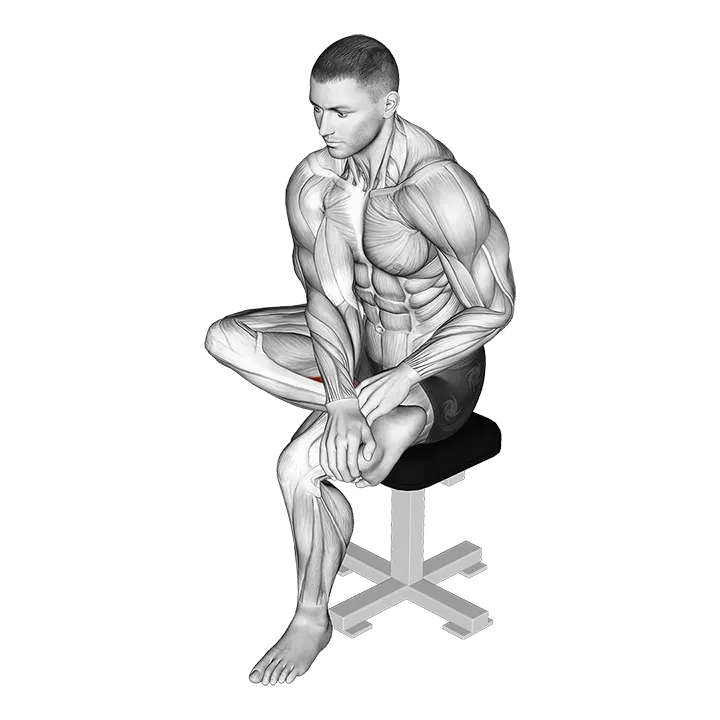
Seated Toe Flexor And Foot Inverter Stretch
- Zielmuskel
- —
- Equipment
- Body weight
- Körperregion
- Calves
- Typ
- Stretching
The Seated Toe Flexor And Foot Inverter Stretch is a bodyweight flexibility exercise that lengthens the toe flexors — flexor digitorum longus and flexor hallucis longus — along the back of the lower leg, as well as the foot invertors, primarily the tibialis posterior. Performed seated, it eases tightness in the calf and foot structures that can contribute to cramping, reduced ankle mobility, and discomfort during activities that require toe extension and foot eversion.
Seated Toe Flexor And Foot Inverter Stretch: So führst du sie aus
- 1Sit upright on a bench or sturdy chair with both feet flat on the floor and your hands resting on your thighs.
- 2Cross your right ankle over your left knee so the sole of your right foot faces outward and you have clear access to your toes.
- 3Wrap the fingers of your right hand around your right toes and the ball of the foot.
- 4With your left hand, hold your right ankle steady to keep the lower leg from rotating.
- 5Gently pull your toes upward toward your shin — dorsiflexing them — while simultaneously turning the sole of your foot outward, away from the midline of your body (eversion).
- 6Hold this combined position for 20–30 seconds, breathing steadily and allowing the stretch to deepen on each exhale.
- 7Slowly release your toes back to a neutral position without letting them snap back.
- 8Repeat on the left foot by crossing your left ankle over your right knee and performing the same movement.
- 9Complete 2–3 holds per foot per session.
Technik-Tipps
- Move slowly into both the toe dorsiflexion and foot eversion at the same time — combining the two motions produces a fuller stretch of the toe flexors and invertors than either direction alone.
- Keep your torso upright throughout; rounding the back reduces your control over the foot and makes it harder to feel where the stretch is occurring.
- If you cannot reach your toes comfortably, loop a towel or resistance band around the ball of the foot and use that to draw the toes back.
- Breathe out as you deepen the stretch — relaxing on the exhale allows the muscles to lengthen more effectively than forcing the position.
- Do not push into pain; a strong pulling sensation along the calf and sole is expected, but sharp or pinching pain in the toes or ankle is a signal to reduce the range.
Häufige Fehler
- Pulling only the toes without everting the foot: Dorsiflexing the toes alone incompletely stretches the toe flexors and misses the foot invertors entirely, reducing the effectiveness of the exercise.
- Forcing the stretch too aggressively: Yanking the toes into end-range immediately can cause the muscles to reflexively contract as a protective response, working against the goal of lengthening them.
- Letting the ankle roll inward during the hold: Internal rotation of the ankle negates the eversion component and shifts tension away from the tibialis posterior toward other structures.
- Holding the breath: Breath-holding increases overall body tension and prevents the calf and sole muscles from relaxing into the stretch, shortening its effect.
- Releasing the toes abruptly at the end of each hold: Letting go suddenly can produce a brief cramp or snap in the toe flexors; always release gradually back to a neutral position.
Häufig gestellte Fragen
What muscles does the Seated Toe Flexor And Foot Inverter Stretch target?
The stretch primarily lengthens the toe flexors — flexor digitorum longus and flexor hallucis longus, which run along the back of the lower leg and curl the toes — along with the foot invertors, particularly the tibialis posterior. These muscles are stretched by pulling the toes upward (dorsiflexion) and turning the sole outward (eversion) simultaneously.
When is a good time to do this stretch?
This stretch is most effective after exercise, when muscles are warm and more pliable. It is useful after running, cycling, or any activity that keeps the toes and foot in a plantarflexed or inverted position for extended periods. It can also be performed in the morning if you experience foot stiffness or cramping after waking.
How long should I hold the Seated Toe Flexor And Foot Inverter Stretch?
Hold each repetition for 20–30 seconds to allow the muscle spindles to relax and the tissue to genuinely lengthen. Aim for 2–3 holds per foot. Shorter holds under 15 seconds are generally not long enough to produce meaningful changes in flexibility over time.
Can this stretch help with foot cramps or plantar tightness?
Yes. Tightness in the toe flexors and foot invertors is a common contributor to cramping along the sole and arch. Regularly stretching these muscles can reduce the frequency and intensity of cramps, particularly those that occur at night or during exercise. If cramps are severe or persistent, discuss them with a healthcare professional to rule out underlying causes.
What is the difference between this stretch and the toe extensor and foot everter stretch?
The two stretches are complementary opposites. This stretch dorsiflexes the toes and everts the foot to lengthen the toe flexors and foot invertors on the back and medial side of the lower leg. The toe extensor and foot everter stretch does the reverse — plantarflexing the toes and inverting the foot — to target the toe extensors and foot evertors on the front and lateral side.







