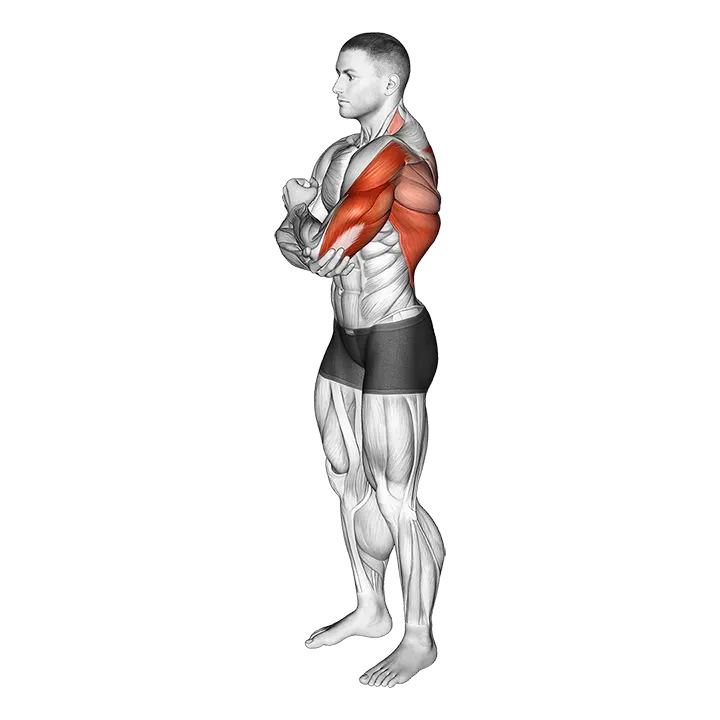
Shoulder Adductor Protractor And Elevator Stretch
- Zielmuskel
- —
- Equipment
- Body weight
- Körperregion
- Shoulders
- Typ
- Stretching
The Shoulder Adductor Protractor And Elevator Stretch is a compound shoulder mobility movement that combines arm adduction, shoulder protraction, and shoulder elevation into a single stretch. It targets the muscles around the shoulder girdle responsible for drawing the arm across the body, rounding the shoulder forward, and shrugging upward. It is well suited for improving shoulder flexibility, relieving tension from prolonged sitting, and as a warm-up or cool-down for upper-body training.
Shoulder Adductor Protractor And Elevator Stretch: So führst du sie aus
- 1Stand or sit tall with your spine neutral and feet shoulder-width apart.
- 2Raise one arm to approximately shoulder height and draw it horizontally across your chest toward the opposite shoulder (adduction).
- 3Use your opposite forearm or hand to gently press the stretching arm closer to your chest, deepening the adduction.
- 4While holding that position, allow the shoulder of the stretching arm to round forward slightly (protraction) — do not rotate your torso to achieve this.
- 5With the arm still held across your chest, gently shrug that shoulder upward toward your ear (elevation) to add the third component of the stretch.
- 6Hold the combined position — arm across chest, shoulder protracted and elevated — for 20 to 30 seconds.
- 7Breathe steadily throughout; exhale to relax deeper into the stretch on each breath.
- 8Release slowly and lower the arm back to your side.
- 9Repeat on the other side for equal time.
Technik-Tipps
- Keep your neck long and your chin level — avoid letting your head tilt toward the elevated shoulder, which compresses the neck rather than stretching the shoulder.
- Apply gentle, steady pressure with the assisting forearm rather than a sharp pull; the shoulder girdle responds better to sustained low-force tension.
- Think of the three actions as a sequence you stack: adduct first, then protract, then elevate — layering them helps you feel each component distinctly.
- If you cannot feel the stretch, try dropping the opposite hip slightly away from the stretching side to remove any compensatory torso lean.
- Perform the stretch bilaterally even if only one side feels tight — asymmetry in shoulder mobility often contributes to posture and movement problems.
Häufige Fehler
- Rotating the torso to pull the arm further across the chest — this creates the appearance of a deeper stretch but shifts the load away from the shoulder and into the spine.
- Holding the breath — breath-holding increases muscular tension throughout the upper body and prevents the shoulder from relaxing into the stretch.
- Jerking or bouncing the arm to increase range — ballistic movement triggers a protective muscle reflex that tightens the very tissues you are trying to lengthen.
- Elevating with a side neck tilt instead of a true shoulder shrug — tilting the neck compresses cervical structures and removes the elevation component from the shoulder girdle.
- Skipping the protraction component and only adducting the arm — omitting protraction leaves the rear-shoulder and upper-back portion of the stretch largely untouched.
Häufig gestellte Fragen
What is the difference between shoulder adduction, protraction, and elevation in this stretch?
Adduction means drawing the arm across the body toward the midline. Protraction means pushing the shoulder blade forward and around the rib cage, which rounds the shoulder. Elevation means shrugging the shoulder upward toward the ear. This stretch combines all three motions to address the muscles responsible for each action simultaneously.
How long should I hold this stretch?
Hold the position for 20 to 30 seconds per side. For general flexibility maintenance, one to two sets per side is sufficient. If you are working through chronic shoulder tightness, two to three sets held for up to 45 seconds can be more effective, provided you feel a comfortable tension rather than pain.
Can I do this stretch at a desk during the workday?
Yes. This stretch requires no equipment and can be performed seated in a standard chair. It is particularly useful for breaking up extended periods of typing or mouse use, which tend to chronically protract and elevate the shoulders under load, shortening the surrounding muscles over time.
Is this stretch safe if I have a shoulder injury?
If you have an existing shoulder impingement, rotator cuff issue, or AC joint problem, consult a physiotherapist before attempting this stretch. The combined adduction and elevation components can increase intra-shoulder pressure in certain conditions. In general, the stretch should produce a feeling of tension, not sharp or pinching pain.
Should I do this stretch before or after a workout?
Both are appropriate, with slightly different goals. Before a workout, perform it with shorter holds of 10 to 15 seconds to increase shoulder range of motion without reducing muscle activation. After a workout, longer holds of 30 to 45 seconds are better suited for releasing accumulated tension and supporting longer-term flexibility gains.







