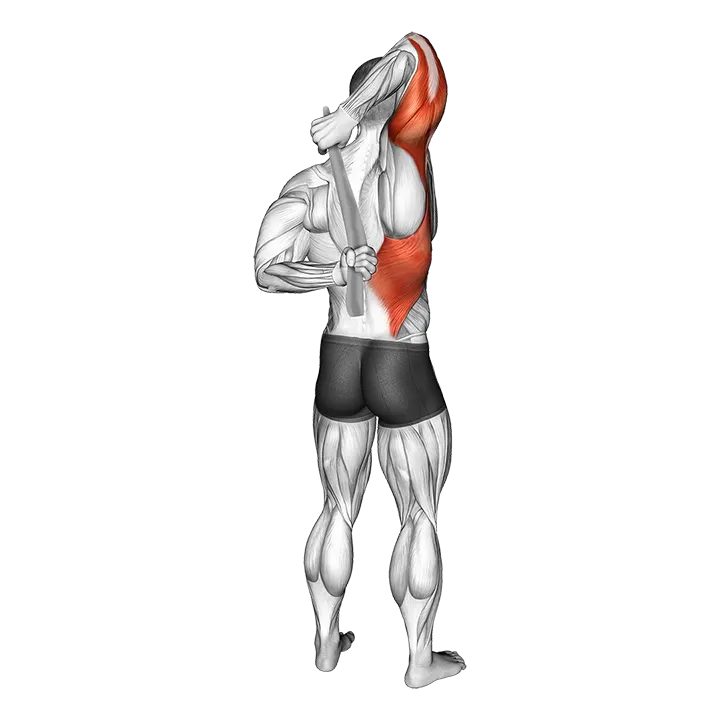
Shoulder Stretch With Towel Behind The Back
- Zielmuskel
- —
- Equipment
- Body weight
- Körperregion
- Shoulders
- Typ
- Stretching
The Shoulder Stretch With Towel Behind The Back is a standing mobility drill that uses a towel as a grip aid to deepen the stretch across the posterior shoulder and rotator cuff area on both sides. One hand reaches down from overhead while the other reaches up from the lower back, with gentle pulling to increase range of motion. It is commonly used in warm-ups, cool-downs, and shoulder mobility routines to address tightness and improve internal and external rotation.
Shoulder Stretch With Towel Behind The Back: So führst du sie aus
- 1Stand tall with your feet shoulder-width apart and hold one end of a towel in your right hand.
- 2Raise your right arm overhead and bend the elbow so your right hand hangs down behind your head, holding the towel.
- 3Reach your left arm behind your lower back and bend the elbow so your left hand reaches upward to grasp the other end of the towel.
- 4Adjust your grip so both hands hold the towel with a comfortable gap between them.
- 5Gently pull downward with your left hand to increase the stretch on your right shoulder, holding for two to three seconds.
- 6Then gently pull upward with your right hand to increase the stretch on your left shoulder, holding for two to three seconds.
- 7Continue alternating the direction of the pull for the desired number of repetitions, or hold the stretch for 20 to 30 seconds per side.
- 8Switch which arm is overhead and which is at the lower back, then repeat the sequence on the opposite side.
Technik-Tipps
- Keep your torso upright and avoid leaning to one side; a neutral spine lets the stretch target the shoulder rather than the trunk.
- Use slow, controlled pulls on the towel rather than jerking movements to protect the shoulder joint and surrounding tissue.
- If your hands can nearly meet without the towel, use a shorter section of towel to progressively challenge your range of motion over time.
- Breathe steadily and exhale as you deepen each pull to help the muscles relax into the stretch.
- Work within a range that produces mild tension, not pain; sharp or pinching sensations in the shoulder are a signal to ease off.
Häufige Fehler
- Pulling too aggressively: Yanking hard on the towel can strain the shoulder joint and surrounding soft tissue rather than producing a productive stretch.
- Allowing the elbow to drift forward: Letting the overhead elbow flare in front of the head reduces tension in the intended shoulder area; keep it pointing directly upward.
- Holding the breath: Breath-holding increases muscular tension and limits how deeply the shoulder can relax into the stretch.
- Skipping the weaker side: Most people have one shoulder that is significantly tighter; stopping early on that side prevents meaningful progress in symmetry.
- Rounding the upper back: Slumping forward compresses the shoulder and reduces the effectiveness of the stretch; maintain an upright posture throughout.
Häufig gestellte Fragen
What does the towel do in this stretch?
The towel bridges the gap between your two hands when your shoulder flexibility does not yet allow them to meet behind your back. It lets you apply controlled pulling force to increase the stretch on the upper shoulder without forcing the joint beyond its current range.
How long should I hold the stretch?
Aim for 20 to 30 seconds per side when holding statically, or perform slow alternating pulls for a similar total duration. Repeat two to three times on each side for a thorough mobility session.
Can this stretch help with shoulder tightness from desk work?
Yes. Prolonged sitting often leads to restricted shoulder rotation and tightness across the posterior shoulder. Performing this stretch regularly can help counteract those effects by improving internal and external rotation range of motion.
How do I know which arm should go overhead?
Start with your dominant or tighter arm overhead, as that position typically produces a more intense stretch on the shoulder of the raised arm. After completing your sets, switch arms so both sides receive equal attention.
Is this stretch safe if I have a previous shoulder injury?
If you have a history of shoulder injury, consult a healthcare or physiotherapy professional before performing this stretch. The pulling motion can place stress on structures that may still be healing, and a professional can advise on appropriate modifications.







