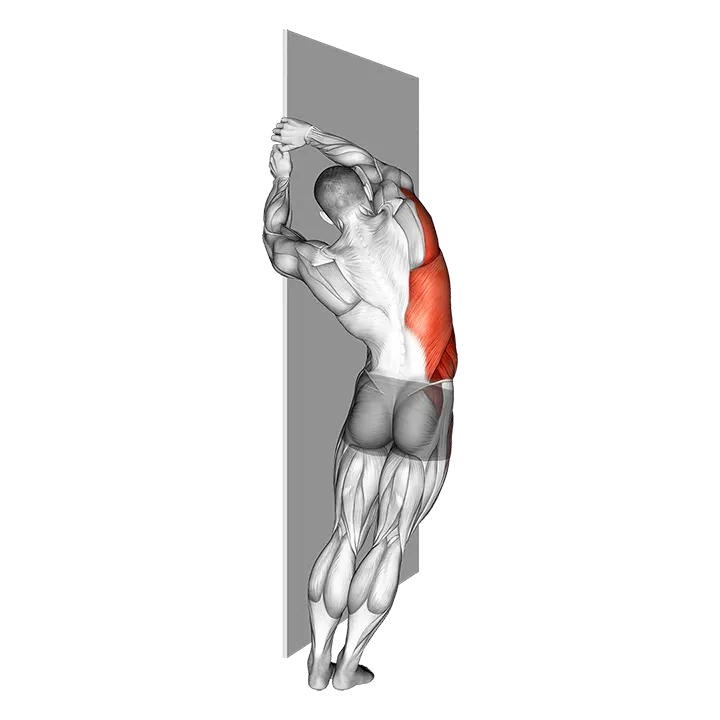
Side Lat Stretch
- Zielmuskel
- —
- Equipment
- Body weight
- Körperregion
- Back
- Typ
- Stretching
The Side Lat Stretch is a bodyweight stretching exercise that targets the latissimus dorsi and the entire side of the back. By reaching one arm overhead and leaning away, it lengthens the lats and intercostal muscles along the ribcage. It is ideal for reducing upper-back tightness, improving thoracic mobility, and warming up or cooling down after pulling movements.
Side Lat Stretch: So führst du sie aus
- 1Stand with your feet shoulder-width apart and your spine tall.
- 2Raise your right arm straight overhead, keeping your bicep close to your ear.
- 3Place your left hand on your hip or thigh for support.
- 4Take a deep breath in, then exhale as you lean your torso slowly to the left.
- 5Keep your hips square and both feet firmly planted on the floor.
- 6Continue leaning until you feel a strong but comfortable stretch along the right side of your back and ribcage.
- 7Hold the position for 20–30 seconds, breathing steadily throughout.
- 8Slowly return to the upright starting position on an inhale.
- 9Lower your right arm, then repeat the stretch on the opposite side.
Technik-Tipps
- Keep your core lightly engaged throughout the stretch to protect your lower back from over-extending.
- Allow your breath to deepen the stretch — each exhale gives you a chance to lean slightly further.
- Think of reaching your fingertips away from your hip rather than simply leaning sideways to maximise lat elongation.
- Keep both feet flat on the ground; letting a heel rise indicates the hips are rotating out of alignment.
- Move into the stretch gradually — avoid dropping into the side bend all at once, as this can cause straining.
Häufige Fehler
- Letting the hips shift sideways: shifting the hips to the opposite side reduces the stretch on the lats and places unnecessary stress on the lower back.
- Rounding the shoulder of the raised arm: a collapsed shoulder shortens the range of motion and prevents a full lat stretch — keep the arm straight and the shoulder open.
- Holding the breath: breath-holding increases tension throughout the body and limits how far you can comfortably stretch.
- Leaning forward instead of directly to the side: a forward lean shifts the stretch away from the lats and into the lower back, reducing effectiveness.
- Rushing through the hold: bouncing or cutting the hold short does not allow the muscle to relax into the elongated position, diminishing flexibility gains.
Häufig gestellte Fragen
What muscles does the Side Lat Stretch work?
The Side Lat Stretch primarily targets the latissimus dorsi — the broad muscle that runs down the sides of the back — along with the intercostals and the muscles of the side body. It helps relieve tightness throughout the entire lateral chain from the hip to the armpit.
When should I do the Side Lat Stretch — before or after a workout?
The Side Lat Stretch is best performed after a workout as part of a cool-down routine, when muscles are warm and most receptive to lengthening. A gentle version can also be included in a dynamic warm-up before pulling exercises such as pull-ups or rows.
How long should I hold the Side Lat Stretch?
Aim to hold each side for 20–30 seconds per repetition. Performing 2–3 repetitions per side gives enough time under stretch for meaningful flexibility improvements over time.
Can the Side Lat Stretch help with back pain?
For many people, tight lats can contribute to poor posture and upper-back discomfort, and the Side Lat Stretch can help alleviate that tightness. However, if you experience sharp or persistent back pain, consult a healthcare professional before continuing.
Can I do the Side Lat Stretch while seated?
Yes. The stretch can be performed seated on a chair or on the floor, making it accessible if you have balance concerns or limited mobility. Sit tall, raise one arm overhead, and lean gently to the opposite side just as you would standing.







