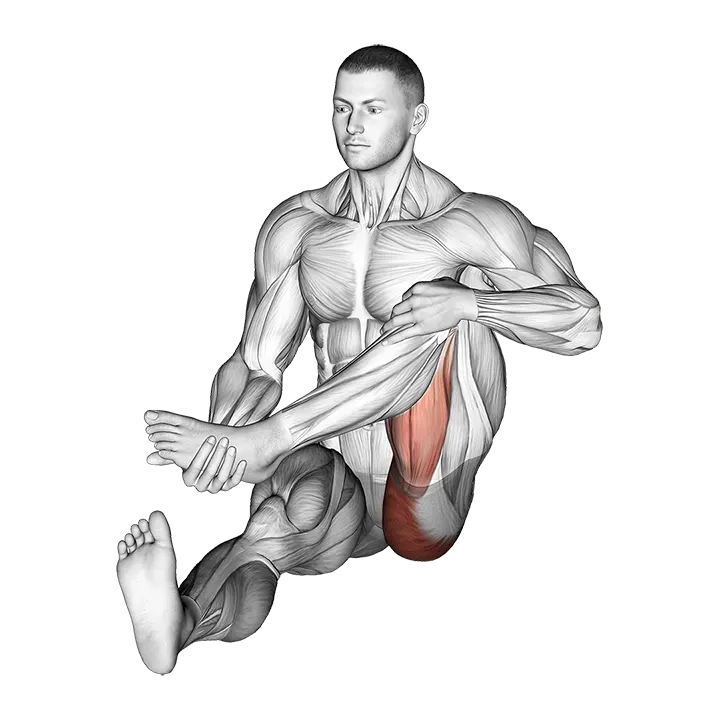
Sitting Foot To Chest Buttocks Stretch
- Zielmuskel
- —
- Equipment
- Body weight
- Körperregion
- Hips
- Typ
- Stretching
The sitting foot to chest buttocks stretch is a seated floor stretch that targets the glutes, piriformis, and hip external rotators. By drawing one foot up toward your chest while keeping your spine tall, you lengthen the deep muscles of the buttocks and outer hip that tighten from prolonged sitting, running, or lower-body training. It requires no equipment and is suitable for all fitness levels.
Sitting Foot To Chest Buttocks Stretch: So führst du sie aus
- 1Sit on the floor with both legs extended straight in front of you and your spine upright.
- 2Bend your right knee and lift your right foot off the floor, cradling the leg with both hands — place one hand under the ankle and one hand under the knee.
- 3Gently draw your right knee and foot toward your chest, keeping your left leg flat on the floor.
- 4Hold your foot and shin close to your chest to the point of a comfortable stretch in the right buttock and outer hip — do not force the range.
- 5Sit tall throughout: do not round your lower back or collapse your shoulders forward.
- 6Breathe slowly and steadily, allowing the stretch to deepen naturally with each exhale.
- 7Hold the position for 20–45 seconds, then gently lower your right leg back to the floor.
- 8Repeat the stretch on the left side, holding for the same duration.
- 9Perform 2–3 rounds per side as needed.
Technik-Tipps
- Exhale fully as you draw the foot closer to your chest — the release of breath naturally relaxes the hip muscles and allows a deeper stretch without forcing.
- Keep your seated leg's heel in contact with the floor and your toes pointing toward the ceiling to stabilise your pelvis during the stretch.
- Aim for a 20–45 second hold per side; stretches held fewer than 20 seconds have minimal impact on muscle length.
- To deepen the stretch, sit taller rather than pulling harder — lengthening the spine reduces pelvic tilt and exposes more range in the glute and piriformis.
- If your lower back rounds as you draw the foot up, sit on a folded blanket or yoga block to tilt the pelvis slightly forward and make an upright position easier to maintain.
Häufige Fehler
- Rounding the lower back to pull the foot higher — this shifts tension away from the glutes onto the lumbar spine and can cause lower-back discomfort instead of a productive hip stretch.
- Forcing the foot aggressively toward the chest — overpressuring the hip joint or piriformis can irritate the joint capsule; ease into the end range and let time do the work.
- Holding the breath — breath-holding increases overall body tension and prevents the hip muscles from releasing; breathe slowly and continuously throughout the hold.
- Letting the non-stretching leg rotate outward — allowing the resting leg to roll to the side destabilises the pelvis and reduces the effectiveness of the stretch on the target side.
- Holding for only a few seconds — brief holds produce little lasting change in tissue length; commit to at least 20 seconds per side to accumulate meaningful stretch stimulus.
Häufig gestellte Fragen
How long should I hold the sitting foot to chest buttocks stretch?
Hold each side for 20–45 seconds per repetition. For general mobility maintenance, two rounds per side is sufficient. If you are targeting chronic hip tightness, three rounds of 45 seconds with a brief rest between rounds is more effective.
When is the best time to do this stretch?
This stretch is best performed after a workout, as part of a cool-down, when the muscles are warm. It can also be done in the morning or during long periods of desk work to counter hip tightness from sitting. Avoid performing it as a cold warm-up before intense activity.
Who benefits most from the sitting foot to chest buttocks stretch?
Anyone who sits for extended periods, runners, cyclists, and people recovering from lower-back or hip tightness benefit greatly. It is also useful for individuals working to improve hip external rotation for activities like squatting, yoga, or martial arts.
What muscles does this stretch target?
The primary muscles stretched are the gluteus maximus, gluteus medius, piriformis, and the other hip external rotators (obturators, gemelli, quadratus femoris). Together these make up the deep buttock and outer-hip musculature.
Are there alternatives if I cannot sit upright on the floor?
Yes — the supine knee-to-chest stretch (lying on your back and hugging one knee to your chest) targets the same muscles with less demand on core stability and hamstring flexibility. Sitting on a chair and placing one ankle on the opposite knee (figure-four stretch) is another accessible option.







