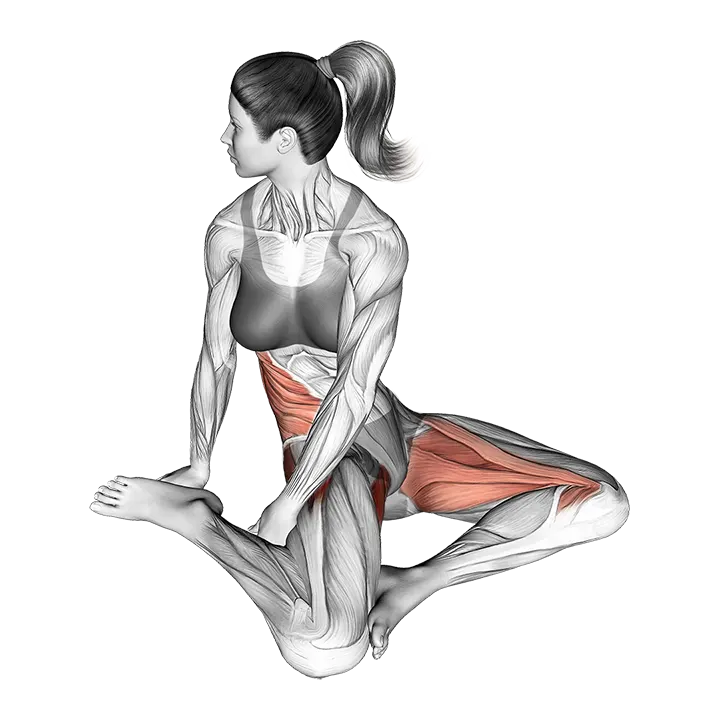
Sitting Rotational Hip Stretch
- Zielmuskel
- —
- Equipment
- Body weight
- Körperregion
- Hips
- Typ
- Stretching
The sitting rotational hip stretch is a bodyweight flexibility exercise that targets the hip rotators and surrounding hip musculature through a controlled rotational movement performed from a seated position. It is well suited for improving hip mobility, reducing stiffness from prolonged sitting, and preparing the hips for athletic activity.
Sitting Rotational Hip Stretch: So führst du sie aus
- 1Sit upright on the floor with your legs extended in front of you, hands resting lightly behind your hips for support.
- 2Bend your right knee and place your right foot flat on the floor outside your left knee, so the right leg crosses over the left.
- 3Sit tall through your spine, keeping your chest lifted and your weight evenly distributed through both sitting bones.
- 4Slowly rotate your torso to the right, placing your left elbow against the outside of your right knee to guide the movement.
- 5Use the contact between your elbow and knee as a gentle lever to deepen the rotational stretch in the right hip — do not force it.
- 6Hold the end position for 20–30 seconds, breathing slowly and allowing the hip to relax further with each exhale.
- 7Release the rotation, uncross your leg, and return to the starting position.
- 8Repeat the sequence on the opposite side, crossing the left foot outside the right knee and rotating to the left.
Technik-Tipps
- Keep your spine tall throughout the stretch — rounding the lower back shifts the stretch away from the hip and into the lumbar spine.
- Let your exhales drive progressive relaxation into the hip rather than forcing depth through muscular effort.
- Press your sitting bones evenly into the floor; allowing one hip to lift reduces the effectiveness of the rotational stretch.
- Use your supporting hand behind you only for light balance, not to prop yourself up, so your core stays engaged.
Häufige Fehler
- Rounding the lower back during the rotation, which loads the lumbar spine rather than mobilising the hip rotators.
- Forcing the knee down toward the floor instead of allowing the hip to open gradually, which can strain the knee joint.
- Holding the breath, which increases muscular tension and prevents the hip from releasing into the stretch.
- Letting the supporting hip lift off the floor, which reduces the rotational demand on the target hip and shortens the effective stretch.
Häufig gestellte Fragen
What muscles does the sitting rotational hip stretch target?
The stretch primarily targets the hip rotators — including the piriformis and deep external rotators — along with the hip flexors and the surrounding musculature of the hip joint. No specific synergist muscles are isolated, but the movement mobilises the hip capsule as a whole.
Is the sitting rotational hip stretch suitable for beginners?
Yes. It requires no equipment and can be performed on any flat surface. Beginners may find it easier to sit on a folded blanket to elevate the hips slightly, which reduces the demand on hip flexibility and makes it easier to maintain an upright spine.
How long should I hold each side?
Hold each side for 20–30 seconds and perform 2–3 repetitions per side. For general mobility work, one round per side is sufficient as part of a warm-up; for a dedicated stretching session, 2–3 rounds allow deeper release.
When is the best time to do this stretch?
It can be performed as part of a warm-up before lower-body training, as a cool-down after exercise, or throughout the day to counteract prolonged sitting. Avoid performing it as the very first movement of a session on cold muscles — a brief walk or light movement beforehand is recommended.
What are good alternatives if this stretch is too uncomfortable?
The supine figure-four stretch (lying on your back with one ankle crossed over the opposite knee) works the same hip rotators with less demand on spinal mobility and balance, making it a useful regression for those with tight hips or lower-back sensitivity.







