
Spinal Stretch (on stability ball)
- Equipment
- Stability ball
- Körperregion
- Waist
- Typ
- Stretching

The spinal stretch on a stability ball is a mobility exercise that targets the erector spinae, obliques, and rectus abdominis by draping the torso over the ball to decompress and lengthen the entire spine. The unstable surface allows a deeper, more passive stretch than floor-based alternatives. It is an effective cool-down or warm-up movement for relieving lower back tension and improving spinal flexibility.
Spinal Stretch (on stability ball): So führst du sie aus
- 1Place a stability ball on a flat, non-slip surface and kneel or stand just behind it.
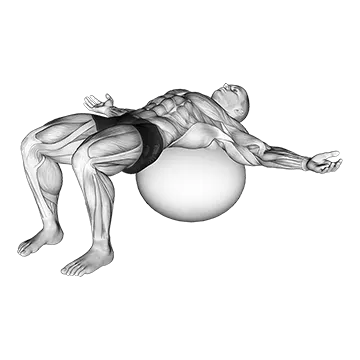
- 2Sit on the floor or on your heels in front of the ball, then lean back and drape your mid-back over the top of the ball so your spine curves around its surface.
- 3Walk your feet slightly forward until the ball rests comfortably under your mid-to-lower back and your hips drop toward the floor.
- 4Allow your arms to fall open to the sides or extend them overhead to deepen the stretch along the obliques and rectus abdominis.
- 5Let gravity gently pull your head, shoulders, and hips downward, elongating the spine over the curve of the ball.
- 6Breathe deeply and slowly, releasing tension with each exhale and allowing the stretch to deepen gradually.
- 7Hold the position for 20–60 seconds, or as long as comfortable, then carefully roll to one side to dismount the ball.
Technik-Tipps
- Keep your feet flat on the floor and hip-width apart throughout the stretch for a stable base that prevents the ball from rolling.
- Relax your neck completely — let your head fall back naturally rather than holding tension in the cervical spine.
- Breathe slowly and deeply; exhaling fully helps the core musculature release, allowing a progressively deeper stretch with each breath.
- Progress the stretch gradually — do not force your back into a deeper curve than is comfortable, especially if you have a history of back issues.
- Keep the movement slow when mounting and dismounting the ball to avoid losing control of the unstable surface.
Häufige Fehler
- Placing the ball too high on the upper back, which limits lower-back decompression and reduces the stretch on the erector spinae.
- Tensing the core or holding the breath, which prevents the abdominals and obliques from lengthening and shortens the effective stretch.
- Using a ball that is too large or too small — an incorrectly sized ball changes the angle of spinal extension and can create discomfort rather than relief.
- Rushing into or out of the position, which on an unstable surface can cause the ball to roll and lead to a fall.
- Forcing extreme extension beyond a comfortable range, which can compress spinal facets and increase rather than relieve back discomfort.
Häufig gestellte Fragen
What muscles does the spinal stretch on a stability ball target?
The stretch primarily targets the erector spinae (the muscles running alongside the spine), the obliques (side of the waist), and the rectus abdominis (front of the abdomen). Together these form the waist musculature that is lengthened as the spine extends over the curve of the ball.
How long should I hold the spinal stretch on a stability ball?
Aim for 20–60 seconds per hold. Holding longer allows the muscles to relax progressively with each breath. You can repeat the stretch 2–3 times in a session, especially as a cool-down after a workout that loads the lower back.
Is the spinal stretch on a stability ball safe for people with lower back pain?
For many people, gentle spinal extension on a stability ball provides relief from lower back tightness. However, anyone with a herniated disc, spinal stenosis, or acute back injury should consult a healthcare professional before attempting this stretch, as passive extension may aggravate certain conditions.
What size stability ball should I use?
A ball sized to your height is generally recommended — typically a 55 cm ball for heights up to 5'5" (165 cm), a 65 cm ball for 5'5"–6'0" (165–183 cm), and a 75 cm ball for taller individuals. The goal is for your knees to be at roughly a 90° angle when seated on the ball.
When is the best time to include this stretch in a workout?
The spinal stretch on a stability ball works well at the end of a workout as part of a cool-down, particularly after exercises that compress the spine such as squats, deadlifts, or overhead presses. It can also be performed in the morning or during breaks from prolonged sitting to relieve accumulated spinal tension.