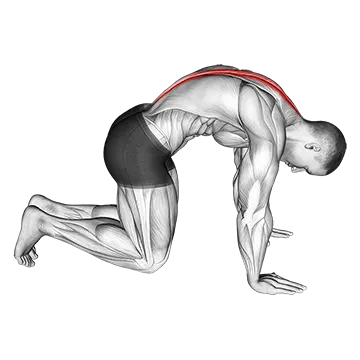
Spine Backbend Stretch
- Zielmuskel
- Erector Spinae
- Equipment
- Body weight
- Körperregion
- Hips
- Typ
- Stretching




The spine backbend stretch is a bodyweight mobility exercise that targets the erector spinae by gently extending the spine into a backward arc. Performed without equipment, it opens the front of the torso and releases tension built up from prolonged sitting or forward-bending activities. It is widely used in warm-up, cool-down, and flexibility routines to improve spinal extension range of motion.
Spine Backbend Stretch: So führst du sie aus
- 1Stand with your feet hip-width apart and place both hands on your lower back, fingers pointing downward with thumbs wrapped around your sides for support.
- 2Engage your core lightly and lengthen through the crown of your head to create space between your vertebrae before moving.
- 3Inhale and begin pressing your hips forward while simultaneously leaning your upper body backward, initiating the movement from your mid-back rather than your lower back.
- 4Continue arching smoothly, allowing your chest to open toward the ceiling and your gaze to follow the arc upward and slightly behind you.
- 5Hold the end position for 20–30 seconds, breathing steadily and allowing your erector spinae to lengthen with each exhale.
- 6Exhale and slowly return to an upright position by engaging your core and stacking your vertebrae back to neutral one at a time.
- 7Repeat for the desired number of holds, releasing further into the stretch with each repetition.
Technik-Tipps
- Initiate the bend from your mid and upper back rather than collapsing entirely into your lower lumbar — this distributes the stretch more evenly along the entire erector spinae.
- Keep your glutes and core lightly engaged throughout to avoid over-compressing the lumbar spine at the bottom of the arch.
- Breathe deeply into your chest during the hold — each inhale naturally deepens the thoracic extension and enhances the stretch.
- Move slowly and with control in both directions; avoid dropping abruptly into or snapping out of the backbend.
Häufige Fehler
- Collapsing entirely into the lower back instead of distributing the arch through the full spine, which concentrates compressive forces on the lumbar vertebrae and can cause discomfort or injury.
- Holding your breath during the stretch, which increases muscular tension and prevents the erector spinae from fully releasing.
- Pushing aggressively to the end range on the first repetition without warming up the spine, which raises the risk of muscle strain.
- Allowing the head to drop back uncontrolled, which places unnecessary strain on the cervical spine — keep the neck in a neutral, natural extension.
Häufig gestellte Fragen
What muscles does the spine backbend stretch target?
The primary muscle worked is the erector spinae, the group of muscles that run along both sides of the vertebral column. Stretching it in spinal extension also gently opens the hip flexors and the front of the torso.
Is the spine backbend stretch safe for people with lower back pain?
It can be beneficial for some types of lower back tightness, but it should be avoided if you have a herniated disc, spinal stenosis, or acute lower back pain. Consult a healthcare professional before adding backbends to your routine if you have an existing condition.
How long should I hold the spine backbend stretch?
Hold each repetition for 20–30 seconds, performing 2–3 holds per session. This duration is sufficient to allow the erector spinae to relax and lengthen without overstressing the spine.
When is the best time to do this stretch?
It fits well into a warm-up after light cardio or at the end of a workout as part of a cool-down. It is also useful as a brief mobility break during long periods of sitting at a desk.
Can beginners do the spine backbend stretch?
Yes — it requires no equipment and can be scaled simply by reducing how far you arch backward. Beginners should start with a shallow bend and gradually increase range of motion as spinal flexibility improves.