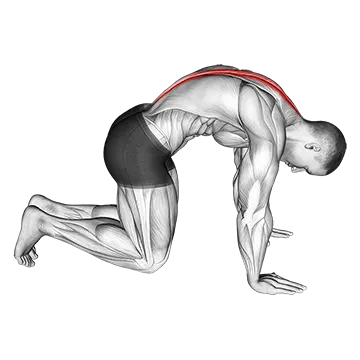
Spine Stretch
- Zielmuskel
- Erector Spinae
- Equipment
- Body weight
- Körperregion
- Back
- Typ
- Stretching
The Spine Stretch is a seated forward-flexion stretch that targets the erector spinae by lengthening the muscles running along both sides of the vertebral column. Performed with no equipment, it is widely used to improve segmental spinal mobility and relieve tension built up from prolonged sitting or heavy loading.
Spine Stretch: So führst du sie aus
- 1Sit upright on a mat with your legs extended straight in front of you, feet flexed and hip-width apart.
- 2Place your arms out in front of you at shoulder height, palms facing down, fingers reaching forward.
- 3Sit tall and take a deep breath in to lengthen the spine, drawing the crown of your head toward the ceiling.
- 4On an exhale, begin to round forward from the base of the spine — imagine each vertebra peeling away from an imaginary wall behind you, one at a time from the tailbone up.
- 5Continue rounding through the mid-back and upper back as you reach your hands forward past your feet, creating a long C-curve from tailbone to the back of the skull.
- 6Hold the end position for a full breath, actively reaching your fingertips further forward while pressing the base of your pelvis down into the mat.
- 7On an inhale, stack the vertebrae back upright one at a time from the base of the spine, returning to a tall seated position.
- 8Repeat for the prescribed number of repetitions, moving slowly and with control throughout.
Technik-Tipps
- Initiate the movement from the pelvis rather than the shoulders — think of emptying the lower abdomen first before the upper back rounds, so the stretch travels the full length of the spine.
- Keep the heels reaching away from you and feet actively flexed throughout; this anchors the pelvis so the stretch stays in the spine rather than escaping into the legs.
- Aim to create a smooth, even curve through every segment of the spine rather than hinging sharply at a single level — uneven rounding concentrates stress at one vertebral level instead of distributing it.
- Exhale fully as you round forward and inhale as you return upright; the breath acts as a natural driver for spinal flexion and extension.
- If tight hamstrings prevent you from sitting upright with legs fully extended, sit on a folded blanket or block to tilt the pelvis slightly forward and reduce posterior pelvic tuck.
Häufige Fehler
- Hinging from the hips instead of rounding the spine: collapsing forward as a rigid unit rather than segmentally flexing the spine turns the exercise into a hamstring stretch and bypasses the intended erector spinae lengthening entirely.
- Pulling with the arms to force the stretch: yanking the torso forward with momentum skips the controlled vertebral articulation that makes the stretch therapeutic and can strain the lower back or shoulder joints.
- Letting the feet drop outward: external rotation of the legs reduces hamstring tension and allows the pelvis to posteriorly tilt excessively, collapsing the low back before the stretch has a chance to travel up the full spine.
- Holding the breath: breath-holding increases muscular tension and intra-abdominal pressure, preventing the relaxation needed for passive spinal lengthening — the stretch is most effective when coordinated with a full exhale.
- Rushing the return: snapping back to upright rather than stacking the vertebrae one at a time removes the eccentric spinal extension benefit and can cause dizziness or strain in individuals with spinal sensitivity.
Häufig gestellte Fragen
What muscles does the Spine Stretch target?
The Spine Stretch primarily targets the erector spinae — the group of muscles running along either side of the vertebral column from the sacrum to the base of the skull. It is a bodyweight stretching movement with no listed synergist muscles — the focus stays on segmental spinal flexion and lengthening the erectors along their full length.
Is the Spine Stretch safe for lower back pain?
For many people with general lower back stiffness or muscular tension, the Spine Stretch provides meaningful relief by gently lengthening the erector spinae. However, individuals with disc herniations, severe stenosis, or acute back pain should consult a physical therapist or physician before performing flexion-based stretches, as forward flexion can aggravate certain spinal conditions.
How many reps of the Spine Stretch should I do?
Three to five slow, controlled repetitions per session is a common and effective range for the Spine Stretch. Because the benefit comes from the quality of vertebral articulation and breath coordination rather than volume, fewer deliberate reps outperform many fast ones. It can be performed daily as part of a warm-up, cool-down, or dedicated mobility session.
What is the difference between the Spine Stretch and a seated forward fold?
A seated forward fold typically focuses on lengthening the hamstrings and is often performed with a neutral or extended spine. The Spine Stretch specifically emphasizes segmental spinal flexion — intentionally rounding each vertebra forward in sequence to mobilize the erector spinae and decompress the spine. The distinction is in the intention and execution: spinal articulation versus posterior-chain lengthening.
Can I do the Spine Stretch every day?
Yes. Because the Spine Stretch is a low-load bodyweight movement with no eccentric muscle damage component, it carries minimal recovery cost and can be performed daily. Many people find it especially beneficial first thing in the morning to counteract overnight spinal compression, or after long periods of sitting to restore mobility and relieve erector spinae tension.