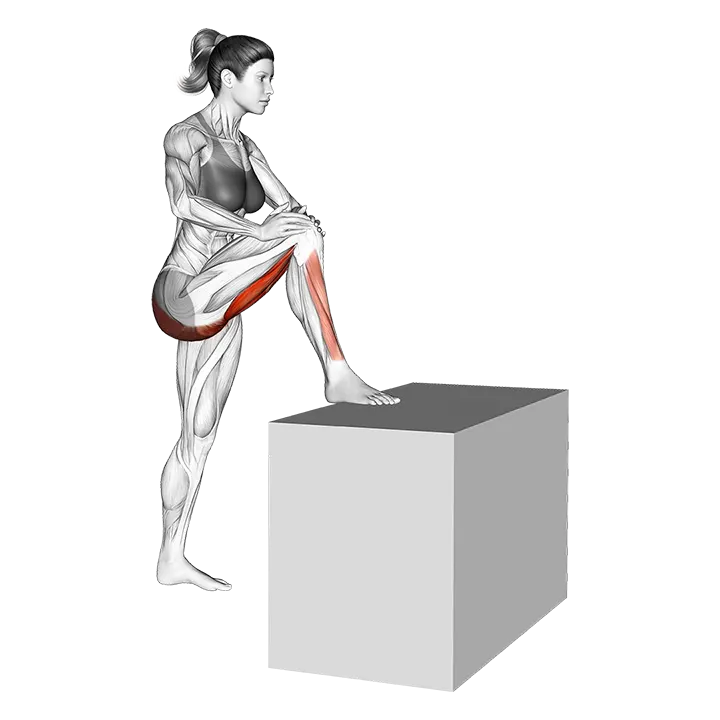
Standing High Leg Bent Knee Hamstring Stretch
- Zielmuskel
- —
- Equipment
- Body weight
- Körperregion
- Thighs
- Typ
- Stretching
The standing high leg bent knee hamstring stretch is a bodyweight flexibility exercise that targets the hamstrings along the back of the thigh. By propping one leg high on a surface with a slight knee bend, it reduces sciatic nerve tension and allows a deeper, more tolerable stretch than straight-leg variations. It is well suited for improving hamstring flexibility and easing lower-back tightness.
Standing High Leg Bent Knee Hamstring Stretch: So führst du sie aus
- 1Stand facing a stable surface — such as a bench, windowsill, or step — that is roughly hip height or slightly higher.
- 2Lift one leg and place your heel on the surface, keeping a slight bend in the raised knee rather than locking it out.
- 3Stand tall with your supporting leg straight and your foot pointing forward beneath your hip.
- 4Place your hands lightly on your raised thigh or the surface for balance.
- 5Inhale to lengthen your spine, then hinge forward at the hips — not the waist — leading with your chest toward your raised knee.
- 6Lean forward until you feel a firm stretch along the back of the raised thigh, then stop and hold the position.
- 7Hold for 20–30 seconds, breathing steadily and relaxing deeper into the stretch on each exhale.
- 8Slowly return to an upright position, lower the leg, and repeat on the opposite side.
Technik-Tipps
- Keep the slight bend in the raised knee throughout the hold — straightening it fully can aggravate the sciatic nerve.
- Initiate the forward lean from your hips, not your lower back; imagine pushing your tailbone back as your chest moves forward.
- Keep your back flat rather than rounding your spine, which shifts the stretch away from the hamstrings and onto the lumbar muscles.
- Engage your core lightly to maintain a neutral pelvis and prevent your lower back from arching as you lean.
- Progress gradually — raise the surface height or lean a fraction deeper only after you can hold the current depth with a flat back.
Häufige Fehler
- Placing the leg too high before you have the flexibility for it, which forces the lower back to round and removes tension from the hamstrings.
- Locking the raised knee completely straight, which increases nerve tension and can cause sharp pain down the leg rather than a productive muscle stretch.
- Rounding the upper back instead of hinging at the hips, which loads the spine and reduces the stretch on the target muscle.
- Holding your breath during the hold, which keeps the muscles tense and limits how far you can relax into the stretch.
- Rushing through the hold by releasing before 20 seconds — the hamstrings need sustained time under tension to lengthen effectively.
Häufig gestellte Fragen
What does the standing high leg bent knee hamstring stretch target?
It primarily targets the hamstrings — the group of muscles running along the back of the thigh. The bent-knee position also reduces tension on the sciatic nerve, making it gentler than straight-leg hamstring stretches.
How high should I raise my leg?
Start with a surface at mid-thigh or hip height and only raise it higher once you can hinge forward with a flat back at the current height. Propping the leg too high before you have the flexibility for it causes the lower back to round, which reduces the hamstring stretch and strains the spine.
How long should I hold this stretch?
Hold each side for 20–30 seconds and aim for 2–3 rounds per leg. Research on static stretching suggests that at least 20 seconds of sustained tension is needed to meaningfully increase muscle length.
Why bent knee instead of straight leg?
A slight bend in the raised knee takes the sciatic nerve off full stretch, which prevents nerve irritation from masking as a hamstring stretch. It lets most people lean deeper and feel the stretch in the muscle belly itself rather than behind the knee.
When is the best time to do this stretch?
It is most effective as part of a post-workout cool-down or a dedicated mobility session when the muscles are already warm. Performing it on cold muscles is less effective and slightly increases the risk of strain.







