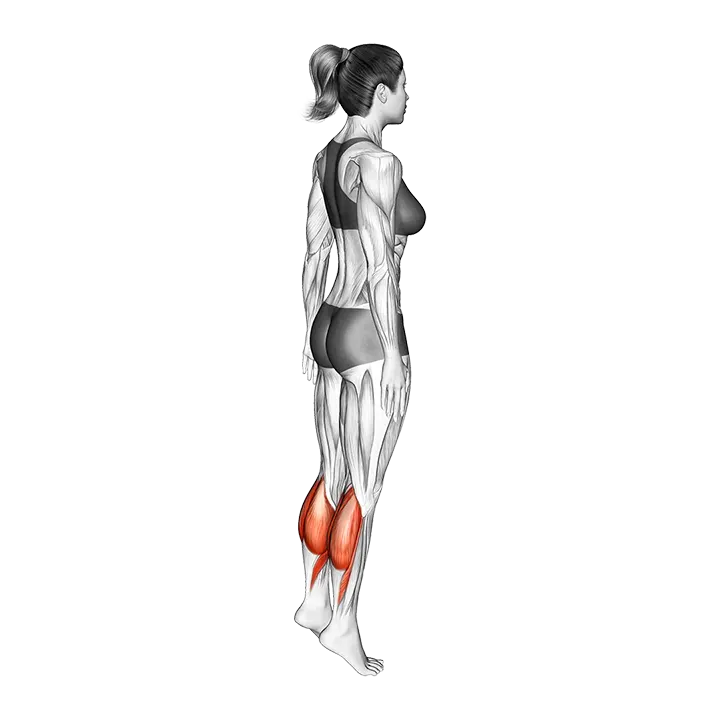
Standing Isometric Hold Calf Raise
- Zielmuskel
- —
- Equipment
- Body weight
- Körperregion
- Calves
- Typ
- Strength
The Standing Isometric Hold Calf Raise is a bodyweight strength exercise that targets the calf muscles — primarily the gastrocnemius and soleus — by rising onto the balls of the feet and holding the peak position under sustained muscular tension. The extended pause at the top eliminates momentum and forces the calves to work isometrically, making it an effective tool for building lower-leg strength and endurance with no equipment required.
Standing Isometric Hold Calf Raise: So führst du sie aus
- 1Stand with feet hip-width apart near a wall or sturdy surface, toes pointing straight ahead.
- 2Place your fingertips lightly on the support — just enough to keep your balance, not to bear any weight.
- 3Press through the balls of both feet and rise onto your toes as high as you can, lifting your heels fully off the floor.
- 4At the top, squeeze your calf muscles hard and lock your ankles in full plantarflexion.
- 5Hold the top position for the prescribed duration — typically 3–10 seconds — keeping the contraction firm and your body upright.
- 6Lower your heels back to the floor in a slow, controlled manner to complete one repetition.
- 7Reset your foot position fully and repeat for the target number of reps.
Technik-Tipps
- Rise as high as possible onto the balls of your feet — a shallow rise shortens the range of motion and reduces calf activation during the hold.
- Keep your fingertip contact on the support minimal; gripping tightly transfers body weight off the calves and lowers the training stimulus.
- Keep your knees straight throughout — a straight knee loads the gastrocnemius most effectively, while a bent knee shifts emphasis toward the soleus.
- Breathe steadily during the hold rather than bracing your breath — exhale slowly through the isometric phase to stay relaxed and maintain the peak position.
- Progress by increasing the hold duration before adding reps; longer pauses raise time under tension more effectively than additional quick repetitions.
Häufige Fehler
- Bouncing up with momentum instead of pressing deliberately — this shortens time under tension and eliminates the isometric training effect entirely.
- Letting the heels drop before the hold is complete — ending the pause early removes the intended stimulus. Lock the peak position and count the full duration before descending.
- Gripping the support surface too tightly, which offloads weight from the calves and reduces the effective training load.
- Allowing the ankles to roll outward during the rise — supination shifts load to the outer edge of the foot and away from the calf muscles. Keep weight centered over the first and second toes.
- Rising only partially onto the toes rather than achieving full plantarflexion — a partial rise limits range of motion and reduces gastrocnemius engagement at the peak.
Häufig gestellte Fragen
What muscles does the Standing Isometric Hold Calf Raise work?
The exercise targets the two main calf muscles: the gastrocnemius (the large, two-headed muscle visible at the back of the lower leg) and the soleus (the broader, deeper muscle beneath it). Both plantarflex the ankle, and the isometric hold forces them to sustain contraction rather than simply moving through a range of motion.
How long should I hold the isometric position?
Beginners typically start with 3–5 second holds and gradually work toward 10 seconds or more as strength improves. Total time under tension matters more than rep count, so focus on maintaining a firm, high position for each prescribed count before lowering under control.
How does the isometric hold differ from a regular calf raise?
A standard calf raise moves continuously through the range of motion and often allows momentum at the top. The isometric hold pauses at full plantarflexion, removing momentum and placing the calf under sustained static tension. This increases time under tension per rep and builds strength specifically at the top of the range, where many people are weakest.
Can I do this exercise without any support?
Yes. Removing the support adds a balance challenge that engages the stabilizing muscles of the ankle and foot. However, using a wall or railing lightly allows you to maintain a more vertical torso and maximize calf activation, which is generally preferred when the primary goal is calf strength.
How many sets and reps should I do?
A practical starting point is 3 sets of 10–15 reps with a 5-second hold at the top of each rep. As you progress, increase the hold duration, shorten rest periods, or perform the exercise on one leg at a time to add difficulty without any equipment.







