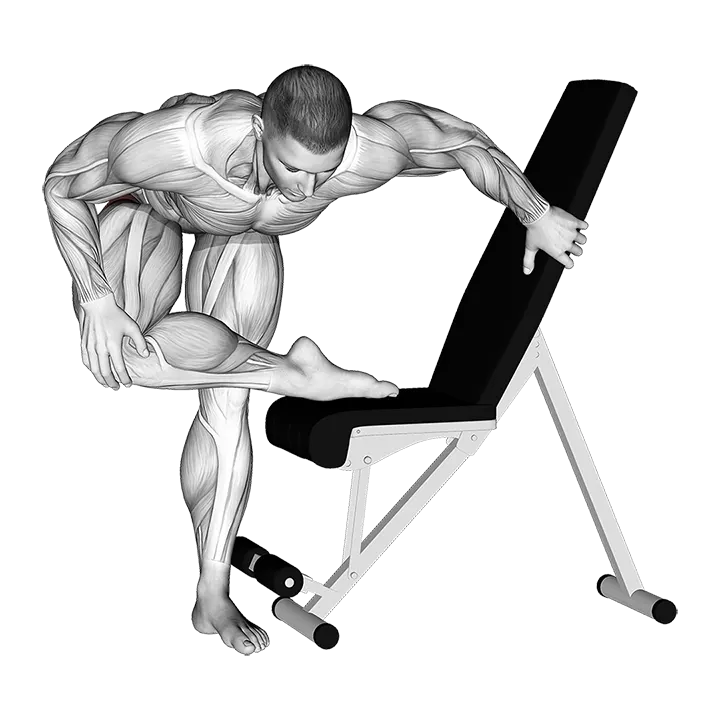
Standing Leg Tuck Hip Stretch
- Zielmuskel
- —
- Equipment
- Body weight
- Körperregion
- Hips
- Typ
- Stretching
The standing leg tuck hip stretch is a bodyweight mobility exercise that targets the hip flexors, hip external rotators, and glutes by drawing one knee toward the chest while balancing on the opposite leg. It improves hip range of motion, relieves tightness from prolonged sitting, and reinforces single-leg stability — making it a practical warm-up or cool-down movement for any lower-body session.
Standing Leg Tuck Hip Stretch: So führst du sie aus
- 1Stand tall with your feet hip-width apart and your core lightly braced. Fix your gaze on a point ahead to help with balance.
- 2Shift your weight onto your left foot, pressing the entire sole into the floor for a stable base.
- 3Lift your right knee toward your chest, clasping both hands around your right shin just below the knee.
- 4Gently pull the knee closer to your chest until you feel a comfortable stretch deep in the right hip and glute.
- 5Hold the end position for 20–30 seconds, keeping your standing leg slightly soft at the knee rather than locked out.
- 6Stand tall throughout — avoid rounding your lower back or leaning the torso forward to compensate.
- 7Slowly lower your right foot back to the floor with control.
- 8Repeat on the left side, completing the same hold duration.
Technik-Tipps
- Actively squeeze the glute of your standing leg to deepen the stretch on the lifted side and reinforce hip stability.
- Keep your chest lifted and spine neutral — rounding through the lower back reduces the hip stretch and adds unnecessary strain.
- If balance is a challenge, lightly rest one hand on a wall or chair; the stretch itself is unaffected.
- Breathe steadily throughout the hold — exhaling as you draw the knee in can help you relax into a greater range of motion.
- Pull through the shin, not the knee joint, to keep pressure off the kneecap and better engage the hip external rotators.
Häufige Fehler
- Rounding the lower back to pull the knee higher — this shifts the work away from the hip and can strain the lumbar spine.
- Locking out the standing knee, which reduces proprioceptive feedback and increases joint stress during the balance hold.
- Holding the breath during the stretch, which increases muscle tension and prevents you from reaching full range of motion.
- Rushing through the hold by releasing in under 10 seconds — adequate time under stretch (20–30 s) is necessary for the hip muscles to relax and lengthen.
- Gripping the knee cap rather than the shin, which applies direct compressive force to a vulnerable joint instead of using the shin as a lever.
Häufig gestellte Fragen
What muscles does the standing leg tuck hip stretch target?
It primarily stretches the hip flexors and hip external rotators — including the piriformis and gluteus medius — of the lifted leg, while the glutes and stabilizers of the standing leg work actively to maintain balance.
How long should I hold the standing leg tuck hip stretch?
Aim for 20–30 seconds per side for a typical warm-up or cool-down. For therapeutic flexibility work, you can extend holds to 45–60 seconds per side.
Can I do this stretch if I have tight hip flexors from sitting all day?
Yes — this is one of the most accessible ways to address hip tightness from prolonged sitting. Perform it daily, focusing on a slow, controlled pull and steady breathing to allow the hip flexors to release progressively.
Is the standing leg tuck hip stretch safe for beginners?
It is suitable for most beginners. Use a wall or sturdy surface for balance support until your single-leg stability improves, and avoid forcing the knee beyond a comfortable range.
How does this stretch differ from a standing quad stretch?
A standing quad stretch pulls the foot behind the body to lengthen the quadriceps, while the standing leg tuck draws the knee forward and upward to open the hip joint and stretch the posterior hip and external rotators instead.







