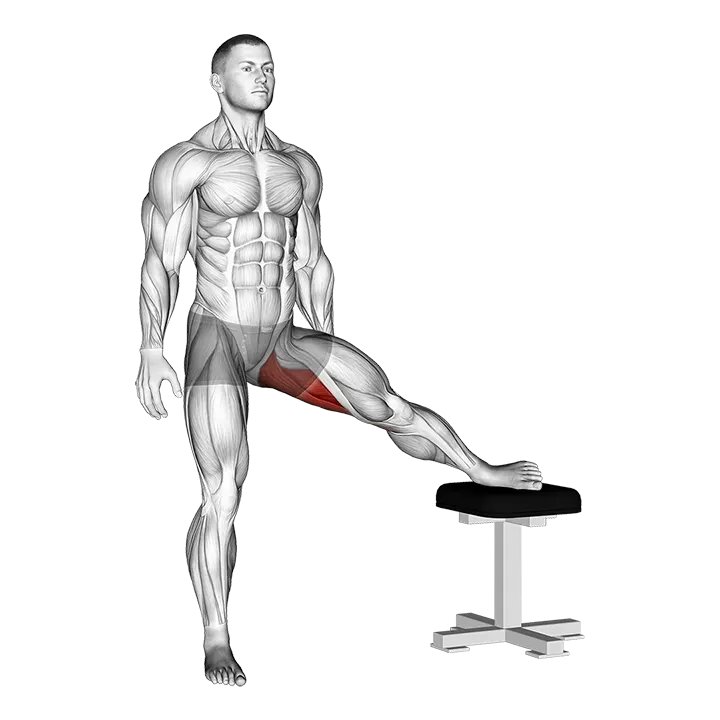
Standing Leg Up Adductor Stretch
- Zielmuskel
- —
- Equipment
- Body weight
- Körperregion
- Hips
- Typ
- Stretching
The Standing Leg Up Adductor Stretch is a bodyweight hip flexibility exercise that targets the adductor muscles along the inner thigh and groin. By elevating one leg to the side while standing, it places a controlled lengthening force through the adductor longus, adductor magnus, and gracilis. Regular practice improves hip range of motion and reduces tightness that can restrict lower-body movement.
Standing Leg Up Adductor Stretch: So führst du sie aus
- 1Stand beside a stable surface such as a bench, chair, or railing set at roughly hip to waist height.
- 2Shift your weight onto your standing leg and engage your core to maintain an upright posture.
- 3Lift your inner leg and place the heel or calf on top of the elevated surface, keeping the leg as straight as comfortably possible.
- 4Turn the elevated leg so the inner thigh faces upward and the toes point toward the ceiling.
- 5Stand tall and allow your body to settle so that gravity begins to draw the elevated leg gently downward, creating a stretch along the inner thigh.
- 6If you need more intensity, hinge slightly forward at the hips while keeping your back flat, or shift your standing hip away from the surface.
- 7Hold the stretch for 20–30 seconds, breathing steadily and letting the inner thigh relax with each exhale.
- 8Lower the leg under control and return to a neutral standing position.
- 9Repeat on the opposite side, completing 2–3 rounds per leg.
Technik-Tipps
- Keep your standing foot pointing straight ahead and your knee soft rather than locked — a rigid standing leg reduces stability and increases the risk of losing balance during the hold.
- Maintain a tall, upright torso instead of leaning sideways toward the elevated leg. Lateral trunk bending shifts tension away from the adductors and into the obliques, reducing the effectiveness of the stretch.
- Point the toes of the elevated leg toward the ceiling rather than letting them fall outward — this internal rotation keeps the inner thigh fibers loaded and prevents the stretch from migrating to the hip flexors.
- Breathe out slowly during the hold and consciously release the inner thigh with each exhale rather than pushing aggressively into a deeper range — relaxed, progressive lengthening produces better flexibility gains than forced end-range loading.
- Use a surface height that allows you to feel a clear stretch without sharp or pinching pain in the groin; lower the surface if discomfort exceeds a gentle pulling sensation.
Häufige Fehler
- Letting the torso lean sideways toward the elevated leg — this reduces adductor tension and loads the lateral trunk instead. Keep the spine vertical and allow the stretch to come from the elevated leg position alone.
- Bending the elevated knee significantly — a bent knee slackens the gracilis, which crosses the knee, and reduces the overall stretch through the inner thigh. Aim to keep the leg as straight as your flexibility allows.
- Allowing the toes of the elevated leg to rotate outward — external rotation shifts the stretch away from the adductors toward the hip external rotators. Keep the toes pointing upward to maintain inner-thigh emphasis.
- Gripping the surface or tensing the elevated leg — muscular guarding prevents the adductors from relaxing and lengthening. Rest the leg passively on the surface and focus on releasing tension rather than holding the position with effort.
- Choosing a surface that is too high — forcing the leg above comfortable range causes the pelvis to tilt and the lower back to compensate, reducing adductor stretch and potentially straining the hip joint. Start lower and progress gradually.
Häufig gestellte Fragen
What muscles does the Standing Leg Up Adductor Stretch target?
The stretch primarily targets the adductor muscles of the inner thigh, including the adductor longus, adductor magnus, and adductor brevis, as well as the gracilis. These muscles run from the pubic bone and ischium down to the inner femur and tibia, and elevating the leg to the side places them all under a lengthening load.
How high should the surface be for a Standing Leg Up Adductor Stretch?
A surface at roughly hip height is a good starting point for most people. At this height you should feel a clear but comfortable stretch along the inner thigh without pelvic tipping or lower-back strain. As your flexibility improves you can gradually use a higher surface, but there is no benefit to forcing the leg higher than your current range of motion comfortably allows.
How long should I hold an adductor stretch?
Holding each side for 20–30 seconds gives the nervous system enough time to allow the adductors to relax and begin lengthening. Performing 2–3 rounds per side produces better cumulative results than a single long hold. If your inner thighs are particularly tight, working gradually toward 45-second holds over several weeks can accelerate progress.
When is the best time to do adductor stretches?
Static adductor stretches are most effective after a workout or any activity that has warmed the muscles, such as a brisk walk. Holding long static stretches on cold muscles is less effective and can temporarily reduce force output, so save this exercise for the end of your training session or after a brief warm-up. Daily stretching on most days of the week is safe and beneficial for building lasting hip flexibility.
Can tight adductors affect athletic performance or cause injury?
Yes. Tight adductors can limit hip abduction and internal rotation, reduce stride length, and alter pelvic alignment during running, squatting, and change-of-direction movements. They are also a common contributor to groin strains, particularly in sports that involve rapid lateral movements. Regular adductor stretching helps maintain the range of motion needed for efficient and injury-resistant lower-body mechanics.







