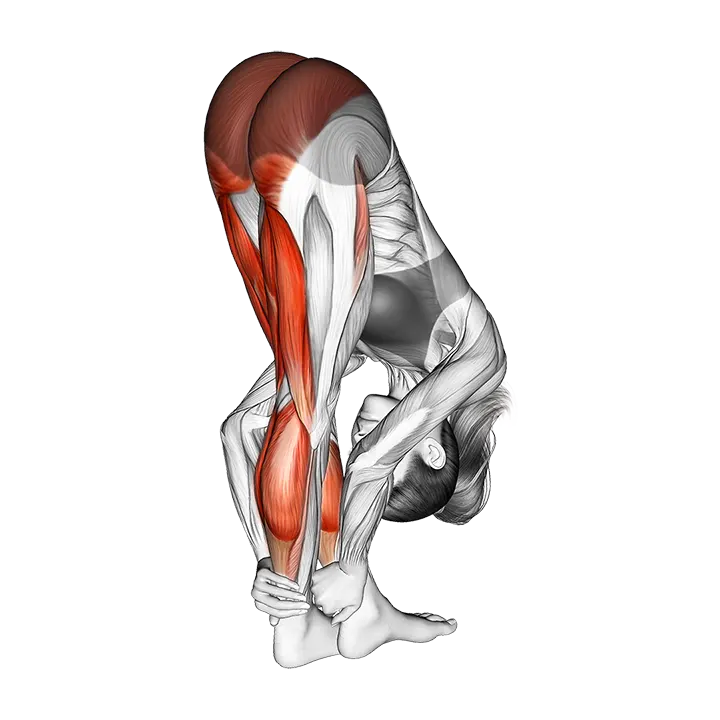
Standing Reach Down Hamstring Crossed Legs Stretch
- Equipment
- Body weight
- Körperregion
- Thighs
- Typ
- Stretching
The Standing Reach Down Hamstring Crossed Legs Stretch is a bodyweight flexibility exercise that targets the hamstrings, gluteus maximus, gastrocnemius, soleus, and tensor fasciae latae. Crossing one leg in front of the other before hinging forward adds rotational tension that deepens the stretch across the entire posterior chain. It is effective for relieving lower-body tightness after running, cycling, or prolonged sitting.
Standing Reach Down Hamstring Crossed Legs Stretch: So führst du sie aus
- 1Stand upright with your feet together and arms relaxed at your sides.
- 2Cross your right foot in front of your left, placing the right foot flat on the floor so both legs are close together.
- 3Keep both legs as straight as possible with only a very slight, soft bend at the knees.
- 4Hinge forward at the hips — not the waist — keeping your back flat as you lower your torso toward the floor.
- 5Reach both hands down toward your shin, ankle, or the floor, stopping where you feel a firm stretch along the back of the rear (left) leg.
- 6Hold the position for 20–30 seconds, breathing steadily and allowing the stretch to deepen with each exhale.
- 7Slowly return to upright by engaging your core and hinging back up from the hips.
- 8Switch legs — place your left foot in front of your right — and repeat for the same duration.
- 9Complete 2–3 rounds per side.
Technik-Tipps
- Hinge at the hips rather than curling through the lower back — a flat spine directs the tension into the hamstrings and gluteus maximus rather than the lumbar vertebrae.
- Press both feet firmly into the floor throughout the hold; allowing the heels to lift reduces tension on the gastrocnemius and soleus.
- Point both feet straight ahead and keep the hips level — allowing the hips to rotate open reduces the effective stretch on the hamstrings and tensor fasciae latae of the rear leg.
- If you cannot reach near the floor without rounding your back, bend the front knee slightly and place your hands on your shin instead — prioritize a flat back over depth of reach.
- Breathe steadily rather than holding your breath; exhaling fully on each breath allows the posterior chain muscles to release more completely over the course of the hold.
Häufige Fehler
- Rounding the lower back instead of hinging at the hips — curling through the lumbar spine shifts stress off the hamstrings and onto the vertebral structures, reducing stretch effectiveness and risking lower-back discomfort.
- Not truly crossing the legs — placing the feet too far apart removes the rotational component that differentiates this variation from a standard standing forward bend, significantly reducing tension on the tensor fasciae latae and outer hamstring.
- Letting the hips shift sideways or rotate open — the hips naturally want to tilt when the legs are crossed; actively squaring them forward maintains even stretch tension across both the hamstrings and gluteus maximus.
- Cutting the hold short — a hold of fewer than 15 seconds does not give the nervous system enough time to allow the muscles to relax and lengthen meaningfully; aim for at least 20 seconds per side.
- Hyperextending the knees — while the legs should be close to straight to maximize hamstring tension, forcefully locking the knees places excess stress on the joint; keep a very slight, soft bend throughout.
Häufig gestellte Fragen
What muscles does the Standing Reach Down Hamstring Crossed Legs Stretch target?
The stretch primarily targets the hamstrings and gluteus maximus along the posterior chain. The crossed-leg position also places meaningful tension on the gastrocnemius, soleus, and tensor fasciae latae, making it an efficient multi-muscle lower-body flexibility exercise with a single movement.
Why do you cross your legs in this hamstring stretch?
Crossing one leg in front of the other adds a rotational component that increases tension across the outer hamstring and tensor fasciae latae compared to a standard standing forward bend. It also biases the stretch toward the rear leg, so you can focus flexibility work on one side at a time.
How long should I hold the Standing Reach Down Hamstring Crossed Legs Stretch?
Hold each side for 20–30 seconds to allow the hamstrings, gluteus maximus, and gastrocnemius to relax and begin lengthening. Repeating 2–3 rounds per side produces better cumulative results than a single long hold.
Can I do this stretch if my hamstrings are very tight?
Yes. Bend the front knee slightly to reduce the range of motion demanded from the hamstrings and reach to your shin or knee rather than the floor. As flexibility improves over weeks of consistent practice, gradually straighten the legs and reach lower.
When is the best time to perform this stretch?
Static stretches like this are most effective after exercise, when the muscles are warm and more pliable. Performing them cold before intense activity can temporarily reduce power output. Daily stretching — even on rest days after a brief warm-up walk — is safe and beneficial for building lasting hamstring and gluteus maximus flexibility.







