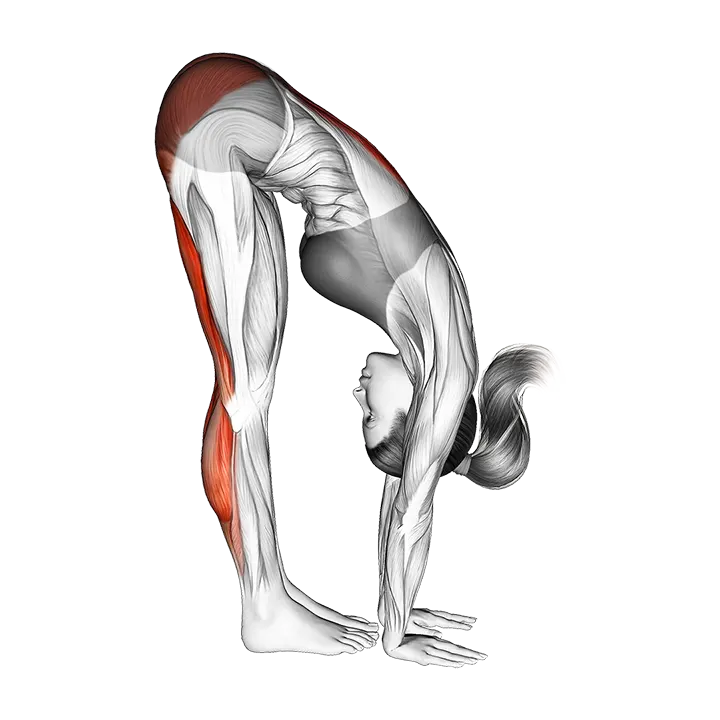
Standing Reach Down Hamstring Stretch
- Synergistenmuskeln
- Soleus
- Equipment
- Body weight
- Körperregion
- Thighs
- Typ
- Stretching
The standing reach down hamstring stretch is a bodyweight flexibility exercise that targets the hamstrings, erector spinae, gluteus maximus, and gastrocnemius by hinging forward from a standing position and reaching toward the floor. It lengthens the entire posterior chain through a simple, equipment-free movement and is well suited for warm-ups, cool-downs, and improving hip-hinge mobility.
Standing Reach Down Hamstring Stretch: So führst du sie aus
- 1Stand tall with your feet hip-width apart and your toes pointing forward. Straighten your legs fully or leave a very slight softness in the knees.
- 2Brace your core lightly and draw your shoulder blades back so your spine is neutral before you begin the movement.
- 3Hinge at your hips — not your waist — and begin lowering your torso toward the floor while keeping your back as flat as possible.
- 4Let your arms hang straight down and reach your fingertips toward the floor, your feet, or your shins — as far as your hamstring flexibility allows.
- 5Hold the deepest comfortable position for 20–30 seconds, breathing slowly and relaxing further into the stretch with each exhale.
- 6To exit, engage your glutes and hamstrings, press your feet into the floor, and hinge back up through your hips until you are standing tall again.
- 7Repeat for the prescribed number of sets or time, gradually deepening the reach as your flexibility allows.
Technik-Tipps
- Lead the movement from your hips, not your lower back — initiating with a hip hinge rather than rounding at the lumbar spine keeps the stretch in the hamstrings where it belongs.
- Allow a gradual release with each breath: inhale to prepare, exhale to relax and sink a little deeper into the stretch.
- Keep your weight centered over the middle of your foot — shifting onto your toes or heels reduces tension on the target muscles.
- Point your toes slightly inward to increase the stretch on the outer hamstrings, or slightly outward to bias the inner hamstrings.
Häufige Fehler
- Rounding the lower back excessively instead of hinging at the hips, which transfers load to the erector spinae and lumbar discs rather than effectively lengthening the hamstrings.
- Bouncing or forcing the stretch aggressively, which can trigger the muscle's stretch reflex and increase injury risk — ease in steadily and hold.
- Bending the knees too much, which reduces tension on the hamstrings and limits the effectiveness of the stretch.
- Holding the breath, which increases spinal tension and prevents the muscles from relaxing fully into the stretch.
- Looking up and craning the neck while reaching down, which compresses the cervical spine — let the head hang naturally in line with the torso.
Häufig gestellte Fragen
What muscles does the standing reach down hamstring stretch target?
It primarily stretches the hamstrings, erector spinae, gluteus maximus, and gastrocnemius, with the soleus also lengthened as a synergist. Together these muscles form the posterior chain that runs from the base of the skull to the heel.
Should I keep my knees straight or slightly bent during this stretch?
Keeping the legs straight maximizes the stretch on the hamstrings. If you feel pain rather than a deep pull, a very slight softness in the knees is acceptable while you build flexibility — just avoid bending them so much that the hamstring tension disappears.
How long should I hold the standing reach down hamstring stretch?
For flexibility gains, hold each rep for 20–30 seconds and perform 2–3 reps per session. Static stretches held for at least 30 seconds performed consistently over several weeks produce the most lasting improvements in hamstring length.
Is this stretch safe for people with lower back pain?
It can be helpful, but people with acute lower back issues should proceed cautiously and focus on hinging strictly from the hips with a neutral spine. If rounding is unavoidable or the stretch aggravates symptoms, consult a healthcare provider before continuing.
When is the best time to do the standing reach down hamstring stretch?
It works well as part of a cool-down after exercise when muscles are warm and most receptive to lengthening. As a pre-workout warm-up, prefer a dynamic version — controlled swings or gradual reaches — rather than prolonged static holds, which can temporarily reduce muscle force output.







