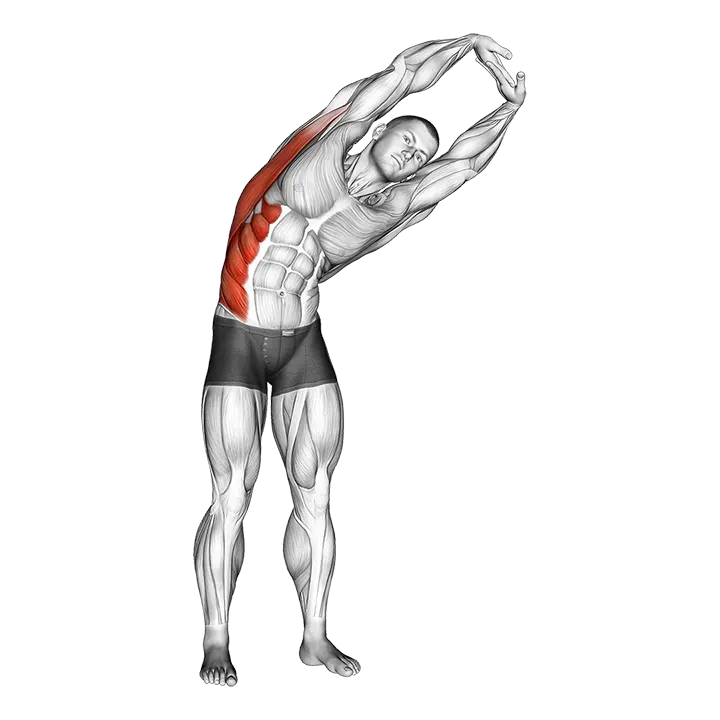
Standing Side Stretch
- Zielmuskel
- —
- Equipment
- Body weight
- Körperregion
- Back, Waist
- Typ
- Stretching
The Standing Side Stretch is a bodyweight movement that lengthens the lateral trunk, targeting the obliques, latissimus dorsi, and intercostal muscles along the back and waist. Performed as a slow lateral bend from a standing position, it improves side-body flexibility and relieves tightness through the torso. It suits warm-up routines, cool-downs, and daily mobility work.
Standing Side Stretch: So führst du sie aus
- 1Stand tall with your feet hip-width apart and arms resting at your sides.
- 2Raise your right arm overhead, keeping your bicep close to your ear and your palm facing inward.
- 3Plant your left hand on your left hip or let it slide down your left thigh for light support.
- 4Inhale to lengthen your spine, then exhale as you slowly lean your torso to the left, reaching your right arm over in an arc.
- 5Stop when you feel a firm stretch along the right side of your torso — do not force the range.
- 6Keep both feet flat on the floor and your hips level; avoid letting the pelvis shift sideways.
- 7Hold the stretched position for 20–30 seconds, breathing steadily and deepening the stretch slightly on each exhale.
- 8Inhale and slowly return to an upright position, lowering your right arm.
- 9Repeat on the opposite side, raising your left arm and bending to the right.
Technik-Tipps
- Keep your core lightly engaged throughout so the bend comes from the spine, not a hip shift.
- Reach through your fingertips as you bend — actively lengthening the arm increases the stretch on the lat and intercostals.
- Breathe into the stretched side; expanding the ribcage on the inhale deepens the intercostal stretch.
- Move slowly and pause at any point of discomfort — this is a stretch, not a dynamic swing.
- Keep both shoulders down and away from your ears to prevent the upper trapezius from dominating the movement.
Häufige Fehler
- Letting the hips drift sideways: shifting the pelvis instead of bending at the spine reduces the lateral trunk stretch and can stress the lower back — keep both hips square and level.
- Bending forward or backward: rotating the torso out of the frontal plane turns the stretch into a twist or forward fold, missing the obliques and lats entirely — stay in a single plane.
- Rushing through the hold: bouncing or holding for only a few seconds does not allow the connective tissue to release — commit to at least 20 seconds per side.
- Collapsing the overhead arm: letting the elbow bend shortens the lever and reduces the lat stretch — keep the arm straight and reach actively.
- Holding the breath: bracing without breathing creates unnecessary tension in the torso and limits how far the ribcage can expand into the stretch — maintain slow, controlled breathing throughout.
Häufig gestellte Fragen
What muscles does the Standing Side Stretch work?
The stretch primarily lengthens the obliques, latissimus dorsi, and intercostal muscles along the side of the torso. Secondary tension is felt through the quadratus lumborum in the lower back and the serratus anterior along the ribcage.
How long should I hold the Standing Side Stretch?
Hold each side for 20–30 seconds to allow the muscle and fascia to relax into the stretch. For a deeper release during a cool-down, you can extend the hold to 45–60 seconds per side.
Can I do this stretch every day?
Yes. Because it uses only bodyweight and places no load on the joints, the Standing Side Stretch is safe to perform daily as part of a morning mobility routine, a workout warm-up, or a cool-down.
Is the Standing Side Stretch good for lower back pain?
It can help by releasing lateral tension in the obliques and quadratus lumborum that contributes to low-back tightness. If you have an existing back injury, check with a healthcare provider before adding lateral bending to your routine.
How is the Standing Side Stretch different from a side bend exercise?
A side bend exercise typically involves added resistance and repetitions to build oblique strength. The Standing Side Stretch is a slow, held movement focused on lengthening the lateral trunk muscles rather than contracting them.







