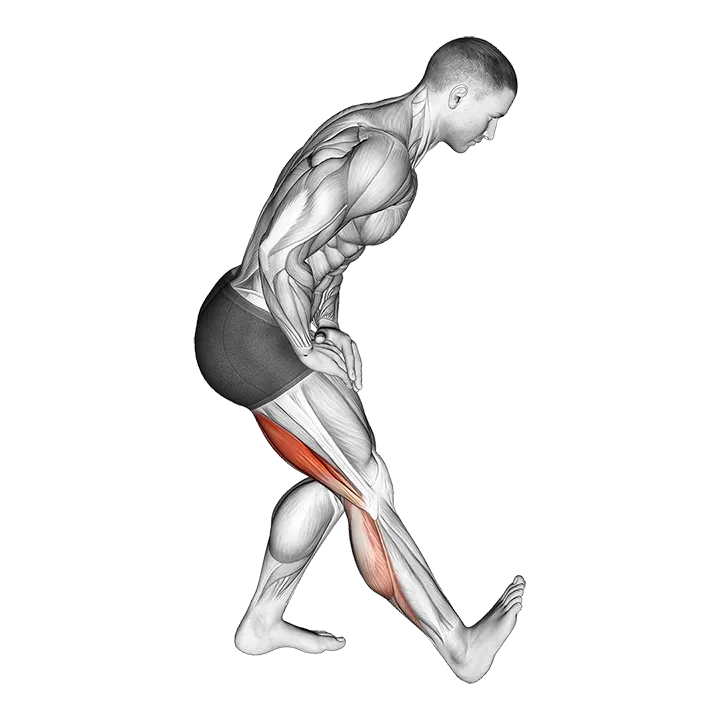
Standing Toe Up Hamstring Stretch
- Zielmuskel
- —
- Equipment
- Body weight
- Körperregion
- Thighs
- Typ
- Stretching
The Standing Toe Up Hamstring Stretch is a bodyweight flexibility exercise that targets the hamstrings along the back of the thigh. By pointing the toes upward while hinging forward at the hip, you add a simultaneous calf stretch and increase the pull along the entire posterior chain. It is a practical drill for improving hamstring flexibility, reducing lower-back tightness, and preparing the legs for activity.
Standing Toe Up Hamstring Stretch: So führst du sie aus
- 1Stand upright and extend one leg forward, placing the heel on the floor with the toes pointing up toward the ceiling.
- 2Keep the front knee straight and the standing leg slightly bent for balance.
- 3Place your hands on your hips or let them rest gently on your front thigh for support.
- 4Inhale to prepare, then hinge forward at the hips — not the waist — keeping your back flat and chest lifted.
- 5Continue tilting your torso forward until you feel a firm stretch along the back of the extended thigh.
- 6Hold the position for 20–30 seconds, breathing steadily and allowing the hamstrings to relax on each exhale.
- 7Return to an upright position by squeezing the glutes and driving the hips back to neutral.
- 8Repeat on the opposite side, completing 2–3 rounds per leg.
Technik-Tipps
- Initiate the forward lean from the hips, not the lower back — think of tilting your pelvis forward rather than rounding your spine. A neutral spine keeps the stretch on the hamstrings, not the lumbar discs.
- Keep the toes of the extended foot actively pulled back toward your shin throughout the hold. This dorsiflexion positions the calf and intensifies the overall posterior-chain stretch.
- Maintain a micro-bend in the standing knee to protect the joint and improve balance. Locking the standing knee can shift your weight and reduce stability.
- Ease into the stretch gradually — move only as far as you can while keeping your back flat. If your lower back rounds, you have gone too far and the tension has shifted away from the hamstrings.
- Use a wall or chair for light fingertip support if balance is a limiting factor, so you can focus on the stretch quality rather than staying upright.
Häufige Fehler
- Rounding the lower back instead of hinging at the hip — this shifts the stretch off the hamstrings and onto the lumbar spine, which can cause discomfort and does not improve hamstring flexibility. Keep the back flat and chest tall throughout the hold.
- Letting the toes drop rather than keeping them pulled upward — allowing the foot to relax reduces the stretch on both the hamstrings and the calf. Actively dorsiflexing the foot is what makes this variation more effective than a standard standing hamstring stretch.
- Bending the front knee — even a slight bend in the extended leg slackens the hamstrings and removes most of the stretch. Keep the leg fully straight from hip to heel to maintain full tension along the muscle.
- Cutting the hold short — a stretch released in under 15 seconds does not allow the nervous system time to permit meaningful muscle lengthening. Hold each side for at least 20 seconds to achieve a useful flexibility stimulus.
- Bouncing or pulsing at the end range — ballistic movement in a static stretch can trigger the muscle's stretch reflex, causing the hamstrings to contract and resist rather than relax. Hold the position steadily and breathe through the tension.
Häufig gestellte Fragen
Why do you point the toes up in this hamstring stretch?
Pointing the toes up — dorsiflexing the ankle — puts a simultaneous stretch on the calf and the tibial nerve, which runs along the back of the leg. This increases the overall pull along the posterior chain and makes the stretch more intense than a version where the foot is relaxed. It is particularly useful if hamstring tightness is linked to stiffness throughout the entire back of the leg.
How long should I hold a standing hamstring stretch?
For most people, 20–30 seconds per side is the effective minimum for a static hamstring stretch. Performing 2–3 rounds per leg with brief rest between rounds produces better flexibility gains than a single long hold. If your hamstrings are very tight, you can gradually work toward 45-second holds over several weeks.
Can I do this stretch without a surface to rest my heel on?
Yes. Simply extend the leg forward and rest the heel on the floor with the toes lifted. You do not need an elevated surface — placing the heel on the ground and hinging forward at the hip is sufficient to achieve the stretch, though a low step or box can make it easier to hold the position with good alignment.
When is the best time to do this hamstring stretch?
Static hamstring stretches are most effective after exercise, when the muscles are warm and more responsive to lengthening. Performing long holds on cold muscles before intense activity can temporarily reduce power output. Daily stretching after a workout or a brief warm-up walk is a practical routine for building lasting hamstring flexibility.
Is the Standing Toe Up Hamstring Stretch suitable for people with lower-back pain?
It can be appropriate, but you must hinge from the hip with a flat back rather than rounding the lower spine. If hinging forward causes lower-back pain or sciatica-like symptoms down the leg, reduce the range of motion or consult a physical therapist before continuing. People with sciatic nerve sensitivity should approach the toe-up position gradually, as the dorsiflexed foot increases neural tension.







