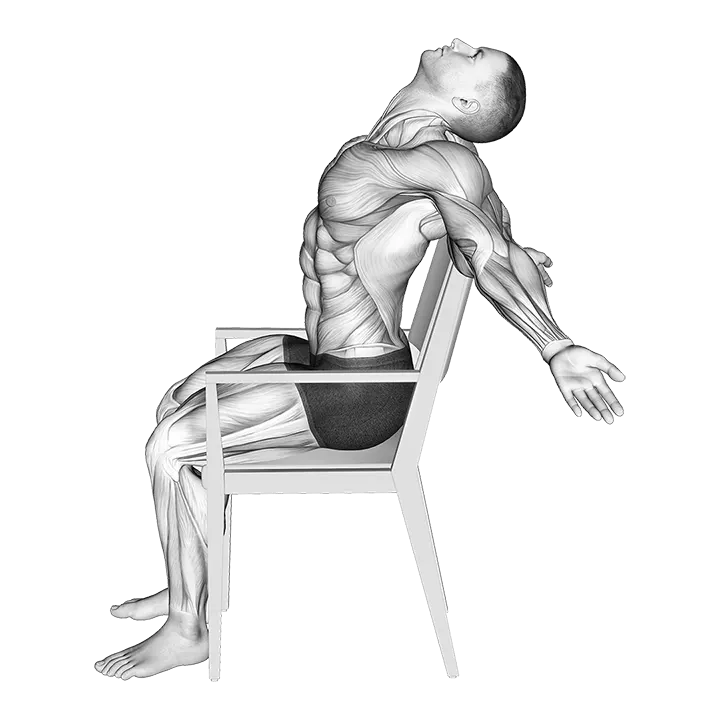
Static Position Seated Back
- Zielmuskel
- —
- Equipment
- Body weight
- Typ
- Stretching
The Static Position Seated Back is a bodyweight stretching exercise that works the muscles along your spine and lower back by holding a deliberate, upright seated posture for an extended duration. Sustained time in a neutral position encourages length through the spinal erectors and reduces chronic tension that accumulates from sitting with poor form. It fits naturally at the end of a training session, during a cooldown, or as a standalone desk-break stretch.
Static Position Seated Back: So führst du sie aus
- 1Sit upright on a chair or bench with your feet flat on the floor, hip-width apart, and your knees bent at roughly 90 degrees.
- 2Position your hips evenly on the seat so your weight is balanced across both sitting bones.
- 3Lengthen your spine by gently tucking your chin and imagining the crown of your head being drawn straight toward the ceiling.
- 4Draw your shoulder blades down and back slightly — away from your ears — without forcing your chest forward.
- 5Rest your hands on your thighs or knees with your arms relaxed.
- 6Maintain this neutral back position while breathing slowly and evenly: inhale through the nose for four counts, exhale through the mouth for four counts.
- 7Hold the position for 20–60 seconds, focusing on keeping the spine long and the surrounding muscles as relaxed as possible.
- 8Release by allowing your back to return to its natural resting position, then repeat for 2–3 sets.
Technik-Tipps
- Think of creating length rather than rigidity — a stiff, over-braced back prevents the muscles from releasing. Aim for a tall, relaxed posture, not a forced military one.
- Use your breath to drive the stretch: as you exhale, consciously release any tension you notice along your spine without letting your posture collapse.
- Place a folded towel or small cushion under your sitting bones if your hips tilt backward in a hard chair — neutral hips make it easier to maintain the correct spinal curve.
- Keep your chin level rather than jutting it forward or pulling it sharply toward the chest; a neutral head position reduces tension at the base of the skull and the upper neck.
Häufige Fehler
- Rounding the lower back and slumping the pelvis forward — this collapses the lumbar curve and places the discs and surrounding muscles in a compromised position rather than a beneficial stretch.
- Gripping the seat or tensing the shoulders upward — accumulated tension in the upper body counteracts the relaxation needed for the back muscles to lengthen through the hold.
- Holding the breath — restricted breathing increases overall muscular tension and shortens the effective stretch duration; steady, full breaths are essential to the exercise.
- Shortening the hold to under 10 seconds — the muscles along the spine need sustained time in a relaxed posture for any meaningful lengthening effect; brief holds produce little benefit.
- Tilting the pelvis too far forward into an exaggerated arch — an overextended lumbar position compresses the facet joints at the back of the spine rather than decompressing them and can cause discomfort.
Häufig gestellte Fragen
How long should I hold the static seated back position?
Aim for 20–60 seconds per set. Shorter holds under 15 seconds do not give the muscles along the spine enough time to begin releasing. Two to three sets with a brief rest between each is a practical starting point; as the position becomes comfortable, extend the hold toward the 60-second end of the range.
Is the static position seated back good for lower back pain?
For many people, holding a neutral seated posture helps relieve tension in the lower back that builds from prolonged slouching or weak postural habits. However, if you have an existing back injury or your pain worsens during or after the hold, stop and consult a healthcare professional before continuing. This exercise is a stretch, not a treatment for structural conditions.
When should I do seated back stretches — before or after a workout?
Seated back stretching is best placed after a workout or during a cooldown, when muscles are warm and more receptive to lengthening. It can also be performed independently throughout the day — particularly after long periods at a desk — to counteract postural fatigue. Avoid long static holds immediately before heavy lifting, as prolonged static stretching can temporarily reduce force output.
How often should I do the static position seated back stretch?
Daily practice is safe and beneficial for most people, especially those who sit for extended periods. Two to three sets held for 20–60 seconds each is an effective routine that takes under five minutes. Consistency over days and weeks produces better results than occasional longer sessions.
Can I do this stretch at my desk?
Yes. A standard office chair works provided it allows you to sit with your feet flat on the floor and your hips at roughly 90 degrees. Avoid chairs that force you to perch on the edge or sink deeply into the seat, as both make it difficult to achieve and hold a neutral spinal position.







