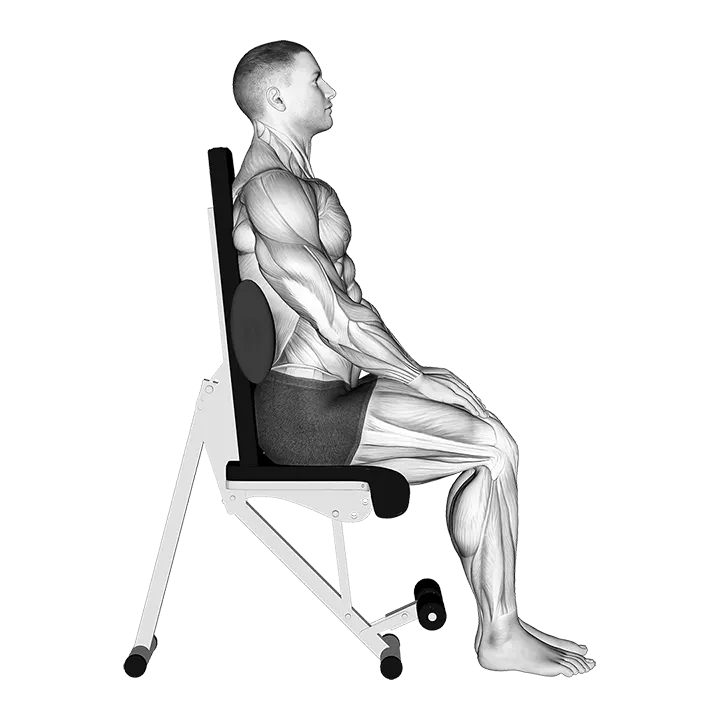
Static Position Seated Back with Pad
- Zielmuskel
- —
- Equipment
- Body weight
- Typ
- Stretching
The static position seated back with pad is a bodyweight posture hold in which you sit upright against a padded support and maintain a neutral spine under no external load. It is commonly used to reinforce proper seated alignment, reduce lower-back tension, and serve as a gentle decompression stretch for the spine. The pad provides tactile feedback that helps you find and sustain a tall, supported position.
Static Position Seated Back with Pad: So führst du sie aus
- 1Place a firm pad — such as a lumbar roll or folded towel — vertically against the back of a chair or flat bench at the level of your lower back.
- 2Sit down and press your lower back gently into the pad, allowing it to support the natural inward curve of your lumbar spine.
- 3Position your feet flat on the floor, hip-width apart, with your knees bent at roughly 90 degrees.
- 4Sit tall through the crown of your head, lengthening your spine rather than arching it forcefully.
- 5Roll your shoulders back and down so they are stacked over your hips, not rounded forward.
- 6Rest your hands loosely on your thighs or in your lap.
- 7Breathe slowly and evenly, letting each exhale release any tension in your back without losing contact with the pad.
- 8Hold the position for the prescribed duration — typically 30 to 60 seconds per set.
- 9To finish, lean forward slightly off the pad, then stand up by engaging your legs rather than pushing with your lower back.
Technik-Tipps
- Think of growing taller with each inhale — use the breath to maintain height in the spine rather than letting it slump between breaths.
- The pad should feel like a gentle reminder, not a wedge forcing an exaggerated arch; if you feel pressure or pain in the lumbar spine, reduce the thickness of the pad.
- Keep your chin parallel to the floor rather than jutting it forward — forward head posture undermines the benefits of the supported lumbar position.
- If your feet do not reach the floor comfortably, place a small block or folded mat beneath them so your hips and knees stay at the same height.
- Focus on passive release rather than active muscle contraction — the goal is relaxed, supported alignment, not a stiff brace.
Häufige Fehler
- Pressing the lower back so hard into the pad that an exaggerated arch forms — this compresses the lumbar facets and defeats the decompressive purpose of the hold.
- Allowing the upper back to round forward over time, which shifts load off the pad and recreates the very posture the exercise is meant to correct.
- Tensing the neck and jaw rather than keeping them relaxed, which spreads muscular tension up the spine and reduces the restorative effect.
- Crossing the ankles or legs during the hold, which rotates the pelvis and makes it harder to maintain symmetrical spinal alignment.
- Holding the breath in an effort to maintain position — breath-holding increases intra-abdominal pressure and creates unnecessary tension around the spine.
Häufig gestellte Fragen
What is the static position seated back with pad exercise good for?
It is primarily used to train and reinforce neutral spinal alignment in a seated position, making it useful for people who spend long periods sitting or who are recovering posture awareness after back discomfort. The pad provides passive lumbar support while you practice holding the position.
What type of pad should I use for this exercise?
A lumbar roll, a tightly rolled towel, or a firm foam pad placed at the level of the natural inward curve of your lower back all work well. Avoid soft, thick cushions that compress easily, as they do not provide consistent feedback about your spinal position.
How long should I hold the static seated back position?
Most protocols recommend 30 to 60 seconds per set for two to three sets. As your postural endurance improves you can extend the hold duration, but keep the focus on relaxed alignment rather than simply increasing time.
Is this exercise suitable for people with lower-back pain?
Gentle seated posture holds with lumbar support are often recommended as a low-load option for managing back stiffness, but individual responses vary. Consult a healthcare professional before adding this or any exercise if you have an existing back condition.
Can I do this exercise at a desk or office chair?
Yes — that is one of the most practical applications. Simply place a lumbar roll or rolled towel behind your lower back in your chair and use it as a cue to sit tall throughout your workday.







