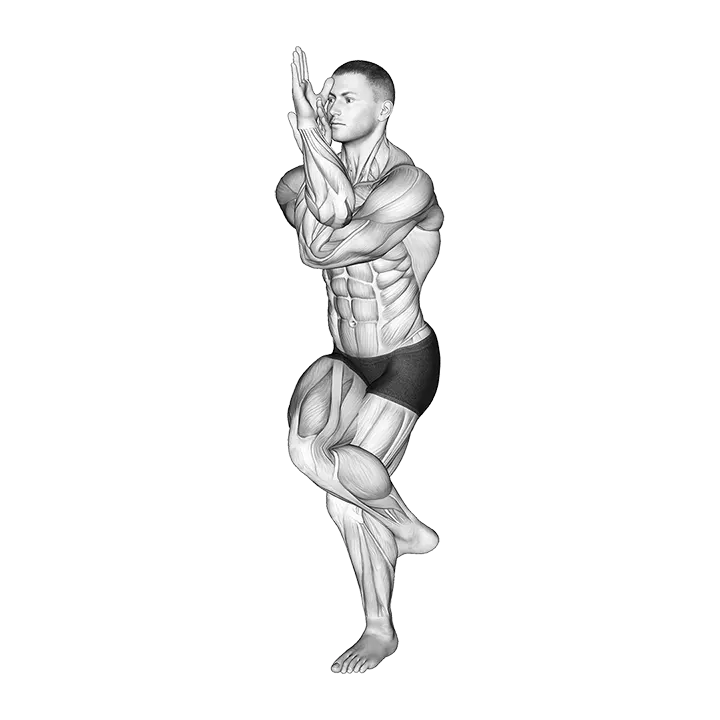
The Eagle Yoga Pose
- Zielmuskel
- —
- Equipment
- Body weight
- Körperregion
- Stretching
- Typ
- Stretching
The Eagle Yoga Pose is a standing balance posture that simultaneously stretches the shoulders, upper back, hips, and thighs while challenging single-leg stability. By wrapping the arms and legs in opposition, it releases tension across multiple joints in one integrated hold. It is well suited for improving flexibility, coordination, and focused body awareness.
The Eagle Yoga Pose: So führst du sie aus
- 1Stand tall with your feet together and arms at your sides, distributing your weight evenly across both feet.
- 2Shift your weight onto your left foot and bend your left knee slightly to create a stable base.
- 3Lift your right leg and cross it over the left thigh, hooking the right foot behind the left calf if your flexibility allows, or resting the right foot on the outside of the left shin.
- 4Extend both arms forward at shoulder height, then cross the left arm over the right at the elbows.
- 5Bend both elbows upward and wrap the forearms so the palms press together or face each other as closely as your range of motion permits.
- 6Lift the wrapped elbows to shoulder height and draw them slightly away from your face to deepen the stretch across the upper back and shoulders.
- 7Square your hips forward, engage your core, and sink your hips down as if lowering into a shallow squat to intensify the hip and thigh stretch.
- 8Hold the position for five to ten slow, controlled breaths, keeping your gaze fixed on a single point to support balance.
- 9Slowly unwind the arms and legs, return both feet to the floor, and repeat on the opposite side.
Technik-Tipps
- Fix your gaze on a stationary point at eye level before crossing the limbs; a stable focal point significantly improves balance throughout the hold.
- Keep the standing knee tracking over the second toe rather than collapsing inward to protect the joint and maintain proper alignment.
- If the feet cannot fully wrap, rest the raised foot lightly against the standing ankle instead of forcing the hook, which risks losing balance or straining the knee.
- Breathe steadily and avoid holding your breath; each exhale can invite a slight deepening of the shoulder and hip stretch without forcing the range of motion.
- Engage the core throughout the pose to keep the torso upright and prevent leaning forward, which reduces the effectiveness of the stretch.
Häufige Fehler
- Rounding the upper back: Collapsing the spine forward diminishes the shoulder and upper-back stretch and places unnecessary strain on the lower back. Keep the chest lifted and the spine long.
- Forcing the foot wrap: Hooking the foot aggressively when the hips lack the necessary flexibility can torque the knee. Use a modified position until mobility improves.
- Allowing the standing knee to cave inward: A valgus collapse at the supporting knee stresses the ligaments and misaligns the hip. Press the knee outward to stay over the foot.
- Raising the shoulders toward the ears: Shrugging during the arm wrap creates tension in the neck and negates the intended shoulder stretch. Actively draw the shoulder blades down.
- Rushing through the hold: Exiting the pose before completing several full breaths limits the stretch benefit. Aim for a minimum of five slow breaths on each side.
Häufig gestellte Fragen
What muscles does the Eagle Yoga Pose stretch?
The Eagle Pose stretches the rear deltoids, rhomboids, and mid-trapezius in the upper back and shoulders through the arm wrap, while the hip crossing stretches the outer hips, glutes, and iliotibial band. The standing leg receives a gentle quad and calf engagement rather than a direct stretch.
Is the Eagle Yoga Pose suitable for beginners?
Yes, with modifications. Beginners can place the toes of the raised foot on the floor for balance support and skip the foot hook behind the calf until hip flexibility develops. The arm wrap can also be simplified by pressing the backs of the hands together instead of the palms.
How long should I hold the Eagle Pose?
Most practitioners hold the pose for five to ten slow breaths per side, which equates to roughly thirty to sixty seconds. Holding longer is fine once balance and flexibility allow, but prioritize quality of alignment over duration.
Can the Eagle Pose help with tight shoulders and upper back?
Yes. The crossed-arm position creates traction across the posterior shoulder capsule and the muscles between the shoulder blades, areas that commonly accumulate tension from desk work or overhead activity. Regular practice can gradually increase range of motion in that region.
What is the difference between the Eagle Pose and a regular standing balance?
Unlike a simple single-leg stand, the Eagle Pose simultaneously challenges balance and delivers a deep multi-joint stretch by wrapping both the arms and the legs. This combination trains proprioception, joint mobility, and concentration in a single integrated posture.







